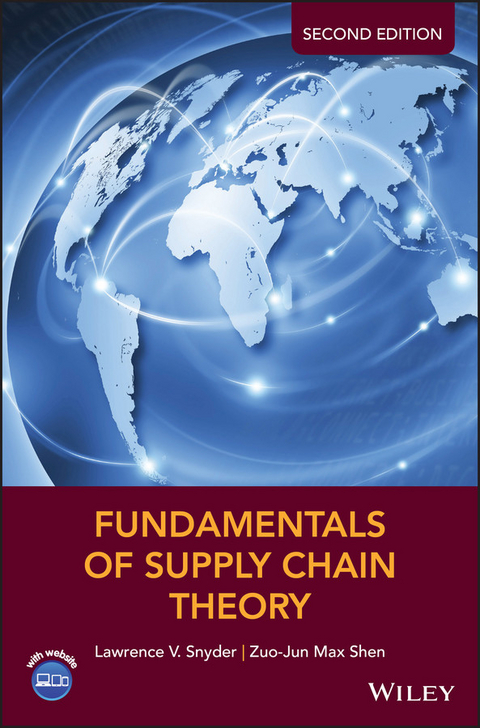
Fundamentals of Supply Chain Theory (eBook)
John Wiley & Sons (Verlag)
978-1-119-02497-2 (ISBN)
Comprehensively teaches the fundamentals of supply chain theory
This book presents the methodology and foundations of supply chain management and also demonstrates how recent developments build upon classic models. The authors focus on strategic, tactical, and operational aspects of supply chain management and cover a broad range of topics from forecasting, inventory management, and facility location to transportation, process flexibility, and auctions. Key mathematical models for optimizing the design, operation, and evaluation of supply chains are presented as well as models currently emerging from the research frontier.
Fundamentals of Supply Chain Theory, Second Edition contains new chapters on transportation (traveling salesman and vehicle routing problems), integrated supply chain models, and applications of supply chain theory. New sections have also been added throughout, on topics including machine learning models for forecasting, conic optimization for facility location, a multi-supplier model for supply uncertainty, and a game-theoretic analysis of auctions. The second edition also contains case studies for each chapter that illustrate the real-world implementation of the models presented. This edition also contains nearly 200 new homework problems, over 60 new worked examples, and over 140 new illustrative figures.
Plentiful teaching supplements are available, including an Instructor's Manual and PowerPoint slides, as well as MATLAB programming assignments that require students to code algorithms in an effort to provide a deeper understanding of the material.
Ideal as a textbook for upper-undergraduate and graduate-level courses in supply chain management in engineering and business schools, Fundamentals of Supply Chain Theory, Second Edition will also appeal to anyone interested in quantitative approaches for studying supply chains.
Lawrence V. Snyder, PhD, is Professor in the Department of Industrial and Systems Engineering and Co-Director of the Institute for Data, Intelligent Systems, and Computation at Lehigh University. He has written numerous journal articles and tutorials on optimization models for supply chains and other infrastructure systems, with a focus on decision-making under uncertainty.
Zuo-Jun Max Shen, PhD, is Professor in the Department of Industrial Engineering and Operations Research and the Department of Civil and Environmental Engineering at the University of California at Berkeley. He is an INFORMS Fellow and has published and consulted extensively in the areas of integrated supply chain design and management, data driven decision making, and systems optimization.
Lawrence V. Snyder, PhD, is Professor in the Department of Industrial and Systems Engineering and Co-Director of the Institute for Data, Intelligent Systems, and Computation at Lehigh University. He has written numerous journal articles and tutorials on optimization models for supply chains and other infrastructure systems, with a focus on decision-making under uncertainty. Zuo-Jun Max Shen, PhD, is Professor in the Department of Industrial Engineering and Operations Research and the Department of Civil and Environmental Engineering at the University of California at Berkeley. He is an INFORMS Fellow and has published and consulted extensively in the areas of integrated supply chain design and management, data driven decision making, and systems optimization.
List of Figures
-
- Figure 2.1 Weight distribution for single exponential smoothing.
- Figure 2.2 Random demands with trend and seasonality.
- Figure 2.3 Observed demands for The TSP Mystery and best‐fit line for Exam...
- Figure 2.4 Regression tree for baseball jerseys for Example 2.8.
- Figure 2.5 A simple neural network.
- Figure 2.6 Color TVs in the 1960s: Forecasts from Bass model and actual de...
- Figure 2.7 Bass diffusion curve.
- Figure 2.8 An example of a leading‐indicator product.
-
- Figure 3.1 Inventory level curve.
- Figure 3.2 EOQ inventory level curve.
- Figure 3.3 Fixed, holding, and total costs as a function of Q.
- Figure 3.4 Total purchase cost under quantity discounts.
- Figure 3.5Figure 3.5 Total purchase cost for Example 3.5.
- Figure 3.6 Total cost curves for all‐units quantity discount structure.
- Figure 3.7 Total cost curves for incremental quantity discount structure....
- Figure 3.8Figure 3.8 Total purchase cost for modified all‐units discou...
- Figure 3.9 EOQB inventory curve.
- Figure 3.10 Inventory–backorder trade‐off in EOQB.
- Figure 3.11 EPQ inventory level curve.
- Figure 3.12 Wagner–Whitin network.
- Figure 3.13 Shortest path network for Problem 3.7.
- Figure 3.14 Inventory level curve for Problem 3.23.
- Figure 3.15 Inventory level curve for Problem 3.26.
-
- Figure 4.1 Optimal solution to newsvendor problem plotted on demand distri...
- Figure 4.2 Optimal solution to newsvendor problem plotted on normal demand...
- Figure 4.3 and .
- Figure 4.4 DP results, : .
- Figure 4.5 Inventory dynamics. All items on order or on hand in period t h...
- Figure 4.6 DP results, : .
- Figure 4.7Figure 4.7 Hypothetical shapes of the function .
- Figure 4.8 Nonconvexity of .
- Figure 4.9 for ; , , , , , , , .
- Figure 4.10 K‐convexity.
- Figure 4.11 Properties of K‐convex functions from Lemma 4.16.
- Figure 4.12Figure 4.12 Proof of Lemma 4.16.
- Figure 4.13 Process for handling returned drives at Hitachi.
- Figure 4.14 functions for Problem 4.38, with fixed cost and order...
- Figure 4.15 function for Problem 4.39, with fixed cost .
-
- Figure 5.1 Inventory level (solid line) and inventory position (dashed lin...
- Figure 5.2 Inventory costs are equal at start and end of replenishment cyc...
- Figure 5.3 Expected inventory curve for policy.
- Figure 5.4 Relative error of approximations.
- Figure 5.5 and .
- Figure 5.6 and .
- Figure 5.7 and .
- Figure 5.8 Determining which y‐values are optimal given .
-
- Figure 6.1 Multiechelon network topologies.
- Figure 6.2 Interpretation of stockout penalties.
- Figure 6.3 N‐stage serial system in stochastic‐service model.
- Figure 6.4 3‐Stage serial system for Example 6.1.
- Figure 6.5 Functions from Theorem 6.3 for Example 6.1.
- Figure 6.6 Digital camera supply chain network..
- Figure 6.7 Single‐stage network.
- Figure 6.8 N‐stage serial system in guaranteed‐service model.
- Figure 6.9 Feasible region for two‐stage system.
- Figure 6.10 Example network for SSSPP DP algorithm for serial systems.
- Figure 6.11 A counterexample to the “all‐or‐nothing” claim for tree system...
- Figure 6.12 Relabeling the network.
- Figure 6.13 Example network for SSSPP DP algorithm for tree systems.
- Figure 6.14 Digital camera supply chain network, with holding costs and pr...
- Figure 6.15 Optimal CSTs and inventories for digital camera supply chain (...
- Figure 6.16 Optimal CSTs and inventories for digital camera supply chain (...
- Figure 6.17 SSSPP trade‐off curve: expected cost vs. end‐customer CST.
- Figure 6.18 Baseball‐hat supply chain for Problem 6.9.
-
- Figure 7.1 The risk‐pooling effect with identical retailers.
- Figure 7.2 Possible realizations of transshipment and ending inventories.....
- Figure 7.3 Examples of flexibility configurations.
- Figure 7.4 Two chaining structures.
- Figure 7.5 structure for and .
- Figure 7.6 Examples of different chaining structures for nonhomogeneous ...
- Figure 7.7 Three‐stage flexibility structure for Problem 7.10.
-
- Figure 8.1 Facility location configurations. Squares represent facilities;...
- Figure 8.2Figure 8.2 Optimal solution to 88‐node UFLP instance. Total cost...
- Figure 8.3 Customer and facility layout for Example 8.2.
- Figure 8.4 Sorted facility positions for Example 8.2.
- Figure 8.5 Considering each facility for iteration 1 of greedy algorithm f...
- Figure 8.6 Considering each facility for iteration 2 of greedy algorithm f...
- Figure 8.7 Solutions from iterations 3, 4, and 5 of greedy algorithm for U...
- Figure 8.8 Optimal solution to 88‐node pMP instance with . Total cost =...
- Figure 8.9 Greedy and swap solutions for 88‐node pMP instance with .
- Figure 8.10 Neighborhood of Springfield, IL in greedy solution to 88‐node ...
- Figure 8.11 400‐mile coverage radii around facilities in 6‐median solution...
- Figure 8.12 Optimal SCLP solution for 88‐node instance with coverage radiu...
- Figure 8.13 Optimal MCLP solution for 88‐node instance with coverage radiu...
- Figure 8.14 Coverage vs. p for 88‐node data set with 400‐mile coverage rad...
- Figure 8.15 Optimal pCP solution for 88‐node instance with . Maximum as...
- Figure 8.16 Three echelons in node design problem: plants ( ), DCs ( )...
- Figure 8.17 Optimal solution to 98‐node node design instance. Total cost =...
- Figure 8.18 Sequential‐optimization solution to 98‐node node design instan...
- Figure 8.19 Simple arc design problem instance. Grey and black bars inside...
- Figure 8.20 Hungary cities arc design problem instance. Grey and black bar...
- Figure 8.21 Solutions to Hungary cities arc design problem instance. Arcs ...
- Figure 8.22 10‐node facility location instance for Problems 8.2–8.11.
- Figure 8.23 UFLP instance for Problem 8.20. Distances use Manhattan metric...
- Figure 8.24 UFLP instance for Problem 8.21. Distances use Manhattan metric...
-
- Figure 9.1 EOQ inventory curve with disruptions.
- Figure 9.2 Exact EOQD cost for Example 9.1.
- Figure 9.3 Approximate and exact EOQD costs and for Example 9.2.
- Figure 9.4 EOQ inventory curve with yield uncertainty.
- Figure 9.5 pdf/pmf of quantity received from each supplier in Example 9.9....
- Figure 9.6 pdf of quantity received from each supplier in Example 9.10. As...
- Figure 9.7 for Example 9.10, varying and while keeping fi...
- Figure 9.8 UFLP solution for 49‐node data set..
- Figure 9.9 UFLP solution for 49‐node data set, after disruption of facilit...
- Figure 9.10 Reliable solution for 49‐node data set.
- Figure 9.11 Sample RFLP trade‐off curve..
-
- Figure 10.1 Hamiltonian cycles.
- Figure 10.2 Car 54 TSP instance.
- Figure 10.3 Optimal solution to Car 54 TSP instance. Total distance = 10,8...
- Figure 10.4 Subtours.
- Figure 10.5 TSP instance for examples. If no edge is present between nodes...
- Figure 10.6 Cutting planes.
- Figure 10.7 Handle and teeth for 2‐matching inequality.
- Figure 10.8 Handle and teeth for comb inequality.
- Figure 10.9 Nearest‐neighbor tour beginning at node 1 for the example inst...
- Figure 10.10 Nearest‐neighbor solution to Car 54 TSP instance. Total dista...
- Figure 10.11...
| Erscheint lt. Verlag | 1.7.2019 |
|---|---|
| Sprache | englisch |
| Themenwelt | Mathematik / Informatik ► Mathematik ► Angewandte Mathematik |
| Wirtschaft ► Betriebswirtschaft / Management ► Logistik / Produktion | |
| Schlagworte | Business & Management • Forecasting • Industrial Engineering • Industrial Engineering / Project Management • Industrielle Verfahrenstechnik • Inventory • Inventory Management • JIT • Just in Time • Lieferkette • Management • Management Science • Manufacturing • operations • Operations Management • Process Flexibility • production management • Production Operations Management • Produktionssteuerung • Projektmanagement i. d. Industriellen Verfahrenstechnik • Qualität, Produktivität u. Zuverlässigkeit • Quality, Productivity & Reliability • SCM • Statistics • Statistik • Supply • Supply Chain • Wirtschaft u. Management |
| ISBN-10 | 1-119-02497-8 / 1119024978 |
| ISBN-13 | 978-1-119-02497-2 / 9781119024972 |
| Informationen gemäß Produktsicherheitsverordnung (GPSR) | |
| Haben Sie eine Frage zum Produkt? |
 EPUB (Adobe DRM)
Kopierschutz: Adobe-DRM
Adobe-DRM ist ein Kopierschutz, der das eBook vor Mißbrauch schützen soll. Dabei wird das eBook bereits beim Download auf Ihre persönliche Adobe-ID autorisiert. Lesen können Sie das eBook dann nur auf den Geräten, welche ebenfalls auf Ihre Adobe-ID registriert sind.
Details zum Adobe-DRM
Dateiformat: EPUB (Electronic Publication)
EPUB ist ein offener Standard für eBooks und eignet sich besonders zur Darstellung von Belletristik und Sachbüchern. Der Fließtext wird dynamisch an die Display- und Schriftgröße angepasst. Auch für mobile Lesegeräte ist EPUB daher gut geeignet.
Systemvoraussetzungen:
PC/Mac: Mit einem PC oder Mac können Sie dieses eBook lesen. Sie benötigen eine
eReader: Dieses eBook kann mit (fast) allen eBook-Readern gelesen werden. Mit dem amazon-Kindle ist es aber nicht kompatibel.
Smartphone/Tablet: Egal ob Apple oder Android, dieses eBook können Sie lesen. Sie benötigen eine
Geräteliste und zusätzliche Hinweise
Buying eBooks from abroad
For tax law reasons we can sell eBooks just within Germany and Switzerland. Regrettably we cannot fulfill eBook-orders from other countries.
aus dem Bereich