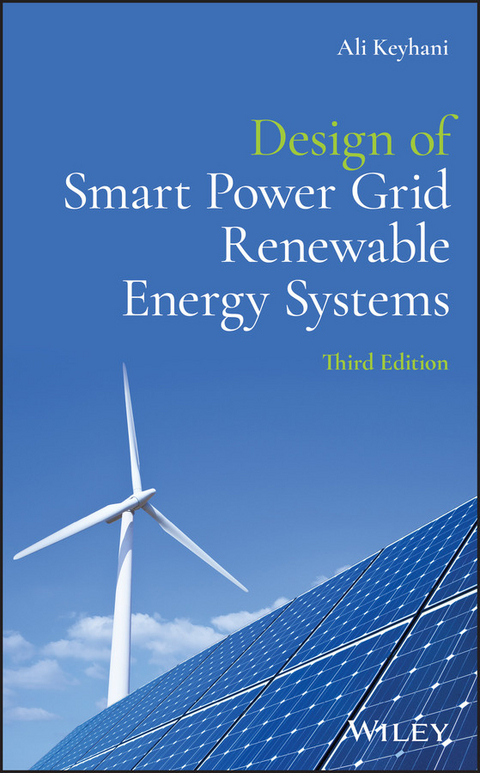
Design of Smart Power Grid Renewable Energy Systems (eBook)
John Wiley & Sons (Verlag)
978-1-119-57334-0 (ISBN)
The Updated Third Edition Provides a Systems Approach to Sustainable Green Energy Production and Contains Analytical Tools for the Design of Renewable Microgrids
The revised third edition of Design of Smart Power Grid Renewable Energy Systems integrates three areas of electrical engineering: power systems, power electronics, and electric energy conversion systems. The book also addresses the fundamental design of wind and photovoltaic (PV) energy microgrids as part of smart-bulk power-grid systems.
In order to demystify the complexity of the integrated approach, the author first presents the basic concepts, and then explores a simulation test bed in MATLAB® in order to use these concepts to solve a basic problem in the development of smart grid energy system. Each chapter offers a problem of integration and describes why it is important. Then the mathematical model of the problem is formulated, and the solution steps are outlined. This step is followed by developing a MATLAB® simulation test bed. This important book:
- Reviews the basic principles underlying power systems
- Explores topics including: AC/DC rectifiers, DC/AC inverters, DC/DC converters, and pulse width modulation (PWM) methods
- Describes the fundamental concepts in the design and operation of smart grid power grids
- Supplementary material includes a solutions manual and PowerPoint presentations for instructors
Written for undergraduate and graduate students in electric power systems engineering, researchers, and industry professionals, the revised third edition of Design of Smart Power Grid Renewable Energy Systems is a guide to the fundamental concepts of power grid integration on microgrids of green energy sources.
Ali Keyhani, PhD, is a Professor in the Department of Electrical and Computer Engineering at Ohio State University. He is a Fellow of the IEEE and a recipient of Ohio State University, College of Engineering Research Award for 1989, 1999, and 2003. He has worked for Columbus and Southern Electric Power Company, Hewlett-Packard Co., Foster Wheeler Engineering, and TRW.
Ali Keyhani, PhD, is a Professor in the Department of Electrical and Computer Engineering at Ohio State University. He is a Fellow of the IEEE and a recipient of Ohio State University, College of Engineering Research Award for 1989, 1999, and 2003. He has worked for Columbus and Southern Electric Power Company, Hewlett-Packard Co., Foster Wheeler Engineering, and TRW.
CHAPTER 1
ENERGY AND CIVILIZATION
1.1 INTRODUCTION: MOTIVATION
Energy technology plays a central role in societal, economic, and social development. Fossil fuel‐based technologies have advanced our quality of life, but at the same time, these advancements have come at a very high price. Fossil fuel sources of energy are the primary cause of environmental pollution and degradation; they have irreversibly destroyed aspects of our environment. Global warming is a result of our fossil fuel consumption. For example, the fish in our lakes and rivers are contaminated with mercury, a byproduct of rapid industrialization. The processing and use of fossil fuels have escalated public health costs: Our health care dollars have been and are being spent on treating environmental pollution‐related health problems, such as black lung disease in coal miners. Our relentless search for and need to control these valuable resources have promoted political strife. We are now dependent on an energy source that is unsustainable as our energy needs grow and we deplete our limited resources. As petroleum supplies dwindle, it will become increasingly urgent to find energy alternatives that are sustainable as well as safe for the environment and humanity.
1.2 FOSSIL FUEL
Fossil fuels—oil, natural gas, and coal—formed in Earth around 300 million years ago. Over millions of years, the decomposition of flora and fauna remains that lived in the world’s oceans produced the first oil. As the oceans receded, these remains were covered by layers of sand and earth and were subjected to severe climate changes: the Ice Age, volcanic eruption, and drought burying them even deeper in the Earth’s crust and closer to the Earth’s core. From the intense heat and pressure, the remains essentially were boiled into the oil. If you check the word, “petroleum” in a dictionary, you find it means “rock oil” or “oil from the earth.”
The ancient Sumerians, Assyrians, Persians, and Babylonians found oil at the bank of the Karun and Euphrates rivers as it seeped above ground. Historically, humans have used oil for many purposes. The ancient Persians and Egyptians used liquid oil as a medicine for wounds. The Zoroastrians of Iran made their fire temples on top of percolating oil from the ground. Native Americans used oil to seal their canoes.
Up to the fifteenth century, history of humanity’s energy use was limited. Regardless we can project the impact of energy on early civilizations from artifacts and monuments. The legacy of our oldest societies and their use of energy in the form of wood, wood charcoal, wind, and water power can be seen in the pyramids of Egypt, the Parthenon in Greece, the Persepolis in Iran, the Great Wall of China, and the Taj Mahal in India.
1.3 ENERGY USE AND INDUSTRIALIZATION
Figure 1.1 depicts the approximate time needed to develop various energy sources. Coal, oil, and natural gas fuels take millions of years to form. The oil that is consumed today was created more than a million years ago in the Earth’s crust. Our first energy source was wood. Then wood charcoal and coal replaced wood, and oil began to replace some of our coal usages to the point that oil and gas now supply most of our energy needs.
Figure 1.1 The approximate time required for the production of various energy sources.
Since the Industrial Revolution, we have used coal. Since 1800, for approximately 200 years, we have been using oil. However, our first energy source was wood and wood charcoal, which we used to cook food. Recorded history shows that humanity has been using wood energy for 10,000 years. In the near future we will exhaust oil and gas reserves. Oil and gas are not renewable: we must conserve energy and save our oil—and gas as well. Figure 1.2 depicts the world’s oil production (consumption) from 1965 to 2000 and estimated from 2005 to 2009.
Figure 1.2 The world’s oil production (consumption) from 1965 to 2000 and estimated from 2005 to 2009.
Source: Based on Figure TS.2 from Solomon et al.
US oil production peaked around 1970. However, by using the fracking technology, oil production in the United States has rapidly increased (Section 1.14). Europe’s oil production is limited except for the North Sea oil reserve; it depends entirely on oil production from other parts of the world. In Asia, China, India, Japan, and Korea depend on imported oil. The rapid economic expansion of China, India, and Brazil are also rapidly depleting the world oil reserves. The Middle East has one of the largest oil reserves in the world. If the world reserves are used at the same rate as we do today, oil may run out in 40–100 years. Our natural gas reserves can be depleted in less than 60 years, and the coal reserves will be exhausted in 200 years. The impact of fossil fuel, coal, oil, and gas is manifested in climate change and the rise of temperature and sea level around the world. All can be said about the future is “Some things are so unexpected that no one is prepared for them.” Predicting the future is a fool’s game. However, we can empower every energy user to become an energy producer. We can develop a new energy economy based on renewable sources and create technology for conserving energy, reducing carbon footprints, and improving the quality of life on the planet. We can develop a distributed renewable energy system for every community and eliminate the long periods of blackout. We can make every energy user an energy producer by use of the solar and wind energy (https://en.wikipedia.org/wiki/Reserves‐to‐production_ratio).
Students are encouraged to study up‐to‐date information on the world energy consumption and production from the Wikipedia (https://en.wikipedia.org/wiki/Energy_development#Fossil_fuels).
1.4 NUCLEAR ENERGY
In 1789, Martin Heinrich Klaproth, a German chemist, discovered uranium while studying the mineral pitchblende. Eugène‐Melchior Péligot, a French chemist, was the first person to isolate the metal, but it was Antoine‐César Becquerel, a French physicist, who recognized its radioactive properties almost 100 years later. In 1934, Enrico Fermi used nuclear fuel to produce steam for the power industry. Then, he participated in building the first nuclear weapon used in World War II. The US Department of Energy estimates that worldwide uranium resources are generally considered to be sufficient for at least several decades.
The amount of energy contained in a mass of hydrocarbon fuel such as gasoline is substantially lower in much less mass of nuclear fuel. This higher density of nuclear fission makes it an essential source of energy; however, the fusion process causes additional radioactive waste products. The radioactive products remain for a long time, giving rise to a nuclear waste problem. The counterbalance to a low carbon footprint of fission as an energy source is the concern about radioactive nuclear waste accumulation and the potential for nuclear destruction in a politically unstable world.
1.5 GLOBAL WARMING
Greenhouse gases in the Earth’s atmosphere emit and absorb radiation. This radiation is within the thermal infrared (IR) range. Since the burning of fossil fuel and the start of the Industrial Revolution, greenhouse gases have accumulated in atmosphere. The greenhouse gases are primarily water vapor, carbon dioxide, carbon monoxide, ozone, and some other gases. Within the atmosphere of Earth, greenhouse gases are trapped.
Figure 1.3 depicts the process of solar radiation incident energy and reflected energy from the Earth’s surface and the Earth’s atmosphere. The solar radiation incident energy as depicted by circle 1 emitted from the sun and its energy is approximated as 343 W/m2. Some of the solar radiation, represented by circles 2 and 4, is reflected from the Earth’s surface and the Earth’s atmosphere. The total reflected solar radiation is approximated as 103 W/m2. Approximately 240 W/m2 of solar radiation, depicted by circle 3, penetrates through the Earth’s atmosphere. About half of the solar radiation (circle 5), approximately 168 W/m2, is absorbed by the Earth’s surface. This radiation (circle 6) is converted into heat energy. This process generates IR radiation in the form of the emission of a long wave back to Earth. A portion of the IR radiation is absorbed. Then, it is re‐emitted by the greenhouse molecules trapped in the Earth’s atmosphere. Circle 7 represents the IR radiation. Finally, some of the IR radiation (circle 8) passes through the atmosphere and into space. As the use of fossil fuel is accelerated, the carbon dioxide in the Earth’s atmosphere is also accelerated.
Figure 1.3 The effects of sun radiation on the surface of the Earth.
The World Meteorological Organization (WMO) is the international body for the monitoring of climate change. The WMO has clearly stated the potential environmental and socioeconomic consequences for the world economy if the current trend continues. In this respect, global warming is an engineering problem, not a moral crusade. Until we take serious steps to reduce our carbon footprints, pollution and the perilous deterioration of the environment continue.
The Intergovernmental Panel on Climate Change (IPCC) is the leading...
| Erscheint lt. Verlag | 12.6.2019 |
|---|---|
| Sprache | englisch |
| Themenwelt | Mathematik / Informatik ► Informatik ► Theorie / Studium |
| Naturwissenschaften ► Physik / Astronomie | |
| Technik ► Elektrotechnik / Energietechnik | |
| Schlagworte | Computer Science • concepts of power grids • cyber-controlled smart grid • design of smart power grids • electric power grid • Energie • Energy • Erneuerbare Energie • Grid & Cloud Computing • Grid- u. Cloud-Computing • Informatik • load factor of power grid • power grid operations • Renewable energy systems • Smart Grid • Smart power grid • Solarenergie • Solarenergie u. Photovoltaik • Solar Energy & Photovoltaics • Transformers • transmission voltage |
| ISBN-10 | 1-119-57334-3 / 1119573343 |
| ISBN-13 | 978-1-119-57334-0 / 9781119573340 |
| Informationen gemäß Produktsicherheitsverordnung (GPSR) | |
| Haben Sie eine Frage zum Produkt? |
 EPUB (Adobe DRM)
Kopierschutz: Adobe-DRM
Adobe-DRM ist ein Kopierschutz, der das eBook vor Mißbrauch schützen soll. Dabei wird das eBook bereits beim Download auf Ihre persönliche Adobe-ID autorisiert. Lesen können Sie das eBook dann nur auf den Geräten, welche ebenfalls auf Ihre Adobe-ID registriert sind.
Details zum Adobe-DRM
Dateiformat: EPUB (Electronic Publication)
EPUB ist ein offener Standard für eBooks und eignet sich besonders zur Darstellung von Belletristik und Sachbüchern. Der Fließtext wird dynamisch an die Display- und Schriftgröße angepasst. Auch für mobile Lesegeräte ist EPUB daher gut geeignet.
Systemvoraussetzungen:
PC/Mac: Mit einem PC oder Mac können Sie dieses eBook lesen. Sie benötigen eine
eReader: Dieses eBook kann mit (fast) allen eBook-Readern gelesen werden. Mit dem amazon-Kindle ist es aber nicht kompatibel.
Smartphone/Tablet: Egal ob Apple oder Android, dieses eBook können Sie lesen. Sie benötigen eine
Geräteliste und zusätzliche Hinweise
Buying eBooks from abroad
For tax law reasons we can sell eBooks just within Germany and Switzerland. Regrettably we cannot fulfill eBook-orders from other countries.
aus dem Bereich