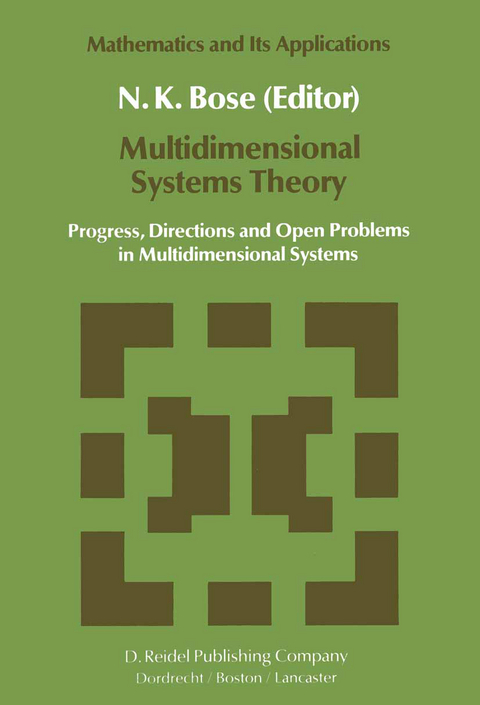
Multidimensional Systems Theory
Kluwer Academic Publishers (Verlag)
978-1-4020-0328-8 (ISBN)
Approach your problem from the right end It isn't that they can't see the solution. and begin with the answers. It is that they can't see the problem. Then one day, perhaps you will find the final question. G. K. Chesterton. The Scandal of Father Brown The point of a Pin. The Hermit Clad in Crane Feathers in R. van Gulik's The Chinese Maze Murders. Growing specialization and diversification have brought a host of mono graphs and textbooks on increasingly specialized topics. However, the "tree" of knowledge of mathematics and related fields does not grow only by putting forth new branches. It also happens, quite often in fact, that branches which were thought to be completely disparate are suddenly seen to be related. Further, the kind and level of sophistication of mathematics applied in various sciences has changed drastically in recent years: measure theory is used (non-trivially) in regional and theoretical economics; algebraic geometry interacts with physics; the Minkowsky lemma, coding theory and the structure of water meet one another in packing and covering theory; quantum fields, crystal defects and mathematical programming profit from homotopy theory; Lie algebras are relevant to filtering; and prediction and electrical engineering can use Stein spaces. And in addi tion to this there are such new emerging subdisciplines as "experimental mathematical", "CFD", "completely integrable systems", "chaos, synergetics and large-scale order" , which are almost impossible to fit into the existing classification schemes.
1. Trends in Multidimensional Systems Theory.- 1.1 Introduction.- 1.2 Multidimensional Systems Stability.- 1.3 Multivariate Realization Theory.- 1.4 n—D Problem of Moments and Its Applications in Multidimensional Systems Theory.- 1.5 Role of Irreducible Polynomials in Multidimensional Systems Theory.- 1.6 Hilbert Transform and Spectral Factorization.- 1.7 Conclusions.- References.- 2. Multivariate Rational Approximants of the Padé-Type in Systems Theory.- 2.1 Introduction and Motivation.- 2.2 Multivariate Padé-Type Approximants (Scalar Case).- 2.3 Padé-Type Matrix Approximants.- 2.4 Conclusions.- References.- 3. Causal and Weakly Causal 2–D Filters with Applications in Stabilization.- 3.1 Scalar 2–D Input/Output Systems.- 3.2 Stability.- 3.3 Structural Stability.- 3.4 Multi-Input/Multi-Output Systems.- 3.5 Stabilization of Scalar Feedback Systems.- 3.6 Characterization of Stabilizers for Scalar Systems.- 3.7 Stabilization of Strictly Causal Transfer Matrices.- 3.8 Characterization of Stabilizers for MIMO Systems.- 3.9 Stabilization of Weakly Causal Systems.- 3.10 Stabilization of MIMO Weakly Causal Systems.- 3.11 Conclusions.- References.- 4. Stabilization of Linear Spatially-Distributed Continuous- Time and Discrete- Time Systems.- 4.1 Introduction.- 4.2 The State Representation and Input/Output Description.- 4.3 Discretizations in Time.- 4.4 Representation in Terms of a Family of Finite-Dimensional Systems.- 4.5 Stability.- 4.6 Reachability and Stabilizability.- 4.7 The Riccati Equation and Stabilizability.- 4.8 Stabilization by Dynamic Output Feedback.- 4.9 Application to Tracking.- Acknowledgement.- References.- 5. Linear Shift-Variant Multidimensional Systems.- 5.1 Introduction.- 5.2 2-D Quarter Plane State-Space Model.- 5.3 k-D State-Space Model.- 5.4State-Space Model for the Inverse System.- 5.5 Examples of Applications.- 5.6 Conclusions.- References.- 6. Gröbner Bases: An Algorithmic Method in Polynomial Ideal Theory.- 6.1 Introduction.- 6.2 Gröbner Bases.- 6.3 Algorithmic Construction of Gröbner Bases.- 6.4 An Improved Version of the Algorithm.- 6.5 Application: Canonical Simplification, Decision of Ideal Congruence and Membership, Computation in Residue Class Rings.- 6.6 Application: Solvability and Exact Solution of Systems of Algebraic Equations.- 6.7 Application: Solution of Linear Homogeneous Equations with Polynomial Coefficients.- 6.8 Gröbner Bases for Polynomial Ideals over the Integers.- 6.9 Other Applications.- 6.10 Specializations, Generalizations, Implementations, Complexity.- Acknowledgement.- References.- 7. The Equation Ax = b Over the Ring C [z, w].- 7.1 Introduction.- 7.2 Sufficient Condition for Solution.- Appendix A: Zero-Dimensional Polynomial Ideals.- References.- 8. Open Problems.
| Reihe/Serie | Mathematics and Its Applications ; 16 | Mathematics and Its Applications ; 16 |
|---|---|
| Zusatzinfo | XV, 264 p. |
| Sprache | englisch |
| Maße | 152 x 229 mm |
| Themenwelt | Mathematik / Informatik ► Mathematik ► Analysis |
| ISBN-10 | 1-4020-0328-5 / 1402003285 |
| ISBN-13 | 978-1-4020-0328-8 / 9781402003288 |
| Zustand | Neuware |
| Informationen gemäß Produktsicherheitsverordnung (GPSR) | |
| Haben Sie eine Frage zum Produkt? |
aus dem Bereich