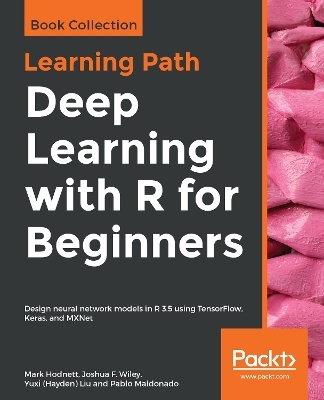
Deep Learning with R for Beginners
Packt Publishing Limited (Verlag)
978-1-83864-270-9 (ISBN)
Explore the world of neural networks by building powerful deep learning models using the R ecosystem
Key Features
Get to grips with the fundamentals of deep learning and neural networks
Use R 3.5 and its libraries and APIs to build deep learning models for computer vision and text processing
Implement effective deep learning systems in R with the help of end-to-end projects
Book DescriptionDeep learning finds practical applications in several domains, while R is the preferred language for designing and deploying deep learning models.
This Learning Path introduces you to the basics of deep learning and even teaches you to build a neural network model from scratch. As you make your way through the chapters, you’ll explore deep learning libraries and understand how to create deep learning models for a variety of challenges, right from anomaly detection to recommendation systems. The book will then help you cover advanced topics, such as generative adversarial networks (GANs), transfer learning, and large-scale deep learning in the cloud, in addition to model optimization, overfitting, and data augmentation. Through real-world projects, you’ll also get up to speed with training convolutional neural networks (CNNs), recurrent neural networks (RNNs), and long short-term memory networks (LSTMs) in R.
By the end of this Learning Path, you’ll be well versed with deep learning and have the skills you need to implement a number of deep learning concepts in your research work or projects.
This Learning Path includes content from the following Packt products:
R Deep Learning Essentials - Second Edition by Joshua F. Wiley and Mark Hodnett
R Deep Learning Projects by Yuxi (Hayden) Liu and Pablo Maldonado
What you will learn
Implement credit card fraud detection with autoencoders
Train neural networks to perform handwritten digit recognition using MXNet
Reconstruct images using variational autoencoders
Explore the applications of autoencoder neural networks in clustering and dimensionality reduction
Create natural language processing (NLP) models using Keras and TensorFlow in R
Prevent models from overfitting the data to improve generalizability
Build shallow neural network prediction models
Who this book is forThis Learning Path is for aspiring data scientists, data analysts, machine learning developers, and deep learning enthusiasts who are well versed in machine learning concepts and are looking to explore the deep learning paradigm using R. A fundamental understanding of R programming and familiarity with the basic concepts of deep learning are necessary to get the most out of this Learning Path.
Mark Hodnett is a data scientist with over 20 years of industry experience in software development, business intelligence systems, and data science. He has worked in a variety of industries, including CRM systems, retail loyalty, IoT systems, and accountancy. He holds a master's in data science and an MBA. He works in Cork, Ireland, as a senior data scientist with AltViz. Joshua F. Wiley is a lecturer at Monash University, conducting quantitative research on sleep, stress, and health. He earned his Ph.D. from the University of California, Los Angeles and completed postdoctoral training in primary care and prevention. In statistics and data science, Joshua focuses on biostatistics and is interested in reproducible research and graphical displays of data and statistical models. He develops or co-develops a number of R packages including Varian, a package to conduct Bayesian scale-location structural equation models, and MplusAutomation, a popular package that links R to the commercial Mplus software. Yuxi (Hayden) Liu is an experienced data scientist who's focused on developing machine learning and deep learning models and systems. He has worked in a variety of data-driven domains and has applied his machine learning expertise to computational advertising, recommendation, and network anomaly detection. He published five first-authored IEEE transaction and conference papers during his master's research at the University of Toronto. He is an education enthusiast and the author of a series of machine learning books. His first book, the first edition of Python Machine Learning By Example, was a #1 bestseller on Amazon India in 2017 and 2018. His other books include R Deep Learning Projects and Hands-On Deep Learning Architectures with Python published by Packt. Pablo Maldonado is an applied mathematician and data scientist with a taste for software development since his days of programming BASIC on a Tandy 1000. As an academic and business consultant, he spends a great deal of his time building applied artificial intelligence solutions for text analytics, sensor and transactional data, and reinforcement learning. Pablo earned his Ph.D. in applied mathematics (with focus on mathematical game theory) at the Universite Pierre et Marie Curie in Paris, France.
Table of Contents
Getting Started with Deep Learning
Training a Prediction Model
Deep Learning Fundamentals
Training Deep Prediction Models
Image Classification Using Convolutional Neural Networks
Tuning and Optimizing Models
Natural Language Processing Using Deep Learning
Deep Learning Models Using TensorFlow in R
Anomaly Detection and Recommendation Systems
Running Deep Learning Models in the Cloud
The Next Level in Deep Learning
Handwritten Digit Recognition Using Convolutional Neural Networks
Traffic Sign Recognition for Intelligent Vehicles
Fraud Detection with Autoencoders
Text Generation Using Recurrent Neural Networks
Sentiment Analysis with Word Embeddings
| Erscheinungsdatum | 23.05.2019 |
|---|---|
| Verlagsort | Birmingham |
| Sprache | englisch |
| Maße | 75 x 93 mm |
| Themenwelt | Mathematik / Informatik ► Informatik ► Datenbanken |
| Informatik ► Theorie / Studium ► Künstliche Intelligenz / Robotik | |
| ISBN-10 | 1-83864-270-6 / 1838642706 |
| ISBN-13 | 978-1-83864-270-9 / 9781838642709 |
| Zustand | Neuware |
| Informationen gemäß Produktsicherheitsverordnung (GPSR) | |
| Haben Sie eine Frage zum Produkt? |
aus dem Bereich