


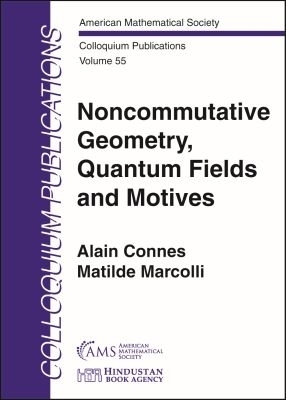
Noncommutative Geometry, Quantum Fields and Motives
Seiten
2019
American Mathematical Society (Verlag)
978-1-4704-5045-8 (ISBN)
American Mathematical Society (Verlag)
978-1-4704-5045-8 (ISBN)
- Titel z.Zt. nicht lieferbar
- Versandkostenfrei
- Auch auf Rechnung
- Artikel merken
The unifying theme of this book is the interplay among noncommutative geometry, physics, and number theory. The two main objects of investigation are spaces where both the noncommutative and the motivic aspects come to play a role.
The unifying theme of this book is the interplay among noncommutative geometry, physics, and number theory. The two main objects of investigation are spaces where both the noncommutative and the motivic aspects come to play a role: space-time, where the guiding principle is the problem of developing a quantum theory of gravity, and the space of primes, where one can regard the Riemann Hypothesis as a long-standing problem motivating the development of new geometric tools. The book stresses the relevance of noncommutative geometry in dealing with these two spaces.
The first part of the book deals with quantum field theory and the geometric structure of renormalization as a Riemann-Hilbert correspondence. It also presents a model of elementary particle physics based on noncommutative geometry. The main result is a complete derivation of the full Standard Model Lagrangian from a very simple mathematical input. Other topics covered in the first part of the book are a noncommutative geometry model of dimensional regularization and its role in anomaly computations, and a brief introduction to motives and their conjectural relation to quantum field theory. The second part of the book gives an interpretation of the Weil explicit formula as a trace formula and a spectral realization of the zeros of the Riemann zeta function. This is based on the noncommutative geometry of the adele class space, which is also described as the space of commensurability classes of Q-lattices, and is dual to a noncommutative motive (endomotive) whose cyclic homology provides a general setting for spectral realizations of zeros of L-functions. The quantum statistical mechanics of the space of Q-lattices, in one and two dimensions, exhibits spontaneous symmetry breaking. In the low-temperature regime, the equilibrium states of the corresponding systems are related to points of classical moduli spaces and the symmetries to the class field theory of the field of rational numbers and of imaginary quadratic fields, as well as to the automorphisms of the field of modular functions. The book ends with a set of analogies between the noncommutative geometries underlying the mathematical formulation of the Standard Model minimally coupled to gravity and the moduli spaces of Q-lattices used in the study of the zeta function.
The unifying theme of this book is the interplay among noncommutative geometry, physics, and number theory. The two main objects of investigation are spaces where both the noncommutative and the motivic aspects come to play a role: space-time, where the guiding principle is the problem of developing a quantum theory of gravity, and the space of primes, where one can regard the Riemann Hypothesis as a long-standing problem motivating the development of new geometric tools. The book stresses the relevance of noncommutative geometry in dealing with these two spaces.
The first part of the book deals with quantum field theory and the geometric structure of renormalization as a Riemann-Hilbert correspondence. It also presents a model of elementary particle physics based on noncommutative geometry. The main result is a complete derivation of the full Standard Model Lagrangian from a very simple mathematical input. Other topics covered in the first part of the book are a noncommutative geometry model of dimensional regularization and its role in anomaly computations, and a brief introduction to motives and their conjectural relation to quantum field theory. The second part of the book gives an interpretation of the Weil explicit formula as a trace formula and a spectral realization of the zeros of the Riemann zeta function. This is based on the noncommutative geometry of the adele class space, which is also described as the space of commensurability classes of Q-lattices, and is dual to a noncommutative motive (endomotive) whose cyclic homology provides a general setting for spectral realizations of zeros of L-functions. The quantum statistical mechanics of the space of Q-lattices, in one and two dimensions, exhibits spontaneous symmetry breaking. In the low-temperature regime, the equilibrium states of the corresponding systems are related to points of classical moduli spaces and the symmetries to the class field theory of the field of rational numbers and of imaginary quadratic fields, as well as to the automorphisms of the field of modular functions. The book ends with a set of analogies between the noncommutative geometries underlying the mathematical formulation of the Standard Model minimally coupled to gravity and the moduli spaces of Q-lattices used in the study of the zeta function.
Alain Connes, College de France, Paris, France. Matilde Marcolli, Max-Planck-Institut fur Mathematik, Bonn, Germany.
Quantum fields, noncommutative spaces, and motives
The Riemann zeta function and noncommutative geometry
Quantum statistical mechanics and Galois symmetries
Endomotives, thermodynamics, and the Weil explicit formula
Appendix
Bibliography
Index.
| Erscheinungsdatum | 17.12.2019 |
|---|---|
| Reihe/Serie | Colloquium Publications |
| Verlagsort | Providence |
| Sprache | englisch |
| Gewicht | 1410 g |
| Themenwelt | Mathematik / Informatik ► Mathematik ► Geometrie / Topologie |
| ISBN-10 | 1-4704-5045-3 / 1470450453 |
| ISBN-13 | 978-1-4704-5045-8 / 9781470450458 |
| Zustand | Neuware |
| Informationen gemäß Produktsicherheitsverordnung (GPSR) | |
| Haben Sie eine Frage zum Produkt? |
Mehr entdecken
aus dem Bereich

aus dem Bereich
Gekrümmte Kurven und Flächen
Buch | Softcover (2024)
De Gruyter (Verlag)
CHF 76,90
a history of modern trigonometry
Buch | Softcover (2025)
Princeton University Press (Verlag)
CHF 34,90


