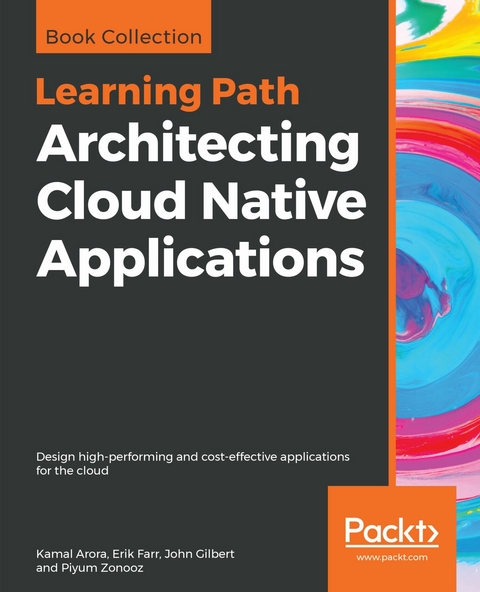
Architecting Cloud Native Applications (eBook)
526 Seiten
Packt Publishing (Verlag)
978-1-83864-239-6 (ISBN)
Apply cloud native patterns and practices to deliver responsive, resilient, elastic, and message-driven systems with confidence
Key Features:
Discover best practices for applying cloud native patterns to your cloud applicationsExplore ways to effectively plan resources and technology stacks for high security and fault toleranceGain insight into core architectural principles using real-world examples
Book Description:
Cloud computing has proven to be the most revolutionary IT development since virtualization. Cloud native architectures give you the benefit of more flexibility over legacy systems.
This Learning Path teaches you everything you need to know for designing industry-grade cloud applications and efficiently migrating your business to the cloud. It begins by exploring the basic patterns that turn your database inside out to achieve massive scalability. You'll learn how to develop cloud native architectures using microservices and serverless computing as your design principles. Then, you'll explore ways to continuously deliver production code by implementing continuous observability in production. In the concluding chapters, you'll learn about various public cloud architectures ranging from AWS and Azure to the Google Cloud Platform, and understand the future trends and expectations of cloud providers.
By the end of this Learning Path, you'll have learned the techniques to adopt cloud native architectures that meet your business requirements.
This Learning Path includes content from the following Packt products:
Cloud Native Development Patterns and Best Practices by John GilbertCloud Native Architectures by Erik Farr et al.What you will learnUnderstand the difference between cloud native and traditional architectureAutomate security controls and configuration managementMinimize risk by evolving your monolithic systems into cloud native applicationsExplore the aspects of migration, when and why to use itApply modern delivery and testing methods to continuously deliver production codeEnable massive scaling by turning your database inside out
Who this book is for:
This Learning Path is designed for developers who want to progress into building cloud native systems and are keen to learn the patterns involved. Software architects, who are keen on designing scalable and highly available cloud native applications, will also find this Learning Path very useful. To easily grasp these concepts, you will need basic knowledge of programming and cloud computing.
Kamal Arora is an inventor, author, and technology leader with more than 15 years of IT experience. He currently works at Amazon Web Services and leads a diverse team of highly experienced solutions architects who enable global consulting partners and enterprise customers on their journey to cloud. Kamal has also led the creation of biggest global technical partnerships, set his team's vision and execution model, and incubated multiple new strategic initiatives. Erik Farr is a technology leader with over 18 years in the IT industry. He has been on the leading edge of cloud technology and enterprise architecture, working with some of the largest companies and system integrators in the world. In his current role at Amazon Web Services, he leads a team of experienced solution architects to help global system integrator partners design enterprise scale cloud native architectures. John Gilbert is a CTO with over 25 years of experience of architecting and delivering distributed, event-driven systems. His cloud journey started more than five years ago and has spanned all the levels of cloud maturity-through lift and shift, software-defined infrastructure, microservices, and continuous deployment. He finds delivering cloud native solutions to be by far the most fun and satisfying, as they force us to rewire how we reason about systems and enable us to accomplish far more with much less effort. Piyum Zonooz is a global partner solution architect at Amazon Web Services, where he works with companies across all industries to help drive cloud adoption and re-architect products to cloud native. He has led projects in TCO analysis, infrastructure design, DevOps adoption, and complete business transformation. Prior to AWS, Piyum was a lead architect as part of the Accenture Cloud Practice where he led large-scale cloud adoption projects.
Apply cloud native patterns and practices to deliver responsive, resilient, elastic, and message-driven systems with confidenceKey FeaturesDiscover best practices for applying cloud native patterns to your cloud applicationsExplore ways to effectively plan resources and technology stacks for high security and fault toleranceGain insight into core architectural principles using real-world examplesBook DescriptionCloud computing has proven to be the most revolutionary IT development since virtualization. Cloud native architectures give you the benefit of more flexibility over legacy systems.This Learning Path teaches you everything you need to know for designing industry-grade cloud applications and efficiently migrating your business to the cloud. It begins by exploring the basic patterns that turn your database inside out to achieve massive scalability. You'll learn how to develop cloud native architectures using microservices and serverless computing as your design principles. Then, you'll explore ways to continuously deliver production code by implementing continuous observability in production. In the concluding chapters, you'll learn about various public cloud architectures ranging from AWS and Azure to the Google Cloud Platform, and understand the future trends and expectations of cloud providers.By the end of this Learning Path, you'll have learned the techniques to adopt cloud native architectures that meet your business requirements. This Learning Path includes content from the following Packt products:Cloud Native Development Patterns and Best Practices by John GilbertCloud Native Architectures by Erik Farr et al.What you will learnUnderstand the difference between cloud native and traditional architectureAutomate security controls and configuration managementMinimize risk by evolving your monolithic systems into cloud native applicationsExplore the aspects of migration, when and why to use itApply modern delivery and testing methods to continuously deliver production codeEnable massive scaling by turning your database inside outWho this book is forThis Learning Path is designed for developers who want to progress into building cloud native systems and are keen to learn the patterns involved. Software architects, who are keen on designing scalable and highly available cloud native applications, will also find this Learning Path very useful. To easily grasp these concepts, you will need basic knowledge of programming and cloud computing.
| Erscheint lt. Verlag | 16.4.2019 |
|---|---|
| Sprache | englisch |
| Themenwelt | Mathematik / Informatik ► Informatik |
| Schlagworte | asynchronous and synchronous API • Cloud Computing • Cloud-native • Event Driven • event streaming • Microservice • reactive |
| ISBN-10 | 1-83864-239-0 / 1838642390 |
| ISBN-13 | 978-1-83864-239-6 / 9781838642396 |
| Informationen gemäß Produktsicherheitsverordnung (GPSR) | |
| Haben Sie eine Frage zum Produkt? |
 EPUB (Adobe DRM)
Kopierschutz: Adobe-DRM
Adobe-DRM ist ein Kopierschutz, der das eBook vor Mißbrauch schützen soll. Dabei wird das eBook bereits beim Download auf Ihre persönliche Adobe-ID autorisiert. Lesen können Sie das eBook dann nur auf den Geräten, welche ebenfalls auf Ihre Adobe-ID registriert sind.
Details zum Adobe-DRM
Dateiformat: EPUB (Electronic Publication)
EPUB ist ein offener Standard für eBooks und eignet sich besonders zur Darstellung von Belletristik und Sachbüchern. Der Fließtext wird dynamisch an die Display- und Schriftgröße angepasst. Auch für mobile Lesegeräte ist EPUB daher gut geeignet.
Systemvoraussetzungen:
PC/Mac: Mit einem PC oder Mac können Sie dieses eBook lesen. Sie benötigen eine
eReader: Dieses eBook kann mit (fast) allen eBook-Readern gelesen werden. Mit dem amazon-Kindle ist es aber nicht kompatibel.
Smartphone/Tablet: Egal ob Apple oder Android, dieses eBook können Sie lesen. Sie benötigen eine
Geräteliste und zusätzliche Hinweise
Buying eBooks from abroad
For tax law reasons we can sell eBooks just within Germany and Switzerland. Regrettably we cannot fulfill eBook-orders from other countries.
aus dem Bereich