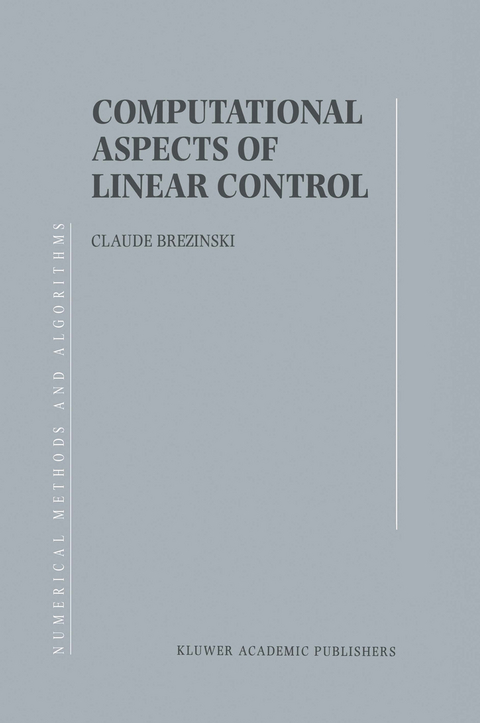
Computational Aspects of Linear Control
Kluwer Academic Publishers (Verlag)
9781402007118 (ISBN)
Many devices (we say dynamical systems or simply systems) behave like black boxes: they receive an input, this input is transformed following some laws (usually a differential equation) and an output is observed. The problem is to regulate the input in order to control the output, that is for obtaining a desired output. Such a mechanism, where the input is modified according to the output measured, is called feedback. The study and design of such automatic processes is called control theory. As we will see, the term system embraces any device and control theory has a wide variety of applications in the real world. Control theory is an interdisci plinary domain at the junction of differential and difference equations, system theory and statistics. Moreover, the solution of a control problem involves many topics of numerical analysis and leads to many interesting computational problems: linear algebra (QR, SVD, projections, Schur complement, structured matrices, localization of eigenvalues, computation of the rank, Jordan normal form, Sylvester and other equations, systems of linear equations, regulariza tion, etc), root localization for polynomials, inversion of the Laplace transform, computation of the matrix exponential, approximation theory (orthogonal poly nomials, Pad6 approximation, continued fractions and linear fractional transfor mations), optimization, least squares, dynamic programming, etc. So, control theory is also a. good excuse for presenting various (sometimes unrelated) issues of numerical analysis and the procedures for their solution. This book is not a book on control.
1. Control of Linear Systems.- 1 The control problem.- 2 Examples.- 3 Basic notions and results.- 4 Controllability.- 5 Observability.- 6 The canonical representation.- 7 Realization.- 8 Model reduction.- 9 Stability analysis.- 10 Poles and zeros.- 11 Decoupling.- 12 State estimation.- 13 Geometric theory.- 14 Solving the control problem.- 15 Effects of finite precision.- 2. Formal Orthogonal Polynomials.- 1 Definition and properties.- 2 Matrix interpretation.- 3 Adjacent families.- 4 Biorthogonal polynomials.- 5 Vector orthogonal polynomials.- 3. Padé Approximations.- 1 Preliminaries.- 2 Padé—type approximants.- 3 Padé approximants.- 4 Error estimation.- 5 Generalizations.- 6 Approximations to the exponential.- 4. Transform Inversion.- 1 Laplace transform.- 2 z—transform.- 5. Linear Algebra Issues.- 1 Singular value decomposition.- 2 Schur complement.- 3 The bordering method.- 4 Determinantal identities.- 5 Hankel matrices and related topics.- 6 Stable matrices.- 7 Recursive projection.- 6. Lanczos Tridiagonalization Process.- 1 The tridiagonalization process.- 2 The non—Hermitian Lanczos process.- 7. Systems of Linear Algebraic Equations.- 1 The method of Arnoldi.- 2 Lanczos method.- 3 Implementation of Lanczos method.- 4 Preconditioning.- 5 Transpose—free algorithms.- 6 Breakdowns.- 7 Krylov subspace methods.- 8 Hankel and Toeplitz systems.- 9 Error estimates for systems of linear equations.- 8. Regularization of Ill—Conditioned Systems.- 1 Introduction.- 2 Analysis of the regularized solutions.- 3 The symmetric positive definite case.- 4 Rational extrapolation procedures.- 9. Sylvester and Riccati Equations.- 1 Sylvester equation.- 2 Riccati equation.- 10. Topics on Nonlinear Differential Equations.- 1 Integrable systems.- 2 Connection to convergenceacceleration.- 11. Appendix: The Mathematics of Model Reduction.- 1 Model reduction by projection.- 2 Matrix interpretation.- 3 Increasing the dimension.- 4 Construction of the projection.- 5 Transfer function matrices.
| Reihe/Serie | Numerical Methods and Algorithms ; 1 |
|---|---|
| Zusatzinfo | X, 295 p. |
| Sprache | englisch |
| Maße | 155 x 235 mm |
| Themenwelt | Mathematik / Informatik ► Mathematik ► Analysis |
| Mathematik / Informatik ► Mathematik ► Angewandte Mathematik | |
| Mathematik / Informatik ► Mathematik ► Wahrscheinlichkeit / Kombinatorik | |
| ISBN-13 | 9781402007118 / 9781402007118 |
| Zustand | Neuware |
| Informationen gemäß Produktsicherheitsverordnung (GPSR) | |
| Haben Sie eine Frage zum Produkt? |
aus dem Bereich