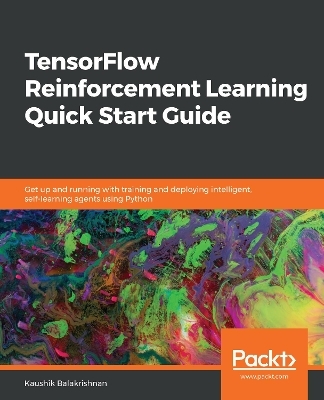
TensorFlow Reinforcement Learning Quick Start Guide
Packt Publishing Limited (Verlag)
978-1-78953-358-3 (ISBN)
Leverage the power of Tensorflow to Create powerful software agents that can self-learn to perform real-world tasks
Key Features
Explore efficient Reinforcement Learning algorithms and code them using TensorFlow and Python
Train Reinforcement Learning agents for problems, ranging from computer games to autonomous driving.
Formulate and devise selective algorithms and techniques in your applications in no time.
Book DescriptionAdvances in reinforcement learning algorithms have made it possible to use them for optimal control in several different industrial applications. With this book, you will apply Reinforcement Learning to a range of problems, from computer games to autonomous driving.
The book starts by introducing you to essential Reinforcement Learning concepts such as agents, environments, rewards, and advantage functions. You will also master the distinctions between on-policy and off-policy algorithms, as well as model-free and model-based algorithms. You will also learn about several Reinforcement Learning algorithms, such as SARSA, Deep Q-Networks (DQN), Deep Deterministic Policy Gradients (DDPG), Asynchronous Advantage Actor-Critic (A3C), Trust Region Policy Optimization (TRPO), and Proximal Policy Optimization (PPO). The book will also show you how to code these algorithms in TensorFlow and Python and apply them to solve computer games from OpenAI Gym. Finally, you will also learn how to train a car to drive autonomously in the Torcs racing car simulator.
By the end of the book, you will be able to design, build, train, and evaluate feed-forward neural networks and convolutional neural networks. You will also have mastered coding state-of-the-art algorithms and also training agents for various control problems.
What you will learn
Understand the theory and concepts behind modern Reinforcement Learning algorithms
Code state-of-the-art Reinforcement Learning algorithms with discrete or continuous actions
Develop Reinforcement Learning algorithms and apply them to training agents to play computer games
Explore DQN, DDQN, and Dueling architectures to play Atari's Breakout using TensorFlow
Use A3C to play CartPole and LunarLander
Train an agent to drive a car autonomously in a simulator
Who this book is forData scientists and AI developers who wish to quickly get started with training effective reinforcement learning models in TensorFlow will find this book very useful. Prior knowledge of machine learning and deep learning concepts (as well as exposure to Python programming) will be useful.
Kaushik Balakrishnan works for BMW in Silicon Valley, and applies reinforcement learning, machine learning, and computer vision to solve problems in autonomous driving. Previously, he also worked at Ford Motor Company and NASA Jet Propulsion Laboratory. His primary expertise is in machine learning, computer vision, and high-performance computing, and he has worked on several projects involving both research and industrial applications. He has also worked on numerical simulations of rocket landings on planetary surfaces, and for this he developed several high-fidelity models that run efficiently on supercomputers. He holds a PhD in aerospace engineering from the Georgia Institute of Technology in Atlanta, Georgia.
Table of Contents
Up and Running with Reinforcement Learning
Temporal Difference, SARSA, and Q-Learning
Deep Q-Network
Double DQN, Dueling Architectures, and Rainbow
Deep Deterministic Policy Gradient
Asynchronous Methods - A3C and A2C
Trust Region Policy Optimization and Proximal Policy Optimization
Deep RL Applied to Autonomous Driving
| Erscheinungsdatum | 03.04.2019 |
|---|---|
| Verlagsort | Birmingham |
| Sprache | englisch |
| Maße | 75 x 93 mm |
| Themenwelt | Mathematik / Informatik ► Informatik ► Datenbanken |
| Informatik ► Theorie / Studium ► Künstliche Intelligenz / Robotik | |
| ISBN-10 | 1-78953-358-9 / 1789533589 |
| ISBN-13 | 978-1-78953-358-3 / 9781789533583 |
| Zustand | Neuware |
| Informationen gemäß Produktsicherheitsverordnung (GPSR) | |
| Haben Sie eine Frage zum Produkt? |
aus dem Bereich