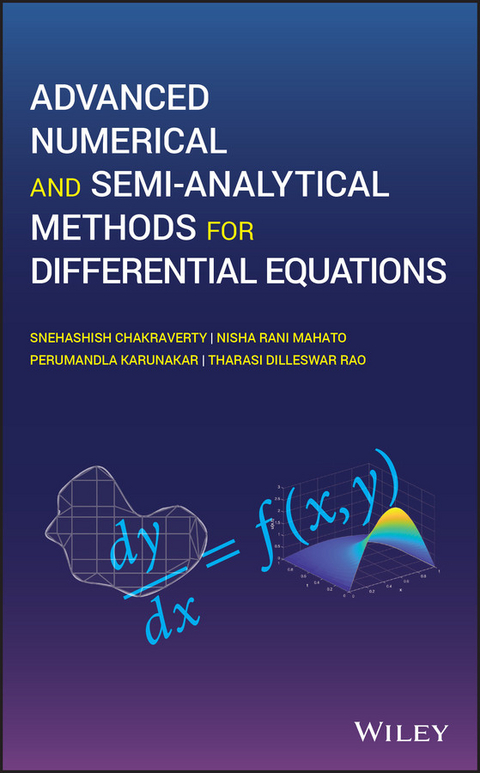
Advanced Numerical and Semi-Analytical Methods for Differential Equations (eBook)
256 Seiten
John Wiley & Sons (Verlag)
978-1-119-42344-7 (ISBN)
This student-friendly book deals with various approaches for solving differential equations numerically or semi-analytically depending on the type of equations and offers simple example problems to help readers along.
Featuring both traditional and recent methods, Advanced Numerical and Semi Analytical Methods for Differential Equations begins with a review of basic numerical methods. It then looks at Laplace, Fourier, and weighted residual methods for solving differential equations. A new challenging method of Boundary Characteristics Orthogonal Polynomials (BCOPs) is introduced next. The book then discusses Finite Difference Method (FDM), Finite Element Method (FEM), Finite Volume Method (FVM), and Boundary Element Method (BEM). Following that, analytical/semi analytic methods like Akbari Ganji's Method (AGM) and Exp-function are used to solve nonlinear differential equations. Nonlinear differential equations using semi-analytical methods are also addressed, namely Adomian Decomposition Method (ADM), Homotopy Perturbation Method (HPM), Variational Iteration Method (VIM), and Homotopy Analysis Method (HAM). Other topics covered include: emerging areas of research related to the solution of differential equations based on differential quadrature and wavelet approach; combined and hybrid methods for solving differential equations; as well as an overview of fractal differential equations. Further, uncertainty in term of intervals and fuzzy numbers have also been included, along with the interval finite element method. This book:
* Discusses various methods for solving linear and nonlinear ODEs and PDEs
* Covers basic numerical techniques for solving differential equations along with various discretization methods
* Investigates nonlinear differential equations using semi-analytical methods
* Examines differential equations in an uncertain environment
* Includes a new scenario in which uncertainty (in term of intervals and fuzzy numbers) has been included in differential equations
* Contains solved example problems, as well as some unsolved problems for self-validation of the topics covered
Advanced Numerical and Semi Analytical Methods for Differential Equations is an excellent text for graduate as well as post graduate students and researchers studying various methods for solving differential equations, numerically and semi-analytically.
SNEHASHISH CHAKRAVERTY, PHD, is Professor in the Department of Mathematics at National Institute of Technology, Rourkela, Odisha, India. He is also the author of Fuzzy Arbitrary Order System: Fuzzy Fractional Differential Equations and Applications and 12 other books. NISHA RANI MAHATO is a Senior Research Fellow in the Department of Mathematics at the National Institute of Technology, Rourkela, Odisha, India where she is pursuing her PhD. PERUMANDLA KARUNAKAR is a Senior Research Fellow in the Department of Mathematics at the National Institute of Technology, Rourkela, Odisha, India where he is pursuing his PhD. THARASI DILLESWAR RAO, is a Senior Research Fellow in the Department of Mathematics at the National Institute of Technology, Rourkela, Odisha, India where he is pursuing his PhD.
1 Basic Numerical Methods
1.1 Introduction
1.2 Ordinary differential equation
1.3 Euler method
1.4 Improved Euler method
1.5 Runge-Kutta Methods
1.6 Multistep methods
1.7 Higher order ODE
2 Integral Transforms
2.1 Introduction
2.2 Laplace Transform
2.3 Fourier Tranform
3 Weighted Residual Methods
3.1 Introduction
3.2 Collocation method
3.3 Subdomain method
3.4 Least-square method
3.5 Galerkin method
3.6 Comparison of WRMs
4 Boundary Characteristics Orthogonal Polynomials
4.1 Introduction
4.2 Gram Schmidt Orthogonalization Process
4.3 Generation of BCOPs
4.4 Galerkin's Method with BCOPs
4.5 Rayleigh-Ritz Method with BCOP's
5 Finite Difference Method
5.1 Introduction
5.2 Finite Difference Scheme
5.3 Explicit and Implicit Finite Difference Schemes
6 Finite Element Method
6.1 Introduction
6.2 Finite element procedure
6.3 Galerkin finite element method
6.4 Structural analysis using FEM
7 Finite Volume Method
7.1 Introduction
7.2 Discretization Techniques of FVM
7.3 General Form of Finite Volume Method
7.4 One Dimensional Convection-diffusion problem
8 Boundary Element Method
8.1 Introduction
8.2 Boundary Representation and Background Theory of BEM
8.3 Derivation of the Boundary Element Method
9 Akbari Ganji's Method
9.1 Introduction
9.2 Nonlinear ordinary differential equations
9.3 Numerical examples
10 Exp-function Method
10.1 Introduction
10.2 Basics of Exp-fucntion method
10.3 Numerical examples
11 Adomian Decomposition Method
11.1 Introduction
11.2 ADM for Ordinary Differential Equations (ODEs)
11.3 Solving system of ODEs by ADM
11.4 ADM for solving Partial Differential Equations (PDEs)
11.5 ADM for system of PDEs
12 Homotopy Perturbation Method
12.1 Introduction
12.2 Basic idea of HPM
12.3 Numerical examples
13 Variational Iteration Method
13.1 Introduction
13.2 VIM procedure
13.3 Numerical examples
14 Homotopy Analysis Method
14.1 Introduction
14.2 HAM procedure
14.3 Numerical examples
15 Differential Quadrature Method
15.1 Introduction
15.2 DQM procedure
15.3 Numerical examples
16 Wavelet Method
16.1 Introduction
16.2 Haar wavelet
16.3 Wavelet-collocation method
17 Hybrid Methods
17.1 Introduction
17.2 Homotopy Perturbation Transform Method
17.3 Laplace Adomian Decomposition Method
18 Preliminaries of Fractal Differential Equations
18.1 Introduction to fractal
18.2 Fractal differential equations
19 Differential Equations with Interval Uncertainty
19.1 Introduction
19.2 Interval Differential Equations (IDEs)
19.3 Generalized Hukuhara Differentiability of IDEs
19.4 Analytical Methods for IDEs
20 Differential Equations with Fuzzy Uncertainty
20.1 Solving Fuzzy Linear System of Differential Equations
21 Interval Finite Element Method
21.1 Introduction
21.2 Interval Galerkin FEM
21.3 Structural analysis using IFEM
| Erscheint lt. Verlag | 20.3.2019 |
|---|---|
| Sprache | englisch |
| Themenwelt | Mathematik / Informatik ► Mathematik ► Analysis |
| Schlagworte | Differential Equations • Differentialgleichungen • Engineering statistics • Mathematics • Mathematik • Numerical Methods • numerische Methoden • Statistics • Statistik • Statistik in den Ingenieurwissenschaften |
| ISBN-10 | 1-119-42344-9 / 1119423449 |
| ISBN-13 | 978-1-119-42344-7 / 9781119423447 |
| Informationen gemäß Produktsicherheitsverordnung (GPSR) | |
| Haben Sie eine Frage zum Produkt? |
 PDF (Adobe DRM)
Kopierschutz: Adobe-DRM
Adobe-DRM ist ein Kopierschutz, der das eBook vor Mißbrauch schützen soll. Dabei wird das eBook bereits beim Download auf Ihre persönliche Adobe-ID autorisiert. Lesen können Sie das eBook dann nur auf den Geräten, welche ebenfalls auf Ihre Adobe-ID registriert sind.
Details zum Adobe-DRM
Dateiformat: PDF (Portable Document Format)
Mit einem festen Seitenlayout eignet sich die PDF besonders für Fachbücher mit Spalten, Tabellen und Abbildungen. Eine PDF kann auf fast allen Geräten angezeigt werden, ist aber für kleine Displays (Smartphone, eReader) nur eingeschränkt geeignet.
Systemvoraussetzungen:
PC/Mac: Mit einem PC oder Mac können Sie dieses eBook lesen. Sie benötigen eine
eReader: Dieses eBook kann mit (fast) allen eBook-Readern gelesen werden. Mit dem amazon-Kindle ist es aber nicht kompatibel.
Smartphone/Tablet: Egal ob Apple oder Android, dieses eBook können Sie lesen. Sie benötigen eine
Geräteliste und zusätzliche Hinweise
Buying eBooks from abroad
For tax law reasons we can sell eBooks just within Germany and Switzerland. Regrettably we cannot fulfill eBook-orders from other countries.
aus dem Bereich