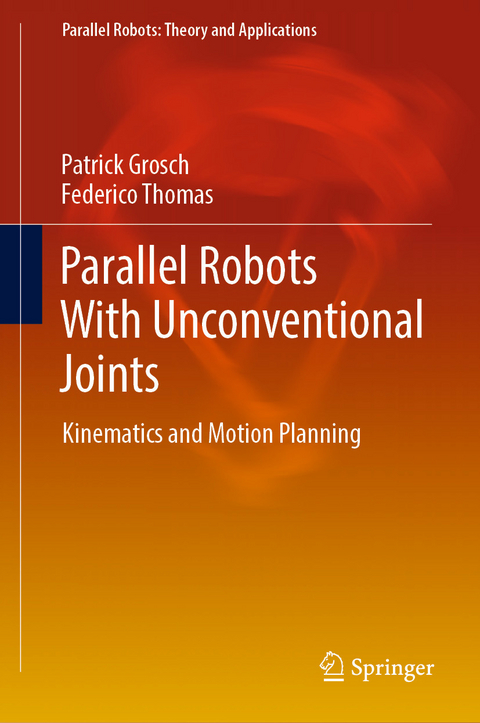
Parallel Robots With Unconventional Joints (eBook)
VIII, 107 Seiten
Springer International Publishing (Verlag)
978-3-030-11304-9 (ISBN)
This book shows how, through certain geometric transformations, some of the standard joints used in parallel robots can be replaced with lockable or non-holonomic joints. These substitutions allow for reducing the number of legs, and hence the number of actuators needed to control the robot, without losing the robot's ability to bring its mobile platform to the desired configuration. The kinematics of the most representative examples of these new designs are analyzed and their theoretical features verified through simulations and practical implementations.
1 Introduction: lockable and non-holonomic joints.- 1.1 Motivation.- 1.2 Precursors.- 1.3 Organization of this book.- References.- 2 Parallel robots with lockable revolute joints.- 2.1 Kinematics of the 4RbRPS parallel robot.- 2.2 Maneuvers.- 2.3 Motion planning.- 2.4 Hardware implementation.- 2.5 Software implementation.- References.- 3 Spherical non-holonomic joints.- 3.1 Under-actuated parallel robots with spherical non-holonomic joints.- 3.2 Implementation of spherical non-holonomic joints.- References.- 4 Kinematics of the 3SnPU spatial robot.- 4.1 The 3SnPU robot.- 4.2 Instantaneous kinematics.- 4.3 Statics analysis.- 4.4 Singularities.- 4.5 Controllability.- 4.6 Example.- References.- 5 Motion planning for the 3SnPU robot.- 5.1 Motion planning.- 5.2 Using truncated series.- 5.3 Example.- References.- 6 Kinematics of the Sn-2UPS spherical robot.- 6.1 Kinematic model.- 6.2 Deriving a bilinear model.- 6.3 Singularities.- 6.4 A, B, and rotations in R4.- 6.5 Workspace computation.- 7 Motion planning for the Sn-2UPS robot.- 7.1 Kinematic model.- 7.2 Three-move motion planner.- 7.3 Two-move motion planner.- 7.4 Single-move motion planner.- 7.5 Example.- 7.6 Implementation.- References.- 8 Conclusions.
| Erscheint lt. Verlag | 20.3.2019 |
|---|---|
| Reihe/Serie | Parallel Robots: Theory and Applications | Parallel Robots: Theory and Applications |
| Zusatzinfo | VIII, 107 p. 52 illus., 42 illus. in color. |
| Verlagsort | Cham |
| Sprache | englisch |
| Themenwelt | Informatik ► Theorie / Studium ► Künstliche Intelligenz / Robotik |
| Technik ► Maschinenbau | |
| Schlagworte | Engineering design • Lockable joints • Non-holonomic joints • Parallel robot design • Robot kinematics • Robot Path Planning |
| ISBN-10 | 3-030-11304-3 / 3030113043 |
| ISBN-13 | 978-3-030-11304-9 / 9783030113049 |
| Informationen gemäß Produktsicherheitsverordnung (GPSR) | |
| Haben Sie eine Frage zum Produkt? |
 PDF (Wasserzeichen)
DRM: Digitales Wasserzeichen
Dieses eBook enthält ein digitales Wasserzeichen und ist damit für Sie personalisiert. Bei einer missbräuchlichen Weitergabe des eBooks an Dritte ist eine Rückverfolgung an die Quelle möglich.
Dateiformat: PDF (Portable Document Format)
Mit einem festen Seitenlayout eignet sich die PDF besonders für Fachbücher mit Spalten, Tabellen und Abbildungen. Eine PDF kann auf fast allen Geräten angezeigt werden, ist aber für kleine Displays (Smartphone, eReader) nur eingeschränkt geeignet.
Systemvoraussetzungen:
PC/Mac: Mit einem PC oder Mac können Sie dieses eBook lesen. Sie benötigen dafür einen PDF-Viewer - z.B. den Adobe Reader oder Adobe Digital Editions.
eReader: Dieses eBook kann mit (fast) allen eBook-Readern gelesen werden. Mit dem amazon-Kindle ist es aber nicht kompatibel.
Smartphone/Tablet: Egal ob Apple oder Android, dieses eBook können Sie lesen. Sie benötigen dafür einen PDF-Viewer - z.B. die kostenlose Adobe Digital Editions-App.
Buying eBooks from abroad
For tax law reasons we can sell eBooks just within Germany and Switzerland. Regrettably we cannot fulfill eBook-orders from other countries.
aus dem Bereich