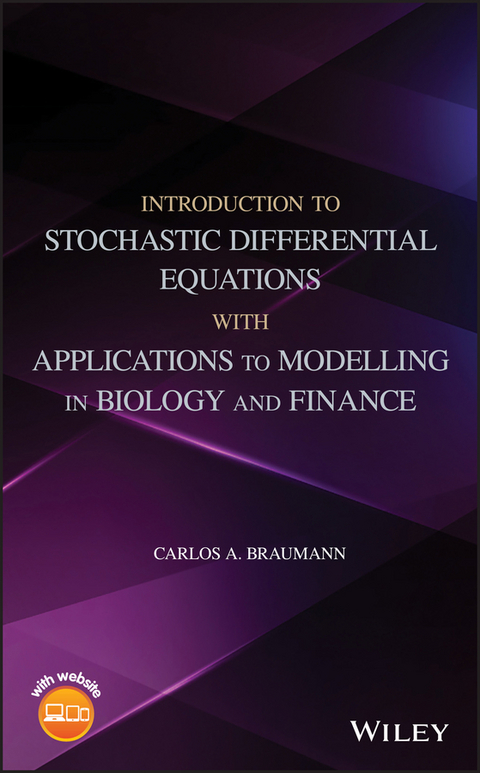
Introduction to Stochastic Differential Equations with Applications to Modelling in Biology and Finance (eBook)
John Wiley & Sons (Verlag)
978-1-119-16608-5 (ISBN)
A comprehensive introduction to the core issues of stochastic differential equations and their effective application
Introduction to Stochastic Differential Equations with Applications to Modelling in Biology and Finance offers a comprehensive examination to the most important issues of stochastic differential equations and their applications. The author - a noted expert in the field - includes myriad illustrative examples in modelling dynamical phenomena subject to randomness, mainly in biology, bioeconomics and finance, that clearly demonstrate the usefulness of stochastic differential equations in these and many other areas of science and technology.
The text also features real-life situations with experimental data, thus covering topics such as Monte Carlo simulation and statistical issues of estimation, model choice and prediction. The book includes the basic theory of option pricing and its effective application using real-life. The important issue of which stochastic calculus, Itô or Stratonovich, should be used in applications is dealt with and the associated controversy resolved. Written to be accessible for both mathematically advanced readers and those with a basic understanding, the text offers a wealth of exercises and examples of application. This important volume:
- Contains a complete introduction to the basic issues of stochastic differential equations and their effective application
- Includes many examples in modelling, mainly from the biology and finance fields
- Shows how to: Translate the physical dynamical phenomenon to mathematical models and back, apply with real data, use the models to study different scenarios and understand the effect of human interventions
- Conveys the intuition behind the theoretical concepts
- Presents exercises that are designed to enhance understanding
- Offers a supporting website that features solutions to exercises and R code for algorithm implementation
Written for use by graduate students, from the areas of application or from mathematics and statistics, as well as academics and professionals wishing to study or to apply these models, Introduction to Stochastic Differential Equations with Applications to Modelling in Biology and Finance is the authoritative guide to understanding the issues of stochastic differential equations and their application.
Carlos A. Braumann is Professor in the Department of Mathematics and member of the Research Centre in Mathematics and Applications, Universidade de Évora, Portugal. He is an elected member of the International Statistical Institute (since 1992), a former President of the European Society for Mathematical and Theoretical Biology (2009-12) and of the Portuguese Statistical Society (2006-09 and 2009-12), and a former member of the European Regional Committee of the Bernoulli Society (2008-12). He has dealt with stochastic differential equation (SDE) models and applications (mainly biological).
A comprehensive introduction to the core issues of stochastic differential equations and their effective application Introduction to Stochastic Differential Equations with Applications to Modelling in Biology and Finance offers a comprehensive examination to the most important issues of stochastic differential equations and their applications. The author a noted expert in the field includes myriad illustrative examples in modelling dynamical phenomena subject to randomness, mainly in biology, bioeconomics and finance, that clearly demonstrate the usefulness of stochastic differential equations in these and many other areas of science and technology. The text also features real-life situations with experimental data, thus covering topics such as Monte Carlo simulation and statistical issues of estimation, model choice and prediction. The book includes the basic theory of option pricing and its effective application using real-life. The important issue of which stochastic calculus, It or Stratonovich, should be used in applications is dealt with and the associated controversy resolved. Written to be accessible for both mathematically advanced readers and those with a basic understanding, the text offers a wealth of exercises and examples of application. This important volume: Contains a complete introduction to the basic issues of stochastic differential equations and their effective application Includes many examples in modelling, mainly from the biology and finance fields Shows how to: Translate the physical dynamical phenomenon to mathematical models and back, apply with real data, use the models to study different scenarios and understand the effect of human interventions Conveys the intuition behind the theoretical concepts Presents exercises that are designed to enhance understanding Offers a supporting website that features solutions to exercises and R code for algorithm implementation Written for use by graduate students, from the areas of application or from mathematics and statistics, as well as academics and professionals wishing to study or to apply these models, Introduction to Stochastic Differential Equations with Applications to Modelling in Biology and Finance is the authoritative guide to understanding the issues of stochastic differential equations and their application.
CARLOS A. BRAUMANN is Professor in the Department of Mathematics and member of the Research Centre in Mathematics and Applications, Universidade de Évora, Portugal. He is an elected member of the International Statistical Institute (since 1992), a former President of the European Society for Mathematical and Theoretical Biology (2009-12) and of the Portuguese Statistical Society (2006-09 and 2009-12), and a former member of the European Regional Committee of the Bernoulli Society (2008-12). He has dealt with stochastic differential equation (SDE) models and applications (mainly biological).
Preface xi
About the companion website xv
1 Introduction 1
2 Revision of probability and stochastic processes 9
2.1 Revision of probabilistic concepts 9
2.2 Monte Carlo simulation of random variables 25
2.3 Conditional expectations, conditional probabilities, and independence 29
2.4 A brief review of stochastic processes 35
2.5 A brief review of stationary processes 40
2.6 Filtrations, martingales, and Markov times 41
2.7 Markov processes 45
3 An informal introduction to stochastic differential equations 51
4 The Wiener process 57
4.1 Definition 57
4.2 Main properties 59
4.3 Some analytical properties 62
4.4 First passage times 64
4.5 Multidimensional Wiener processes 66
5 Diffusion processes 67
5.1 Definition 67
5.2 Kolmogorov equations 69
5.3 Multidimensional case 73
6 Stochastic integrals 75
6.1 Informal definition of the Itô and Stratonovich integrals 75
6.2 Construction of the Itô integral 79
6.3 Study of the integral as a function of the upper limit of integration 88
6.4 Extension of the Itô integral 91
6.5 Itô theorem and Itô formula 94
6.6 The calculi of Itô and Stratonovich 100
6.7 The multidimensional integral 104
7 Stochastic differential equations 107
7.1 Existence and uniqueness theorem and main proprieties of the solution 107
7.2 Proof of the existence and uniqueness theorem 111
7.3 Observations and extensions to the existence and uniqueness theorem 118
8 Study of geometric Brownian motion (the stochastic Malthusian model or Black-Scholes model) 123
8.1 Study using Itô calculus 123
8.2 Study using Stratonovich calculus 132
9 The issue of the Itô and Stratonovich calculi 135
9.1 Controversy 135
9.2 Resolution of the controversy for the particular model 137
9.3 Resolution of the controversy for general autonomous models 139
10 Study of some functionals 143
10.1 Dynkin's formula 143
10.2 Feynman-Kac formula 146
11 Introduction to the study of unidimensional Itô diffusions 149
11.1 The Ornstein-Uhlenbeck process and the Vasicek model 149
11.2 First exit time from an interval 153
11.3 Boundary behaviour of Itô diffusions, stationary densities, and first passage times 160
12 Some biological and financial applications 169
12.1 The Vasicek model and some applications 169
12.2 Monte Carlo simulation, estimation and prediction issues 172
12.3 Some applications in population dynamics 179
12.4 Some applications in fisheries 192
12.5 An application in human mortality rates 201
13 Girsanov's theorem 209
13.1 Introduction through an example 209
13.2 Girsanov's theorem 213
14 Options and the Black-Scholes formula 219
14.1 Introduction 219
14.2 The Black-Scholes formula and hedging strategy 226
14.3 A numerical example and the Greeks 231
14.4 The Black-Scholes formula via Girsanov's theorem 236
14.5 Binomial model 241
14.6 European put options 248
14.7 American options 251
14.8 Other models 253
15 Synthesis 259
References 269
Index 277
1
Introduction
Stochastic differential equations (SDEs) are basically differential equations with an additional stochastic term. The deterministic term, which is common to ordinary differential equations, describes the ‘average’ dynamical behaviour of the phenomenon under study and the stochastic term describes the ‘noise’, i.e. the random perturbations that influence the phenomenon. Of course, in the particular case where such random perturbations are absent (deterministic case), the SDE becomes an ordinary differential equation.
As the dynamical behaviour of many natural phenomena can be described by differential equations, SDEs have important applications in basically all fields of science and technology whenever we need to consider random perturbations in the environmental conditions (environment taken here in a very broad sense) that affect such phenomena in a relevant manner.
As far as I know, the first SDE appeared in the literature in Uhlenbeck and Ornstein (1930). It is the Ornstein–Uhlenbeck model of Brownian motion, the solution of which is known as the Ornestein–Uhlenbeck process. Brownian motion is the irregular movement of particles suspended in a fluid, which was named after the botanist Brown, who first observed it at the microscope in the 19th century. The Ornstein–Ulhenbeck model improves Einstein treatment of Brownian motion. Einstein (1905) explained the phenomenon by the collisions of the particle with the molecules of the fluid and provided a model for the particle's position which corresponds to what was later called the Wiener process. The Wiener process and its relation with Brownian motion will be discussed on Chapters and .
Although the first SDE appeared in 1930, we had to wait till the mid of the 20th century to have a rigorous mathematical theory of SDEs by Itô (1951). Since then the theory has developed considerably and been applied to physics, astronomy, electronics, telecommunications, civil engineering, chemistry, seismology, oceanography, meteorology, biology, fisheries, economics, finance, etc. Using SDEs, one can study phenomena like the dispersion of a pollutant in water or in the air, the effect of noise on the transmission of telecommunication signals, the trajectory of an artificial satellite, the location of a ship, the thermal noise in an electric circuit, the dynamics of a chemical reaction, the control of an insulin delivery device, the dynamics of one or several populations of living beings when environmental random perturbations affect their growth rates, the optimization of fishing policies for fish populations subject to random environmental fluctuations, the variation of interest rates or of exchange rates, the behaviour of stock prices, the value of a call or put financial option or the risk immunization of investment portfolios or of pension plans, just to mention a few examples.
We will give special attention to the modelling issues, particularly the translation from the physical phenomenon to the SDE model and back. This will be illustrated with several examples, mainly in biological or financial applications. The dynamics of biological phenomena (particularly the dynamics of populations of living beings) and of financial phenomena, besides some clear trends, are frequently influenced by unpredictable components due to the complexity and variability of environmental or market conditions. Such phenomena are therefore particularly prone to benefit from the use of SDE models in their study and so we will prioritize examples of application in these fields. The study of population dynamics is also a field to which the author has dedicated a good deal of his research work. As for financial applications, it has been one of the most active research areas in the last decades, after the pioneering works of Black and Scholes (1973), Merton (1971), and Merton (1973). The 1997 Nobel prize in Economics was given to Merton and Scholes (Black had already died) for their work on what is now called financial mathematics, particularly for their work on the valuation of financial options based on the stochastic calculus this book will introduce you to. In both areas, there is a clear cross‐fertilization between theory and applications, with the needs induced by applications having considerably contributed to the development of the theory.
This book is intended to be read by both more mathematically oriented readers and by readers from other areas of science with the usual knowledge of calculus, probability, and statistics, who can skip the more technical parts. Due to the introductory character of this presentation, we will introduce SDEs in the simplest possible context, avoiding clouding the important ideas which we want to convey with heavy technicalities or cumbersome notations, without compromising rigour and directing the reader to more specialized literature when appropriate. In particular, we will only study stochastic differential equations in which the perturbing noise is a continuous‐time white noise. The use of white noise as a reasonable approximation of real perturbing noises has a great advantage: the cumulative noise (i.e. the integral of the noise) is the Wiener process, which has the nice and mathematically convenient property of having independent increments.
The Wiener process, rigorously studied by Wiener and Lévy after 1920 (some literature also calls it the Wiener–Lévy process), is also frequently named Brownian motion in the literature due to its association with the Einstein's first description of the Brownian motion of a particle suspended in a fluid in 1905. We personally prefer not to use this alternative naming since it identifies the physical phenomenon (the Brownian motion of particles) with its first mathematical model (the Wiener process), ignoring that there is an improved more realistic model (the Ornstein–Uhlenbeck process) of the same phenomenon. The ‘invention’ of the Wiener process is frequently attributed to Einstein, probably because it was thought he was the first one to use it (although at the time not yet under the name of ‘Wiener process’). However, Bachelier (1900) had already used it as a (not very adequate) model for stock prices in the Paris Stock Market.
With the same concern of prioritizing simple contexts in order to more effectively convey the main ideas, we will deal first with unidimensional SDEs. But, of course, if one wishes to study several variables simultaneously (e.g. the value of several financial assets in the stock market or the size of several interacting populations), we need multidimensional SDEs (systems of SDEs). So, we will also present afterwards how to extend the study to the multidimensional case; with the exception of some special issues, the ideas are the same as in the unidimensional case with a slightly heavier matrix notation.
We assume the reader to be knowledgeable of basic probability and statistics as is common in many undergraduate degree studies. Of course, sometimes a few more advanced concepts in probability are required, as well as basic concepts in stochastic processes (random variables that change over time). Chapter intends to refresh the basic probabilistic concepts and present the more advanced concepts in probability that are required, as well as to provide a very brief introduction to basic concepts in stochastic processes. The readers already familiar with these issues may skip it. The other readers should obviously read it, focusing their attention on the main ideas and the intuitive meaning of the concepts, which we will convey without sacrificing rigour.
Throughout the remaining chapters of this book we will have the same concern of conveying the main ideas and intuitive meaning of concepts and results, and advise readers to focus on them. Of course, alongside this we will also present the technical definitions and theorems that translate such ideas and intuitions into a formal mathematical framework (which will be particularly useful for the more mathematically trained readers).
Chapter presents an example of an SDE that can be used to study the growth of a biological population in an environment with abundant resources and random perturbations that affect the population growth rate. The same model is known as the Black–Scholes model in the financial literature, where it is used to model the value of a stock in the stock market. This is a nice illustration of the universality of mathematics, but the reason for its presentation is to introduce the reader to the Wiener process and to SDEs in an informal manner.
Chapter studies the more relevant aspects of the Wiener process. Chapter 5 introduces the diffusion processes, which are in a certain way generalizations of the Wiener process and which are going to play a key role in the study of SDEs. Later, we will show that, under certain regularity conditions, diffusion processes and solutions of SDEs are equivalent.
Given an initial condition and an SDE, i.e. given a Cauchy problem, its solution is the solution of the associated stochastic integral equation. In a way, either in the deterministic case or in the case of a stochastic environment, a Cauchy problem is no more than an integral equation in disguise, since the integral equation is the fulcrum of the theoretical treatment. In the stochastic world, it is the integral version of the SDE that truly makes sense since derivatives, as we shall see, do not exist in the current sense (the...
| Erscheint lt. Verlag | 25.2.2019 |
|---|---|
| Sprache | englisch |
| Themenwelt | Mathematik / Informatik ► Mathematik ► Statistik |
| Mathematik / Informatik ► Mathematik ► Wahrscheinlichkeit / Kombinatorik | |
| Schlagworte | American options • Angewandte Wahrscheinlichkeitsrechnung u. Statistik • Angew. Wahrscheinlichkeitsrechn. u. Statistik / Modelle • Applied Probability & Statistics • Applied Probability & Statistics - Models • Autonomous SDE • binomial model • Black-Scholes formula • Black-Scholes stock model • Boundary classification • Dynkin and Feynman-Kac formulas • European call and put options • Existence, uniqueness and properties of SDE solutions • Filtrations • Finanz- u. Wirtschaftsstatistik • first passage times • Fisheries model and profit optimization • Geometric Brownian motion • Girsanov theorem • Greeks • Hedging Strategy • Interest and exchange rate models • Ito diffusions • Ito Formula • Ito integral • Kolmogorov equations • Markov and diffusion processes • Martingales • Model Choice • Monte Carlo simulation of SDE and R codes • Ornstein-Uhlenbeck process • Parameter Estimation • population extinction • Prediction • Resolution of controversy on the use of Ito or Stratonovich calculi • Revision of probability and stochastic processes • SDE mortality rate model • Stationary density • Statistics • Statistics for Finance, Business & Economics • Statistik • Stochastic differential equations • Stochastic Malthusian growth • Stochastic population growth density-dependent models • Stochastische Differentialgleichung • Stratonovich Integral • Wiener process |
| ISBN-10 | 1-119-16608-X / 111916608X |
| ISBN-13 | 978-1-119-16608-5 / 9781119166085 |
| Informationen gemäß Produktsicherheitsverordnung (GPSR) | |
| Haben Sie eine Frage zum Produkt? |
 EPUB (Adobe DRM)
Kopierschutz: Adobe-DRM
Adobe-DRM ist ein Kopierschutz, der das eBook vor Mißbrauch schützen soll. Dabei wird das eBook bereits beim Download auf Ihre persönliche Adobe-ID autorisiert. Lesen können Sie das eBook dann nur auf den Geräten, welche ebenfalls auf Ihre Adobe-ID registriert sind.
Details zum Adobe-DRM
Dateiformat: EPUB (Electronic Publication)
EPUB ist ein offener Standard für eBooks und eignet sich besonders zur Darstellung von Belletristik und Sachbüchern. Der Fließtext wird dynamisch an die Display- und Schriftgröße angepasst. Auch für mobile Lesegeräte ist EPUB daher gut geeignet.
Systemvoraussetzungen:
PC/Mac: Mit einem PC oder Mac können Sie dieses eBook lesen. Sie benötigen eine
eReader: Dieses eBook kann mit (fast) allen eBook-Readern gelesen werden. Mit dem amazon-Kindle ist es aber nicht kompatibel.
Smartphone/Tablet: Egal ob Apple oder Android, dieses eBook können Sie lesen. Sie benötigen eine
Geräteliste und zusätzliche Hinweise
Buying eBooks from abroad
For tax law reasons we can sell eBooks just within Germany and Switzerland. Regrettably we cannot fulfill eBook-orders from other countries.
aus dem Bereich