


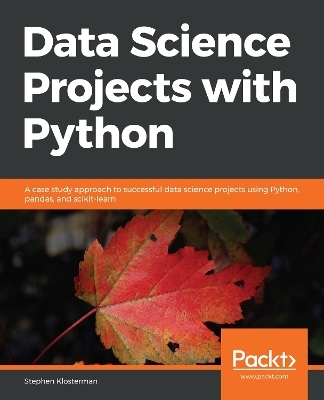
Data Science Projects with Python
A case study approach to successful data science projects using Python, pandas, and scikit-learn
Seiten
2019
Packt Publishing Limited (Verlag)
978-1-83855-102-5 (ISBN)
Packt Publishing Limited (Verlag)
978-1-83855-102-5 (ISBN)
Data Science Projects with Python will help you get comfortable with using the Python environment for data science. This book will start you on your journey to mastering topics within machine learning. These skills will help you deliver the kind of state-of-the-art predictive models that are being used to deliver value to businesses across ...
Gain hands-on experience with industry-standard data analysis and machine learning tools in Python
Key Features
Tackle data science problems by identifying the problem to be solved
Illustrate patterns in data using appropriate visualizations
Implement suitable machine learning algorithms to gain insights from data
Book DescriptionData Science Projects with Python is designed to give you practical guidance on industry-standard data analysis and machine learning tools, by applying them to realistic data problems. You will learn how to use pandas and Matplotlib to critically examine datasets with summary statistics and graphs, and extract the insights you seek to derive. You will build your knowledge as you prepare data using the scikit-learn package and feed it to machine learning algorithms such as regularized logistic regression and random forest. You’ll discover how to tune algorithms to provide the most accurate predictions on new and unseen data. As you progress, you’ll gain insights into the working and output of these algorithms, building your understanding of both the predictive capabilities of the models and why they make these predictions.
By then end of this book, you will have the necessary skills to confidently use machine learning algorithms to perform detailed data analysis and extract meaningful insights from unstructured data.
What you will learn
Install the required packages to set up a data science coding environment
Load data into a Jupyter notebook running Python
Use Matplotlib to create data visualizations
Fit machine learning models using scikit-learn
Use lasso and ridge regression to regularize your models
Compare performance between models to find the best outcomes
Use k-fold cross-validation to select model hyperparameters
Who this book is forIf you are a data analyst, data scientist, or business analyst who wants to get started using Python and machine learning techniques to analyze data and predict outcomes, this book is for you. Basic knowledge of Python and data analytics will help you get the most from this book. Familiarity with mathematical concepts such as algebra and basic statistics will also be useful.
Gain hands-on experience with industry-standard data analysis and machine learning tools in Python
Key Features
Tackle data science problems by identifying the problem to be solved
Illustrate patterns in data using appropriate visualizations
Implement suitable machine learning algorithms to gain insights from data
Book DescriptionData Science Projects with Python is designed to give you practical guidance on industry-standard data analysis and machine learning tools, by applying them to realistic data problems. You will learn how to use pandas and Matplotlib to critically examine datasets with summary statistics and graphs, and extract the insights you seek to derive. You will build your knowledge as you prepare data using the scikit-learn package and feed it to machine learning algorithms such as regularized logistic regression and random forest. You’ll discover how to tune algorithms to provide the most accurate predictions on new and unseen data. As you progress, you’ll gain insights into the working and output of these algorithms, building your understanding of both the predictive capabilities of the models and why they make these predictions.
By then end of this book, you will have the necessary skills to confidently use machine learning algorithms to perform detailed data analysis and extract meaningful insights from unstructured data.
What you will learn
Install the required packages to set up a data science coding environment
Load data into a Jupyter notebook running Python
Use Matplotlib to create data visualizations
Fit machine learning models using scikit-learn
Use lasso and ridge regression to regularize your models
Compare performance between models to find the best outcomes
Use k-fold cross-validation to select model hyperparameters
Who this book is forIf you are a data analyst, data scientist, or business analyst who wants to get started using Python and machine learning techniques to analyze data and predict outcomes, this book is for you. Basic knowledge of Python and data analytics will help you get the most from this book. Familiarity with mathematical concepts such as algebra and basic statistics will also be useful.
Steve Klosterman is a machine learning data scientist at CVS Health. He enjoys helping to frame problems in a data science context and delivering machine learning solutions that business stakeholders understand and value. His education includes a Ph.D. in biology from Harvard University, where he was an assistant teacher of the data science course.
Table of Contents
Data Exploration and Cleaning
Introduction to Scikit-Learn and Model Evaluation
Details of Logistic Regression and Feature Exploration
The Bias-Variance Trade-off
Decision Trees and Random Forests
Imputation of Missing Data, Financial Analysis, and Delivery to Client
| Erscheinungsdatum | 07.05.2019 |
|---|---|
| Verlagsort | Birmingham |
| Sprache | englisch |
| Maße | 75 x 93 mm |
| Themenwelt | Mathematik / Informatik ► Informatik ► Web / Internet |
| ISBN-10 | 1-83855-102-6 / 1838551026 |
| ISBN-13 | 978-1-83855-102-5 / 9781838551025 |
| Zustand | Neuware |
| Informationen gemäß Produktsicherheitsverordnung (GPSR) | |
| Haben Sie eine Frage zum Produkt? |
Mehr entdecken
aus dem Bereich

aus dem Bereich
Handbuch für die Praxis
Buch | Hardcover (2023)
O'Reilly (Verlag)
CHF 55,85


