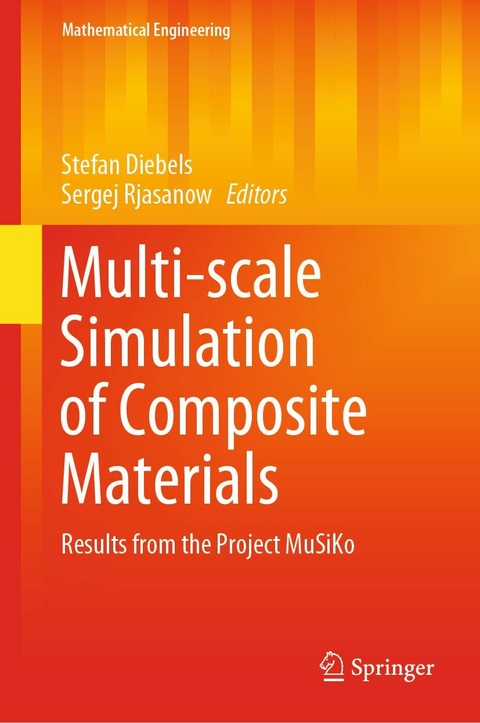
Multi-scale Simulation of Composite Materials (eBook)
VII, 178 Seiten
Springer Berlin Heidelberg (Verlag)
978-3-662-57957-2 (ISBN)
Due to their high stiffness and strength and their good processing properties short fibre reinforced thermoplastics are well-established construction materials.
Up to now, simulation of engineering parts consisting of short fibre reinforced thermoplastics has often been based on macroscopic phenomenological models, but deformations, damage and failure of composite materials strongly depend on their microstructure. The typical modes of failure of short fibre thermoplastics enriched with glass fibres are matrix failure, rupture of fibres and delamination, and pure macroscopic consideration is not sufficient to predict those effects. The typical predictive phenomenological models are complex and only available for very special failures. A quantitative prediction on how failure will change depending on the content and orientation of the fibres is generally not possible, and the direct involvement of the above effects in a numerical simulation requires multi-scale modelling.
One the one hand, this makes it possible to take into account the properties of the matrix material and the fibre material, the microstructure of the composite in terms of fibre content, fibre orientation and shape as well as the properties of the interface between fibres and matrix. On the other hand, the multi-scale approach links these local properties to the global behaviour and forms the basis for the dimensioning and design of engineering components. Furthermore, multi-scale numerical simulations are required to allow efficient solution of the models when investigating three-dimensional problems of dimensioning engineering parts.
Bringing together mathematical modelling, materials mechanics, numerical methods and experimental engineering, this book provides a unique overview of multi-scale modelling approaches, multi-scale simulations and experimental investigations of short fibre reinforced thermoplastics. The first chapters focus on two principal subjects: the mathematical and mechanical models governing composite properties and damage description. The subsequent chapters present numerical algorithms based on the Finite Element Method and the Boundary Element Method, both of which make explicit use of the composite's microstructure. Further, the results of the numerical simulations are shown and compared to experimental results.Lastly, the book investigates deformation and failure of composite materials experimentally, explaining the applied methods and presenting the results for different volume fractions of fibres.
This book is a valuable resource for applied mathematics, theoretical and experimental mechanical engineers as well as engineers in industry dealing with modelling and simulation of short fibre reinforced composites.
The authors of the book as well as both editors are closely working together in a team within the subsidy program ,,Mathematik für Innovationen in Industrie und Dienstleistungen' of the German 'Bundesministerium für Bildung und Forschung'. Each of the five academic group leaders have a distinguished record in research and a series of successful grants. The authors from the German industry are experts in their fields and both have a big experience with cooperation between industry, mechanics and applied mathematics.
The authors of the book as well as both editors are closely working together in a team within the subsidy program ,,Mathematik für Innovationen in Industrie und Dienstleistungen“ of the German „Bundesministerium für Bildung und Forschung“. Each of the five academic group leaders have a distinguished record in research and a series of successful grants. The authors from the German industry are experts in their fields and both have a big experience with cooperation between industry, mechanics and applied mathematics.
Introduction.- Multi-scale Methods in Simulation - a Path to a Better Understanding of the Behaviour of Structures.- Microstructure Simulation for Short Fiber Reinforced Materials.- Parallel Inelastic Heterogeneous Multi-scale Simulations.- Fast Boundary Element Methods for Composite Materials.- Experimental Studies.
| Erscheint lt. Verlag | 1.2.2019 |
|---|---|
| Reihe/Serie | Mathematical Engineering | Mathematical Engineering |
| Zusatzinfo | VII, 178 p. 119 illus., 101 illus. in color. |
| Verlagsort | Berlin |
| Sprache | englisch |
| Themenwelt | Mathematik / Informatik ► Informatik |
| Naturwissenschaften ► Physik / Astronomie | |
| Technik ► Maschinenbau | |
| Schlagworte | boundary element methods • composite materials • Damage and failure • Experimental studies of mechanical properties • Finite Element Methods • multiscale simulation |
| ISBN-10 | 3-662-57957-X / 366257957X |
| ISBN-13 | 978-3-662-57957-2 / 9783662579572 |
| Informationen gemäß Produktsicherheitsverordnung (GPSR) | |
| Haben Sie eine Frage zum Produkt? |
 PDF (Wasserzeichen)
DRM: Digitales Wasserzeichen
Dieses eBook enthält ein digitales Wasserzeichen und ist damit für Sie personalisiert. Bei einer missbräuchlichen Weitergabe des eBooks an Dritte ist eine Rückverfolgung an die Quelle möglich.
Dateiformat: PDF (Portable Document Format)
Mit einem festen Seitenlayout eignet sich die PDF besonders für Fachbücher mit Spalten, Tabellen und Abbildungen. Eine PDF kann auf fast allen Geräten angezeigt werden, ist aber für kleine Displays (Smartphone, eReader) nur eingeschränkt geeignet.
Systemvoraussetzungen:
PC/Mac: Mit einem PC oder Mac können Sie dieses eBook lesen. Sie benötigen dafür einen PDF-Viewer - z.B. den Adobe Reader oder Adobe Digital Editions.
eReader: Dieses eBook kann mit (fast) allen eBook-Readern gelesen werden. Mit dem amazon-Kindle ist es aber nicht kompatibel.
Smartphone/Tablet: Egal ob Apple oder Android, dieses eBook können Sie lesen. Sie benötigen dafür einen PDF-Viewer - z.B. die kostenlose Adobe Digital Editions-App.
Buying eBooks from abroad
For tax law reasons we can sell eBooks just within Germany and Switzerland. Regrettably we cannot fulfill eBook-orders from other countries.
aus dem Bereich