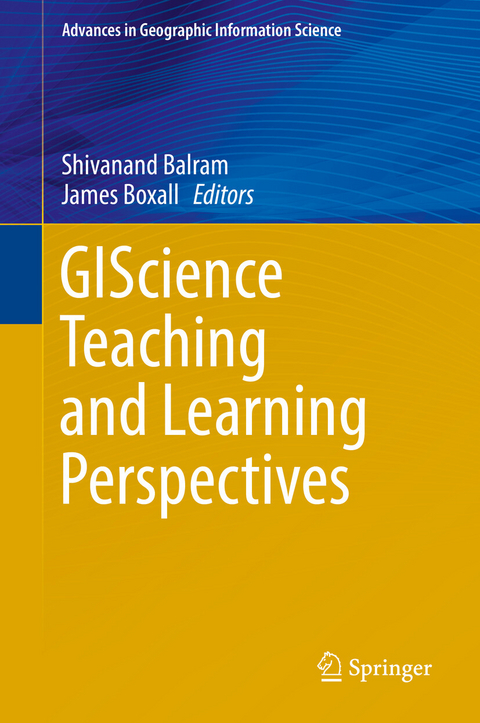
GIScience Teaching and Learning Perspectives (eBook)
XV, 200 Seiten
Springer International Publishing (Verlag)
978-3-030-06058-9 (ISBN)
University teaching and service have always been tightly interconnected aspects for Shivanand Balram. Since his undergraduate studies he has been continuously active in all aspects of university teaching and service in various capacities. He has an undergraduate degree in Physics (solar energy applications), a Masters degree in GIS and Remote Sensing (medical geography), and a PhD degree in Geography (GIS and Environmental Modelling) together with more than twenty years of university teaching experience. In chronological order, he was: Instructor for High School Physics Students, University Lecturer in Physics, GIS Consultant for a US$ 3M training program for government agencies, Urban GIS consultant for a US$10M Inter-American Development Bank urban renewal program, Online course instructor, MOOC course instructor, and currently serves as a Senior Lecturer of Spatial and Geographic Information Science. Through a number of grants from internal and external sources for the last 5 years, he has completed three projects dealing with blended learning, learning outcomes, and video learning objects within a Scholarship of Teaching and Learning (SoTL) investigation framework. He has contributed to the profession through peer-reviewed publications, manuscript reviews, conference organization, specialized committees of professional organizations, and graduate student supervisory committees.
James Boxall is first and foremost an educator. He teaches geography and GIS at Dalhousie University where holds appointments in Marine Affairs, Planning, Earth Sciences and Information management. His current position is as The Geographer in the GIS Centre at Dalhousie. He was on the National Science Foundation Review Panel of the Alexandria Digital Geolibrary project, a past-president of the Canadian Cartographic Association, the Association of Canadian Map Libraries and Archives, and the Geomatics Association of Nova Scotia. He is a Governor and Fellow of the Royal Canadian Geographical Society (RCGS) and a member of the Canadian Geographic Education Committee (CGE) and Chairs the Research Grants Committee for RCGS. He received the Society's Education Medal in 2012 for helping to found the CGE of RCGS, and also received the Franklin Expedition Erebus Medal in 2015. He is also a Fellow of the Royal Geographical Society. He is also on Board of Governors of the Nova Scotia Museums. James co-chairs the International Network for Learning and Teaching Geography; is a regional representative on the IGU Commission for Geographical Education; member of the Canadian Committee for International Map Year; and past co-chair of the Canadian Round Table on Geomatics (NRCan) leading the development of GeoAlliance Canada. He was a lead proponent for the Declaration to Enhance Geographic Education in Canada. He sits on the Journal of Map and Geography Libraries review board. His professional passion is geospatial information and oceans.
University teaching and service have always been tightly interconnected aspects for Shivanand Balram. Since his undergraduate studies he has been continuously active in all aspects of university teaching and service in various capacities. He has an undergraduate degree in Physics (solar energy applications), a Masters degree in GIS and Remote Sensing (medical geography), and a PhD degree in Geography (GIS and Environmental Modelling) together with more than twenty years of university teaching experience. In chronological order, he was: Instructor for High School Physics Students, University Lecturer in Physics, GIS Consultant for a US$ 3M training program for government agencies, Urban GIS consultant for a US$10M Inter-American Development Bank urban renewal program, Online course instructor, MOOC course instructor, and currently serves as a Senior Lecturer of Spatial and Geographic Information Science. Through a number of grants from internal and external sources for the last 5 years, he has completed three projects dealing with blended learning, learning outcomes, and video learning objects within a Scholarship of Teaching and Learning (SoTL) investigation framework. He has contributed to the profession through peer-reviewed publications, manuscript reviews, conference organization, specialized committees of professional organizations, and graduate student supervisory committees.James Boxall is first and foremost an educator. He teaches geography and GIS at Dalhousie University where holds appointments in Marine Affairs, Planning, Earth Sciences and Information management. His current position is as The Geographer in the GIS Centre at Dalhousie. He was on the National Science Foundation Review Panel of the Alexandria Digital Geolibrary project, a past-president of the Canadian Cartographic Association, the Association of Canadian Map Libraries and Archives, and the Geomatics Association of Nova Scotia. He is a Governor and Fellow of the Royal Canadian Geographical Society (RCGS) and a member of the Canadian Geographic Education Committee (CGE) and Chairs the Research Grants Committee for RCGS. He received the Society’s Education Medal in 2012 for helping to found the CGE of RCGS, and also received the Franklin Expedition Erebus Medal in 2015. He is also a Fellow of the Royal Geographical Society. He is also on Board of Governors of the Nova Scotia Museums. James co-chairs the International Network for Learning and Teaching Geography; is a regional representative on the IGU Commission for Geographical Education; member of the Canadian Committee for International Map Year; and past co-chair of the Canadian Round Table on Geomatics (NRCan) leading the development of GeoAlliance Canada. He was a lead proponent for the Declaration to Enhance Geographic Education in Canada. He sits on the Journal of Map and Geography Libraries review board. His professional passion is geospatial information and oceans.
Chapter1: Teaching and learning pedagogies in higher education geographic information science.- Chapter2: The evolution and definition of geospatial literacy.- Chapter3: Enabling scientific research skills in undergraduate students during a spatial modeling course.- Chapter4: The AMETHYST program: The NSERC create experience.- Chapter5: "The map is not the territory": Adding value to technical GIS education.- Chapter6: Using an online format to teach graduate-level remote sensing basics.- Chapter7: WebGIS in development: From research and teaching perspectives.- Chapter8: Neogeography: Rethinking participatory mapping and place-based learning in the geoweb age.- Chapter9: Navigating employment prospects for new graduates in the geospatial sciences.- Chapter10: Epilogue: Future of convergence and crisis
| Erscheint lt. Verlag | 31.1.2019 |
|---|---|
| Reihe/Serie | Advances in Geographic Information Science | Advances in Geographic Information Science |
| Zusatzinfo | XV, 200 p. 34 illus., 12 illus. in color. |
| Verlagsort | Cham |
| Sprache | englisch |
| Themenwelt | Informatik ► Theorie / Studium ► Künstliche Intelligenz / Robotik |
| Naturwissenschaften ► Geowissenschaften ► Geografie / Kartografie | |
| Sozialwissenschaften ► Pädagogik | |
| Schlagworte | Geospatial literacy • GIScience • GIS education • Learning and Instruction • neogeography • Participatory Mapping • Remote Sensing • spatial modeling • WebGIS |
| ISBN-10 | 3-030-06058-6 / 3030060586 |
| ISBN-13 | 978-3-030-06058-9 / 9783030060589 |
| Informationen gemäß Produktsicherheitsverordnung (GPSR) | |
| Haben Sie eine Frage zum Produkt? |
 PDF (Wasserzeichen)
DRM: Digitales Wasserzeichen
Dieses eBook enthält ein digitales Wasserzeichen und ist damit für Sie personalisiert. Bei einer missbräuchlichen Weitergabe des eBooks an Dritte ist eine Rückverfolgung an die Quelle möglich.
Dateiformat: PDF (Portable Document Format)
Mit einem festen Seitenlayout eignet sich die PDF besonders für Fachbücher mit Spalten, Tabellen und Abbildungen. Eine PDF kann auf fast allen Geräten angezeigt werden, ist aber für kleine Displays (Smartphone, eReader) nur eingeschränkt geeignet.
Systemvoraussetzungen:
PC/Mac: Mit einem PC oder Mac können Sie dieses eBook lesen. Sie benötigen dafür einen PDF-Viewer - z.B. den Adobe Reader oder Adobe Digital Editions.
eReader: Dieses eBook kann mit (fast) allen eBook-Readern gelesen werden. Mit dem amazon-Kindle ist es aber nicht kompatibel.
Smartphone/Tablet: Egal ob Apple oder Android, dieses eBook können Sie lesen. Sie benötigen dafür einen PDF-Viewer - z.B. die kostenlose Adobe Digital Editions-App.
Buying eBooks from abroad
For tax law reasons we can sell eBooks just within Germany and Switzerland. Regrettably we cannot fulfill eBook-orders from other countries.
aus dem Bereich