


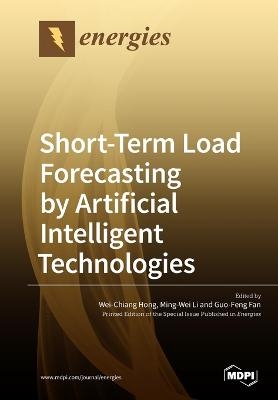
Short-Term Load Forecasting by Artificial Intelligent Technologies
Seiten
2019
MDPI (Verlag)
9783038975823 (ISBN)
MDPI (Verlag)
9783038975823 (ISBN)
- Keine Verlagsinformationen verfügbar
- Artikel merken
In last few decades, short-term load forecasting (STLF) has been one of the most important research issues for achieving higher efficiency and reliability in power system operation, to facilitate the minimization of its operation cost by providing accurate input to day-ahead scheduling, contingency analysis, load flow analysis, planning, and maintenance of power systems. There are lots of forecasting models proposed for STLF, including traditional statistical models (such as ARIMA, SARIMA, ARMAX, multi-variate regression, Kalman filter, exponential smoothing, and so on) and artificial-intelligence-based models (such as artificial neural networks (ANNs), knowledge-based expert systems, fuzzy theory and fuzzy inference systems, evolutionary computation models, support vector regression, and so on).
Recently, due to the great development of evolutionary algorithms (EA) and novel computing concepts (e.g., quantum computing concepts, chaotic mapping functions, and cloud mapping process, and so on), many advanced hybrids with those artificial-intelligence-based models are also proposed to achieve satisfactory forecasting accuracy levels. In addition, combining some superior mechanisms with an existing model could empower that model to solve problems it could not deal with before; for example, the seasonal mechanism from the ARIMA model is a good component to be combined with any forecasting models to help them to deal with seasonal problems.
Recently, due to the great development of evolutionary algorithms (EA) and novel computing concepts (e.g., quantum computing concepts, chaotic mapping functions, and cloud mapping process, and so on), many advanced hybrids with those artificial-intelligence-based models are also proposed to achieve satisfactory forecasting accuracy levels. In addition, combining some superior mechanisms with an existing model could empower that model to solve problems it could not deal with before; for example, the seasonal mechanism from the ARIMA model is a good component to be combined with any forecasting models to help them to deal with seasonal problems.
School of Computer Science and Technology, Jiangsu Normal University, China.
College of Shipbuilding Engineering, Harbin Engineering University, China.
College of Mathematics & Information Science, PingDingShan University, China.
| Erscheinungsdatum | 05.03.2022 |
|---|---|
| Mitarbeit |
Gast Herausgeber: Wei-Chiang Hong, Ming-Wei Li, Guo-Feng Fan |
| Verlagsort | Basel |
| Sprache | englisch |
| Maße | 170 x 244 mm |
| Themenwelt | Informatik ► Theorie / Studium ► Algorithmen |
| Informatik ► Theorie / Studium ► Künstliche Intelligenz / Robotik | |
| Technik | |
| Schlagworte | artificial neural networks (ANNs) • evolutionary algorithms • knowledge-based expert systems • Meta-heuristic Algorithms • novel intelligent technologies • seasonal mechanism • Short Term Load Forecasting • statistical forecasting models • support vector regression/support vector machines |
| ISBN-13 | 9783038975823 / 9783038975823 |
| Zustand | Neuware |
| Informationen gemäß Produktsicherheitsverordnung (GPSR) | |
| Haben Sie eine Frage zum Produkt? |
Mehr entdecken
aus dem Bereich


aus dem Bereich
Buch | Softcover (2025)
Lehmanns Media (Verlag)
CHF 62,95
die Welt der generativen KI verstehen
Buch | Hardcover (2025)
Hanser (Verlag)
CHF 48,95
IT zum Anfassen für alle von 9 bis 99 – vom Navi bis Social Media
Buch | Softcover (2021)
Springer (Verlag)
CHF 46,15


