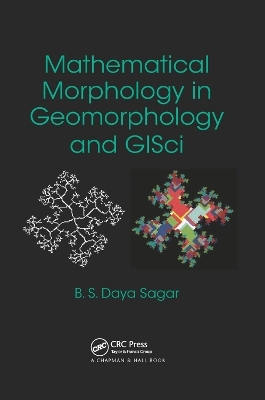
Mathematical Morphology in Geomorphology and GISci
CRC Press (Verlag)
978-1-138-37459-1 (ISBN)
For understanding the spatiotemporal characteristics of terrestrial phenomena and processes, the author provides morphological approaches and algorithms to:
Retrieve unique geomorphologic networks and certain terrestrial features
Analyze various geomorphological phenomena and processes via a host of scaling laws and the scale-invariant but shape-dependent indices
Simulate the fractal-skeletal-based channel network model and the behavioral phases of geomorphologic systems based on the interplay between numeric and graphic analyses
Detect strategically significant sets and directional relationships via quantitative spatial reasoning
Visualize spatiotemporal behavior and generate contiguous maps via spatial interpolation
Incorporating peer-reviewed content, this book offers simple explanations that enable readers—even those with no background in mathematical morphology—to understand the material. It also includes easy-to-follow equations and many helpful illustrations that encourage readers to implement the ideas.
B.S. Daya Sagar is an associate professor at the Indian Statistical Institute, Bangalore, where he is also the founding head of the Systems Science and Informatics Unit. He has written more than 80 papers and is the editor of Discrete Dynamics in Nature and Society: Multidisciplinary Research and Review Journal. Dr. Sagar is a senior member of the IEEE Geoscience and Remote Sensing Society; a member of the New York Academy of Sciences, American Geophysical Union, International Association for Mathematical Geosciences, and Association for Computing Machinery; and a fellow of the Royal Geographical Society and Indian Geophysical Union. He has been a recipient of several honors, including the Georges Matheron Award from the International Association for Mathematical Geosciences. His research interests include mathematical morphology and fractal geometry and their applications to terrestrial surface and associated features as well as geomorphologic information retrieval, quantitative geomorphometry, allometry, granulometry, scaling analysis, quantitative spatial reasoning, and spatiotemporal modeling.
Introduction. Mathematical Morphology: An Introduction. Simulated, Realistic Digital Elevation Models, Digital Bathymetric Maps, Remotely Sensed Data, and Thematic Maps. Feature Extraction. Terrestrial Surface Characterization: A Quantitative Perspective. Size Distributions, Spatial Heterogeneity, and Scaling Laws. Morphological Shape Decomposition: Scale-Invariant but Shape-Dependent Measures. Granulometries, Convexity Measures, and Geodesic Spectrum for DEM Analyses. Synthetic Examples to Understand Spatiotemporal Dynamics of Certain Geo(morpho)logical Processes. Quantitative Spatial Relationships and Spatial Reasoning. Derivation of Spatially Significant Zones from a Cluster. Directional Spatial Relationship. "Between" Space. Spatial Interpolations. Index.
| Erscheinungsdatum | 21.01.2019 |
|---|---|
| Zusatzinfo | 56 Tables, black and white; 216 Illustrations, black and white |
| Verlagsort | London |
| Sprache | englisch |
| Maße | 156 x 234 mm |
| Gewicht | 1010 g |
| Themenwelt | Mathematik / Informatik ► Mathematik |
| Naturwissenschaften ► Biologie | |
| Naturwissenschaften ► Geowissenschaften ► Geografie / Kartografie | |
| Naturwissenschaften ► Geowissenschaften ► Geologie | |
| Technik ► Umwelttechnik / Biotechnologie | |
| ISBN-10 | 1-138-37459-8 / 1138374598 |
| ISBN-13 | 978-1-138-37459-1 / 9781138374591 |
| Zustand | Neuware |
| Informationen gemäß Produktsicherheitsverordnung (GPSR) | |
| Haben Sie eine Frage zum Produkt? |
aus dem Bereich