


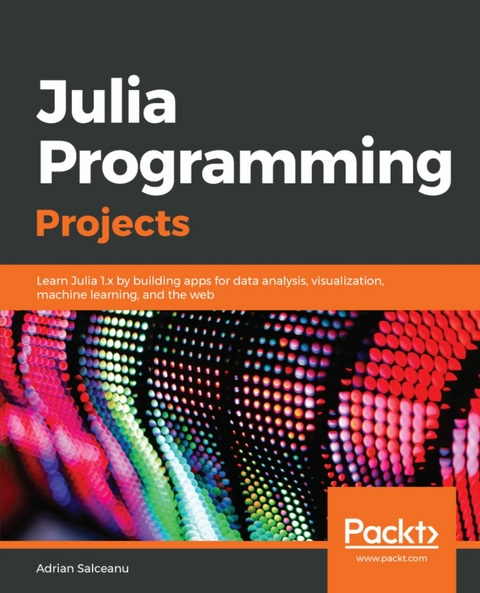
Julia Programming Projects (eBook)
500 Seiten
Packt Publishing (Verlag)
978-1-78829-725-7 (ISBN)
Julia is a new programming language that offers a unique combination of performance and productivity. Its powerful features, friendly syntax, and speed are attracting a growing number of adopters from Python, R, and Matlab, effectively raising the bar for modern general and scientific computing.
After six years in the making, Julia has reached version 1.0. Now is the perfect time to learn it, due to its large-scale adoption across a wide range of domains, including fintech, biotech, education, and AI.
Beginning with an introduction to the language, Julia Programming Projects goes on to illustrate how to analyze the Iris dataset using DataFrames. You will explore functions and the type system, methods, and multiple dispatch while building a web scraper and a web app. Next, you'll delve into machine learning, where you'll build a books recommender system. You will also see how to apply unsupervised machine learning to perform clustering on the San Francisco business database. After metaprogramming, the final chapters will discuss dates and time, time series analysis, visualization, and forecasting.
We'll close with package development, documenting, testing and benchmarking.
By the end of the book, you will have gained the practical knowledge to build real-world applications in Julia.
A step-by-step guide that demonstrates how to build simple-to-advanced applications through examples in Julia Lang 1.x using modern toolsKey FeaturesWork with powerful open-source libraries for data wrangling, analysis, and visualizationDevelop full-featured, full-stack web applications Learn to perform supervised and unsupervised machine learning and time series analysis with JuliaBook DescriptionJulia is a new programming language that offers a unique combination of performance and productivity. Its powerful features, friendly syntax, and speed are attracting a growing number of adopters from Python, R, and Matlab, effectively raising the bar for modern general and scientific computing.After six years in the making, Julia has reached version 1.0. Now is the perfect time to learn it, due to its large-scale adoption across a wide range of domains, including fintech, biotech, education, and AI.Beginning with an introduction to the language, Julia Programming Projects goes on to illustrate how to analyze the Iris dataset using DataFrames. You will explore functions and the type system, methods, and multiple dispatch while building a web scraper and a web app. Next, you'll delve into machine learning, where you'll build a books recommender system. You will also see how to apply unsupervised machine learning to perform clustering on the San Francisco business database. After metaprogramming, the final chapters will discuss dates and time, time series analysis, visualization, and forecasting.We'll close with package development, documenting, testing and benchmarking.By the end of the book, you will have gained the practical knowledge to build real-world applications in Julia.What you will learnLeverage Julia's strengths, its top packages, and main IDE optionsAnalyze and manipulate datasets using Julia and DataFramesWrite complex code while building real-life Julia applicationsDevelop and run a web app using Julia and the HTTP packageBuild a recommender system using supervised machine learning Perform exploratory data analysis Apply unsupervised machine learning algorithmsPerform time series data analysis, visualization, and forecastingWho this book is forData scientists, statisticians, business analysts, and developers who are interested in learning how to use Julia to crunch numbers, analyze data and build apps will find this book useful. A basic knowledge of programming is assumed.
| Erscheint lt. Verlag | 26.12.2018 |
|---|---|
| Sprache | englisch |
| Themenwelt | Mathematik / Informatik ► Informatik ► Programmiersprachen / -werkzeuge |
| ISBN-10 | 1-78829-725-3 / 1788297253 |
| ISBN-13 | 978-1-78829-725-7 / 9781788297257 |
| Informationen gemäß Produktsicherheitsverordnung (GPSR) | |
| Haben Sie eine Frage zum Produkt? |
 EPUB (Ohne DRM)
Digital Rights Management: ohne DRM
Dieses eBook enthält kein DRM oder Kopierschutz. Eine Weitergabe an Dritte ist jedoch rechtlich nicht zulässig, weil Sie beim Kauf nur die Rechte an der persönlichen Nutzung erwerben.
Dateiformat: EPUB (Electronic Publication)
EPUB ist ein offener Standard für eBooks und eignet sich besonders zur Darstellung von Belletristik und Sachbüchern. Der Fließtext wird dynamisch an die Display- und Schriftgröße angepasst. Auch für mobile Lesegeräte ist EPUB daher gut geeignet.
Systemvoraussetzungen:
PC/Mac: Mit einem PC oder Mac können Sie dieses eBook lesen. Sie benötigen dafür die kostenlose Software Adobe Digital Editions.
eReader: Dieses eBook kann mit (fast) allen eBook-Readern gelesen werden. Mit dem amazon-Kindle ist es aber nicht kompatibel.
Smartphone/Tablet: Egal ob Apple oder Android, dieses eBook können Sie lesen. Sie benötigen dafür eine kostenlose App.
Geräteliste und zusätzliche Hinweise
Buying eBooks from abroad
For tax law reasons we can sell eBooks just within Germany and Switzerland. Regrettably we cannot fulfill eBook-orders from other countries.
aus dem Bereich


