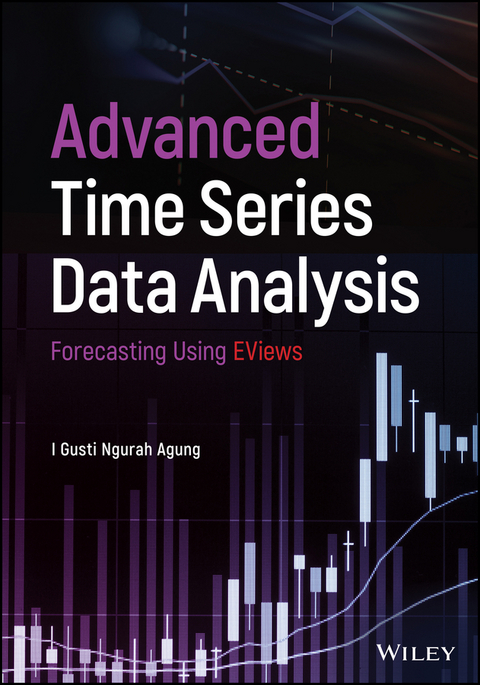
Advanced Time Series Data Analysis (eBook)
John Wiley & Sons (Verlag)
978-1-119-50474-0 (ISBN)
Introduces the latest developments in forecasting in advanced quantitative data analysis
This book presents advanced univariate multiple regressions, which can directly be used to forecast their dependent variables, evaluate their in-sample forecast values, and compute forecast values beyond the sample period. Various alternative multiple regressions models are presented based on a single time series, bivariate, and triple time-series, which are developed by taking into account specific growth patterns of each dependent variables, starting with the simplest model up to the most advanced model. Graphs of the observed scores and the forecast evaluation of each of the models are offered to show the worst and the best forecast models among each set of the models of a specific independent variable.
Advanced Time Series Data Analysis: Forecasting Using EViews provides readers with a number of modern, advanced forecast models not featured in any other book. They include various interaction models, models with alternative trends (including the models with heterogeneous trends), and complete heterogeneous models for monthly time series, quarterly time series, and annually time series. Each of the models can be applied by all quantitative researchers.
- Presents models that are all classroom tested
- Contains real-life data samples
- Contains over 350 equation specifications of various time series models
- Contains over 200 illustrative examples with special notes and comments
- Applicable for time series data of all quantitative studies
Advanced Time Series Data Analysis: Forecasting Using EViews will appeal to researchers and practitioners in forecasting models, as well as those studying quantitative data analysis. It is suitable for those wishing to obtain a better knowledge and understanding on forecasting, specifically the uncertainty of forecast values.
I. Gusti Ngurah Agung, PhD, has been an advisor at the Ary Suta Center, Jakarta since 2008. He recently retired from his position as a lecturer at the Graduate School of Management, University of Indonesia. In addition to teaching and being an academic advisor, he has served as independent consultant for various institutions, such as the World Bank, UNFPA, ADB, USAID, and the Rand Corporation. He is the author of several statistical textbooks and research papers in the area of statistics and management. His area of interest is in statistical analysis based on censored data, multiple regression analysis, multivariate statistical analysis, and sociodemographic development.
I. Gusti Ngurah Agung, PhD, has been an advisor at the Ary Suta Center, Jakarta since 2008. He recently retired from his position as a lecturer at the Graduate School of Management, University of Indonesia. In addition to teaching and being an academic advisor, he has served as independent consultant for various institutions, such as the World Bank, UNFPA, ADB, USAID, and the Rand Corporation. He is the author of several statistical textbooks and research papers in the area of statistics and management. His area of interest is in statistical analysis based on censored data, multiple regression analysis, multivariate statistical analysis, and sociodemographic development.
Preface
It is well‐known that forecasting is one of the best inputs for decision‐making. However, we never know what type of model gives a perfect forecast values beyond the sample period, since there are a lot of possible models that can be developed to forecast any selected endogenous time series that are acceptable in the statistical sense. In addition, in‐sample forecast values are highly dependent on the data that happens to be selected by or available to researchers.
This book presents many alternative multiple regression models of a monthly, quarterly, and annual endogenous time series with specific growth patterns, starting with the simplest up to the most advanced time series models so that those models can show their differential in‐sample forecast values of the endogenous variable. Hence, the main objectives of this book are to present (i) various general specific equation of forecast models, which in fact are multiple time series regression models; (ii) various illustrative statistical results based on selected specific equations, with special notes and comments; and (iii) comparative studies between a set of special type of models using the same set of variables, such as additive models, interaction models, and heterogeneous regression models, without trend and with various alternative trends. The best possible fit forecasting model of an endogenous time series, in the statistical sense, is presented based on alternative specific growth cures of the time series. Furthermore, as a comparison, several alternative models of the same endogenous time series are also presented with illustrative examples.
EViews provides the object/option “Forecast,” which can directly be used to conduct the forecasting, while the estimate of a regression of a time series appears on the screen. I am very confident that all regressions of a time series presented in various books, such as Agung (2009a), Gujarati (2003), Wooldridge (2002), Tsay (2002), Hankle and Reitch (1992), and Wilson and Keating (1994), as well as presented in various journals, could be used to forecast their dependent variables. This book mainly presents forecasting data analysis based on various interaction models, such as the lag‐variable models: LV(1) models, based on a single time series, say Y t , bivariate (X t ,Y t ) or (Y1 t ,Y2 t ), and triple time series (X1 t ,X2 t ,Y t ) or (Y1 t ,Y2 t ,Y2 t ), since it is found that Y t‐1 = Y(−1) is the best predictor for all‐time series, Y t.. In addition, those models are extended to lag‐variable‐autoregressive‐moving‐average models: LVARMA(p,q,r) for non‐negative integers p ≥ 1, q ≥ 0, and r ≥ 0, which should be selected using the trial‐and‐error method in order to obtain acceptable in‐sample forecasting values. Over 350 general equation specifications of various models, with over 200 illustrative examples of the statistical results of specific models based on the same set of variables are presented, with special notes and comments so that the readers can be well informed on the limitations of a model compared to others in the set. Aside from the good fit forecast models, worse unexpected forecast models are also presented.
The models presented in this book in fact are the extension of my first book: Time Series Data Analysis Using EViews (Agung 2009a). The models also can be considered as modifications of the panel data models presented in the first part of Agung (2014). For this reason, it is recommended that readers also use the models in those books to conduct forecasting using their own data sets.
This book contains seven chapters. Chapter 1 presents various alternative models of a single monthly time series Y t , with a specific growth curve, namely a systematic growth curves by @Year, such as basic and special LV(p), LVAR(p,q), ARMA(q,r), and TGARCH(a,b,c) models with illustrative examples of the statistical results based on selected models. This chapter also presents residual analysis with special notes and comments, such as the BPG Heteroskedasticity Test, the Harvey Test, and Glejser Test, the White Heteroskedasticity Tests, the ARCH Heteroskedasticity Tests, Custom Test Wizard, the Homogeneity test, and the Breusch–Godfrey Serial Correlation LM Test. In addition, this chapter discusses the application of the White and the HAC (Newey–West) Covariances.
Chapter 2 presents various models based on a monthly time series using three possible time predictors, such as @Month, @Year, and the time variable t = @Trend or t = @Trend + 1, as the extension of all models presented in Chapter 1. Special LV(12) interaction models are presented, as in the first part of this chapter, to demonstrate heterogeneous regressions models by @Year and alternative testing hypotheses, such as the Omitted Variables Test () and Redundant Variables Test (). In addition, alternative heterogeneous classical growth models are also presented along with the reduced heterogeneous regression models, alternative ANCOVA models, and fixed‐effects models, with special notes and comments.
Chapter 3 presents alternative continuous forecast models. As the simplest model presented is a two‐way interaction LV(1) model with “Y C Y(‐1) t t*Y1(‐1)” as its equation specification. In practice, however, based on a data set, there are four alternative reduced models that can be obtained as a good fit. Then each of those models could be extended to the lag‐variable‐autoregressive‐moving‐average: LVARMA(p,g,r) models for various integers p ≥ 1, q ≥ 0, and r ≥ 0, and models with alternative time variables. In addition, this chapter also presents translog‐linear models with linear trend or logarithmic trend, translog interaction models, and alternative non‐linear models.
Chapter 4 presents various models based on bivariate time series (X t ,Y t ) and (Y1 t ,Y2 t ) as the extension or modification of each model presented in previous chapters, depending on the growth patterns of the endogenous variables. Two of the simplest LV(1) two‐way interaction models with the equation specifications “Y C Y(‐1) X(‐1) Y(‐1)*X(‐1)” and “Y C Y(‐1) X Y(‐1)*X” are presented as the preliminary models. Then each of these can easily be modified to more advanced models, such as LVARMA(p,q,r) of LNY = log(Y) or LNYul = log((U_L)/(U‐Y), those with alternative trends that are presented in Table , and heterogeneous regression models by @Year or @Month, as presented in previous chapters. The application of the object VAR is also presented. In addition, based on (Y1 t ,Y2 t ) six two‐way‐interaction lag‐variables models are presented, namely TWI_LVM(p1,p2) where four of them are reciprocal causal effect models (). Finally, this chapter also presents special notes and comments, referring to unbelievable and unexpected statistical results.
Chapter 5 presents various models based on triple time series (X1 t ,X2 t ,Y t ) and (Y1 t ,Y2 t ,Y3 t ) as the extension or modification of each model presented in Chapter 4. Initially, a set of four translog‐linear LV(1) models are presented, depending on the growth patterns of the endogenous variables. Then each of the translog‐linear models can be extended to LVARMA(p,g,r), those with alternative trends, and heterogeneous regression models. As a comparative study, the same translog‐linear models are presented based on (X1 t ,X2 t ,Y1 t ) and (X1 t ,X2 t ,Y2 t ) with Y1 and Y2 having different growth patterns. Then various two‐way and three‐way interaction models are also presented using the original time series. Furthermore, various special sets of triangular and circular effects multivariate lag‐variables models are presented based on (Y1 t ,Y2 t ,Y3 t ), such as additive, two‐ and three‐way interaction models, as the alternative applications of the objects VAR and System. Finally, referring to a lot of possible models based on the monthly time series, it is important to consider special notes by Tukey (1962) and Bezzecri (1973 in Gifi, 1991).
Chapter 6 presents various models based on a quarterly time series. In fact, all models presented in the previous five chapters can easily be applied for a quarterly time series, conditional on the growth curve of an endogenous time series. However, note that all models with the time variable @Month as an independent...
| Erscheint lt. Verlag | 31.12.2018 |
|---|---|
| Sprache | englisch |
| Themenwelt | Mathematik / Informatik ► Mathematik ► Statistik |
| Mathematik / Informatik ► Mathematik ► Wahrscheinlichkeit / Kombinatorik | |
| Schlagworte | Bayesian forecast models • Business Forecasting • continuous forecast models • Econometrics • economic forecasting • Economics • finance forecasting • Finanz- u. Wirtschaftsstatistik • forecasting annually time series • forecasting based on balanced panel data</p> • forecasting based on time series by states • forecasting monthly time series • forecasting quarterly time series • forecasting using EViews • forecasting with alternative time predictors • forecast models • forecast values beyond the sample period • heterogeneous forecast models • in-sample forecast values • <p>advanced time series data analysis • Ökonometrie • public-health forecasting • Statistics • Statistics for Finance, Business & Economics • Statistik • system equation forecast models • Time Series • VAR forecast models • VEC forecast models • Volkswirtschaftslehre • Zeitreihen • Zeitreihenanalyse |
| ISBN-10 | 1-119-50474-0 / 1119504740 |
| ISBN-13 | 978-1-119-50474-0 / 9781119504740 |
| Informationen gemäß Produktsicherheitsverordnung (GPSR) | |
| Haben Sie eine Frage zum Produkt? |
 EPUB (Adobe DRM)
Kopierschutz: Adobe-DRM
Adobe-DRM ist ein Kopierschutz, der das eBook vor Mißbrauch schützen soll. Dabei wird das eBook bereits beim Download auf Ihre persönliche Adobe-ID autorisiert. Lesen können Sie das eBook dann nur auf den Geräten, welche ebenfalls auf Ihre Adobe-ID registriert sind.
Details zum Adobe-DRM
Dateiformat: EPUB (Electronic Publication)
EPUB ist ein offener Standard für eBooks und eignet sich besonders zur Darstellung von Belletristik und Sachbüchern. Der Fließtext wird dynamisch an die Display- und Schriftgröße angepasst. Auch für mobile Lesegeräte ist EPUB daher gut geeignet.
Systemvoraussetzungen:
PC/Mac: Mit einem PC oder Mac können Sie dieses eBook lesen. Sie benötigen eine
eReader: Dieses eBook kann mit (fast) allen eBook-Readern gelesen werden. Mit dem amazon-Kindle ist es aber nicht kompatibel.
Smartphone/Tablet: Egal ob Apple oder Android, dieses eBook können Sie lesen. Sie benötigen eine
Geräteliste und zusätzliche Hinweise
Buying eBooks from abroad
For tax law reasons we can sell eBooks just within Germany and Switzerland. Regrettably we cannot fulfill eBook-orders from other countries.
aus dem Bereich