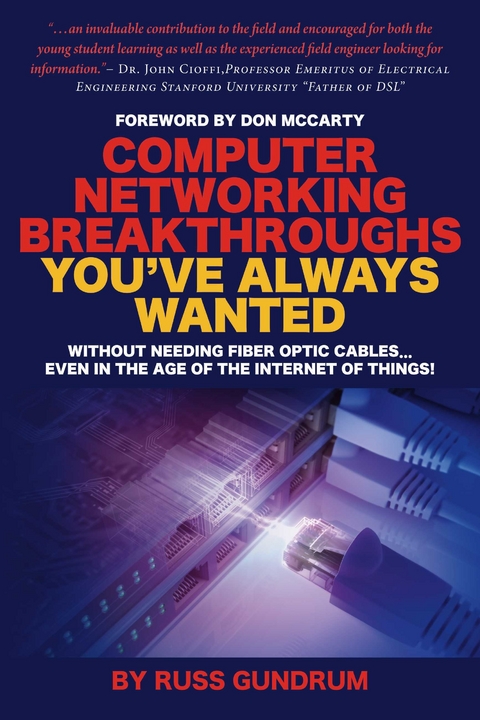
Computer Networking Breakthroughs You've Always Wanted (eBook)
384 Seiten
Bookbaby (Verlag)
978-1-5439-5405-0 (ISBN)
Unlike any other book in the world, this book discloses important, new information in the computer networking field that has never been brought to your attention! The technical facts of many problems affecting telecommunication and computer networks haven't changed since the author wrote his first book on the subject in 1982, but the equipment and network applications sure have, along with their solutions. And there's a whole new generation of engineers, managers, and technicians who aren't familiar with the past development and history of these networks, but who could benefit greatly from that knowledge. This is especially the case in the local area networking (LAN) environment and the backhaul networks that are being used to provide Wi-Fi and 5G wireless access. It's the author's sincere hope and desire that what the reader discovers in this book will be very helpful in designing, installing, and maintaining very cost-effective, reliable, and high-performance computer and telecom networks. This kind of information is especially needed in the age of the Internet of Things, as well as understanding that you don't have to use fiber optic cables in order to achieve these successful results! Understanding all the issues affecting the performance and reliability of high-speed computer and telecom wireline networks Being able to quickly identify potential service-affecting problems and correct them before the customer or user experiences them Explaining in simple terms to your boss, customer, or other technical personnel why certain "e;mysterious"e; and strange things can occur in the operation of a network application and how equipment can also be damaged as a result Being aware of what can cause an unhappy customer experience that could lead to them lodging a complaint or even seeking another service provider out of frustration Learning how to prevent lost revenue, wasted work hours spent on unproductive efforts, and other ineffective measures from occurring Realizing that the solutions to these problems aren't rocket science and aren't being taught anymore, which is why you need to read this book since there's not another one like it on the subject!
Chapter 1
That Antiquated and Obsolete Copper Network…Really?
I hope this provocative chapter title helps to capture the intent of this book and to make you understand that this original network infrastructure that was designed for voice communications over a hundred years ago is still just as resilient and viable a transmission medium for the high bandwidth data circuits of the twenty-first century. I may be one of the few people left to be concerned about copper facilities, because most people are either talking about 5G cellular and/or fiber, and very few seem to care about the wireline world anymore. I’m certainly not against either of these great networking technologies, and even have a chapter devoted to not just 5G, but its big competitor, Wi-Fi.
“I may be one of the few people left to be concerned about copper facilities…”
You may be reading this book because you’re in computer networking and wondering about the breakthroughs you’ve always wanted to know about. Well I’ll go ahead and give you the main breakthrough now, because it will be discussed throughout the book: the Induction Neutralizing Transformer or INT. Bet you’ve never heard of it, have you? Although the INT was developed back in the early 1970s for the telecommunications industry, most people in this industry aren’t familiar with the INT either! But it’s still needed more than ever in today’s telecom and computer networks, so this book is the story of the INT – a long misunderstood and virtually unknown technology – and my journey with it throughout my professional career.
So Why the Focus on Computer Networking?
I considered naming this book after my consulting company, because so many people ask me what kind of telecom problems I solve. But I knew the story was much bigger than just the telecom industry, like the “Bellhead vs. Nethead”2 discussion back in the late twentieth-century, which I’ve been telling my advanced computer networking students at the University of Houston about since 2007. Incidentally, the Netheads, or the information technology (IT) folks, won that battle in the end. And the new buzz word in the industry is information communications technology (ICT), which more accurately reflects what is taking place in the convergence of the two technologies.
Dan Poynter, author of Writing Nonfiction…Turning Thoughts into Books, said the first word in the title was the most important and should reflect the subject of the book. The more I thought about it, especially in the age of the Internet of Things, the word computer is more accurate than telecom to best describe the main usage of today’s network. The subject matter really is about computer networking and what we in the telecom industry have learned over the years that can help these networks achieve higher performance and reliability.
The First Book
When I wrote my first book in 1982 for Lee’s abc of the Telephone—Power Line Interference; Problems and Solutions, hereinafter referenced simply as the abc book—I was accused of writing it just to build a case for the INT. Even the publisher had concerns, so I restructured it to avoid coming out too strong in that regard, even though I can’t deny that was my strategy!
Basically the approach was the same as I had for my infamous three-day seminars that I conducted throughout the world in the 1980s (discussed in chapter 10).
I began each seminar with some history of how the physics hadn’t changed in over a one hundred years, what the interference problem now looked like in today’s environment, and how we had gotten to this point in the industry. I’d then describe mitigation philosophy in general and discuss many standard techniques the telecom industry employed that fell in that category, but that didn’t have the same kind of negative connotations as the INT. I’d then get into the details of power interference parameters, explaining how the power system operates and why there’s only so much power engineers can reasonably be expected to do to help solve the problem. This parameter usually took up the first day of the seminar and, by the end of the day, telephone people were usually tired of hearing about this part of the story. They just wanted to know what it was going to take to solve the problem. But I did give them one successful mitigative technique in this section: the Harmonic Suppression Reactor (HSR), which is the topic of the next chapter in my abc book.
SNC Surge Protection Ad Circa 1980
The next day, just like in the book, I’d talk about the coupling parameters of the problem, and why if you’re going to solve the problem here, you’ve got to do it initially in the engineering design stages or you’re going to have to live with the problem after the fact. There is only so much a telephone company Outside Plant Engineer (OSPE) could reasonably be expected to do about coupling, because both utilities serve the same customers and you usually have a paralleling situation with both of their facilities. However, today, an INT could be designed initially into the cable to take care of any potential inductive interference problem.
I’d also explain how the coupling parameter is very dependent on the earth resistivity of the area being served. I’d spend a lot of time trying to make people understand this part of the story, because earth resistivity can’t be changed by anything humans can do. And, the higher the resistivity, the worse the induction! I’d also point out how earth resistivity is not the same thing as ground resistance, because all telephone people know the importance of having a low ground resistance. I wish I had the fortune the industry mistakenly spent on ground rods while trying to solve the AC induction problem this way, when in some cases, they could actually be making the situation worse!
“…wish I had the fortune the industry mistakenly spent on ground rods while trying to solve the AC induction problem…”
Then I’d talk about the importance of cable shielding, and the much-misunderstood subject of bonding and grounding of the cable’s sheath. Most everyone believes poor sheath conditions is why they have the interference problem and that they should concentrate their efforts there to solve it. This myopic focus is still such a myth even to this day, and countless hours have literally been wasted trying to solve the problem this way.
By the end of the second day I’d get into the third parameter needed for an interference problem to exist: the susceptibility of the circuit and the equipment to which it’s connected. This parameter was also the next chapter in the abc book. At this point of the seminar, I was finally covering stuff phone people could relate to, even if they didn’t fully understand it. Most of them dealt with circuit susceptibilities every day, especially if they were a cable repair or maintenance technician.
Initial SNC Product Induction Demo Panel
This is also when I’d demonstrate induction on an artificial telephone line where they could see it with an oscilloscope, digital multimeter, and a noise measuring set. They could also hear the noise! That’s when the subject would really generate interest, especially when I showed the effects of different capacitive or resistive unbalances, depending on their location in the circuit, and particularly if the unbalance was in the customer’s equipment. I’d have a lot of fun with that last one, because I had a switch I could flip in a speaker phone that had a small capacitor to ground on one side of the line. Then I’d apply a particular mitigative “fix,” which is when the audience really started to understand the lessons I’d been teaching.
Again, in my humble opinion, the best mitigative fix to power interference problems is the INT, and that just happens to be the next chapter of the abc book. So I’d spend a good part of the third day of the seminar describing how the INT works and demonstrating it, which really impressed a lot of people. Then they’d realize the simplicity of the solution.
I’d wrap up the end of the third day, just as in the book, by discussing the single line noise choke. That device really doesn’t have much application anymore, which is why I didn’t spend a lot of time on it, even back in the 1980s. My conclusion to the seminar was just as in the book: discussing the inductive interference trends in both industries and why the future environment would be making the situation worse.
My abc book concludes with a summary and provides some investigative considerations in the planning or maintenance stage of a cable route and whether the problem is 50/60 Hz steady-state or fault/surge related or voice-frequency harmonic or impulse noise related. And these considerations are still just as valid today as they were almost forty years ago.
Although I’ve wanted to update my first book for quite some time now, this book is not really an attempt to do that. Instead, this book is intended to be more of a fun read and I keep the technical details to a very minimum to increase its readability. But for those who want to “get into the weeds” and explore more...
| Erscheint lt. Verlag | 28.11.2018 |
|---|---|
| Vorwort | Don McCarty |
| Sprache | englisch |
| Themenwelt | Mathematik / Informatik ► Informatik ► Netzwerke |
| ISBN-10 | 1-5439-5405-7 / 1543954057 |
| ISBN-13 | 978-1-5439-5405-0 / 9781543954050 |
| Informationen gemäß Produktsicherheitsverordnung (GPSR) | |
| Haben Sie eine Frage zum Produkt? |
 EPUB (Ohne DRM)
Größe: 34,2 MB
Digital Rights Management: ohne DRM
Dieses eBook enthält kein DRM oder Kopierschutz. Eine Weitergabe an Dritte ist jedoch rechtlich nicht zulässig, weil Sie beim Kauf nur die Rechte an der persönlichen Nutzung erwerben.
Dateiformat: EPUB (Electronic Publication)
EPUB ist ein offener Standard für eBooks und eignet sich besonders zur Darstellung von Belletristik und Sachbüchern. Der Fließtext wird dynamisch an die Display- und Schriftgröße angepasst. Auch für mobile Lesegeräte ist EPUB daher gut geeignet.
Systemvoraussetzungen:
PC/Mac: Mit einem PC oder Mac können Sie dieses eBook lesen. Sie benötigen dafür die kostenlose Software Adobe Digital Editions.
eReader: Dieses eBook kann mit (fast) allen eBook-Readern gelesen werden. Mit dem amazon-Kindle ist es aber nicht kompatibel.
Smartphone/Tablet: Egal ob Apple oder Android, dieses eBook können Sie lesen. Sie benötigen dafür eine kostenlose App.
Geräteliste und zusätzliche Hinweise
Buying eBooks from abroad
For tax law reasons we can sell eBooks just within Germany and Switzerland. Regrettably we cannot fulfill eBook-orders from other countries.
aus dem Bereich