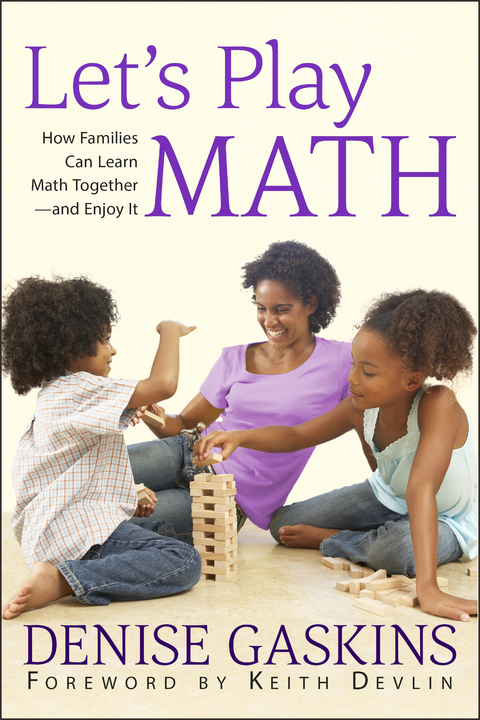
Let's Play Math (eBook)
CCLXXXVIII, 288 Seiten
Tabletop Academy Press (Verlag)
978-1-892083-24-1 (ISBN)
Transform your child's experience of math!
Even if you struggled with mathematics in school, you can help your children enjoy learning and prepare them for academic success.
Author Denise Gaskins makes it easy with this mixture of math games, low-prep project ideas, and inspiring coffee-chat advice from a veteran homeschooling mother of five. Filled with stories and illustrations, Let's Play Math offers a practical, activity-filled exploration of what it means to learn math as a family.
Drawing on more than thirty years' teaching experience, Gaskins provides helpful tips for parents with kids from preschool to high school, whether your children learn at home or attend a traditional classroom.
Sections include:
• How to Understand Math: Introduce your children to the thrill of conquering a challenge. Build deep understanding by thinking, playing, and asking questions like a mathematician.
• Playful Problem Solving: Awaken your children's minds to the beauty and wonder of mathematics. Discover the social side of math, and learn games for players of all ages.
• Math with Living Books: See how mathematical ideas ebb and flow through the centuries with this brief tour through history. Can your kids solve puzzles from China, India, or Ancient Egypt?
• Let's Get Practical: Fit math into your family's daily life, help your children develop mental calculation skills, and find out what to try when your child struggles.
• Resources and References: With so many library books and Internet sites, you'll never run out of playful mathematical adventures.
All parents and teachers share one goal: we want our children to understand and be able to use math. Your children will gain a strong foundation when you approach math as a family game, playing with ideas.
Don't let your children suffer from the epidemic of math anxiety. Grab a copy of Let's Play Math, and start enjoying math today.
Transform your child's experience of math!Even if you struggled with mathematics in school, you can help your children enjoy learning and prepare them for academic success.Author Denise Gaskins makes it easy with this mixture of math games, low-prep project ideas, and inspiring coffee-chat advice from a veteran homeschooling mother of five. Filled with stories and illustrations, Let's Play Math offers a practical, activity-filled exploration of what it means to learn math as a family.Drawing on more than thirty years' teaching experience, Gaskins provides helpful tips for parents with kids from preschool to high school, whether your children learn at home or attend a traditional classroom.Sections include: How to Understand Math: Introduce your children to the thrill of conquering a challenge. Build deep understanding by thinking, playing, and asking questions like a mathematician. Playful Problem Solving: Awaken your children's minds to the beauty and wonder of mathematics. Discover the social side of math, and learn games for players of all ages. Math with Living Books: See how mathematical ideas ebb and flow through the centuries with this brief tour through history. Can your kids solve puzzles from China, India, or Ancient Egypt? Let's Get Practical: Fit math into your family's daily life, help your children develop mental calculation skills, and find out what to try when your child struggles. Resources and References: With so many library books and Internet sites, you'll never run out of playful mathematical adventures.All parents and teachers share one goal: we want our children to understand and be able to use math. Your children will gain a strong foundation when you approach math as a family game, playing with ideas.Don't let your children suffer from the epidemic of math anxiety. Grab a copy of Let's Play Math, and start enjoying math today.
It is in fact nothing short of a miracle that the modern methods of instruction have not entirely strangled the holy curiosity of inquiry; for this delicate little plant, aside from stimulation, stands mainly in need of freedom.
— Albert Einstein
Introduction
A cup of coffee, a slice of pecan pie, and a robust discussion of educational philosophy — when I was a novice homeschooler, our local moms’ night out provided mentoring and kept me sane. Years passed. Children grew. Many of the kids we worried over then are now raising children of their own. Though I can’t remember growing older, I look in the mirror and find a gray-haired veteran.
I’d love to sit down with you for an afternoon’s chat or an evening at the coffee shop, but our “night out” will have to be virtual. So I’ll sip at my cup while I write. Perhaps you can nibble a bit of pie as you read. And together let’s ponder the problem of learning math.
Our childhood struggles with schoolwork left many of us wary of mathematics. We learned to manipulate numbers and recite basic facts and formulas, but we never saw how or why it all fit together. We stumbled from one class to the next, packing ever more information into our strained memory, until the whole structure threatened to collapse. Eventually we crashed in a blaze of confusion, some of us in high school algebra, others in college calculus.
If this is your experience, you may be wondering how you can possibly help your children learn math. Don’t worry, you can! I’ll show you that doing math together is easier than you think, and an awful lot of fun for both you and your children.
Before plunging in, let’s take a moment to think about education.
Everyone has a philosophy of education, though they may not have thought it through. We’ve all been taught. There were parts of our schooling we liked and other parts we’d like to have changed. Over the years — in books, on websites and parenting forums, and in personal discussions — I’ve heard a range of opinions about how children learn math. Take a look at the list of statements I’ve collected, and think about the education you want for your children.
Which of the following points would you say are true? Which are math myths?
• Mathematics means the rules for working with numbers, shapes, and algebraic symbols.
• Math is in the genes. Some people have a “math mind,” but most of us don’t.
• Math is logical and rigid, not creative or artistic.
• Math is timeless and objective. It’s the same for everyone.
• In mathematics, answers are either right or wrong. The right answer is never a matter of opinion.
• To do well at math, you need a good memory.
• Learning mathematics is like climbing a ladder. You have to master the basics before you can reach the higher rungs.
• Children need a textbook or workbook to learn math.
• Looking at someone else’s answer is cheating.
• Students should show all the steps of their work. Shortcuts will lead to mistakes.
• Children shouldn’t count on their fingers.
• Children need to memorize the times tables. They should drill the math facts until they can answer flashcard-fast.
These statements sum up the way many adults remember school mathematics. Yet they are all math myths. Not one of these statements is indisputably true.
Could these myths be the reason why so many children learn to hate math? Or why so many parents feel inadequate to help their kids?
“There is a huge elephant standing in most math classrooms,” says Stanford University math education professor Jo Boaler. “It is the idea that only some students can do well in math. Students believe it, parents believe and teachers believe it. The myth that math is a gift that some students have and some do not, is one of the most damaging ideas that pervades education in the US and that stands in the way of students’ math achievement.”
Unfortunately, math myths don’t just stand there peacefully. Like a wild animal caught in a small room, they stamp and trample and wreak havoc on a child’s confidence. Before we can help our children learn math, we need to chase these myths away.
Mathematics is much more than a set of rules. Contrary to popular perception, it can be very artistic. Unlike traditional school work, real math poses intriguing questions, making us want to explore its patterns and puzzles. As we play alongside our children, we can share the satisfaction of discovering why things work.
Yes, there are advanced topics that can be hard to understand. Some math problems are fiendishly difficult. Yet the basic principles of math — even at the high school level — grow from common sense. Learning them should feel natural.
Math is not the same for everyone, because what you see depends on your point of view. There are also different kinds of math. For example, can you draw a pair of parallel lines? In some versions of geometry, parallel lines do not exist. Does 2 + 2 = 4? Not always: in modular arithmetic 2 + 2 = 0 mod 4, while in base three 2 + 2 = 11. These topics can be interesting to explore with your children. Finding new ways to look at familiar ideas is part of the joy of learning math as a family.
[Picture below] Modular arithmetic works like a one-handed clock. In mod 4, moving 2 + 2 brings you back around to zero. And 2 + 3 isn’t five, because that number doesn’t exist in mod 4. Instead, you keep moving around the clock, so 2 + 3 = 1. How many other mod 4 math facts can you find?
A few of the myths in my list may have a semblance of truth, but their cumulative effect is to limit our children’s understanding and ability to appreciate math. Many later math topics do build on earlier ones, but learning math is more like taking a meandering nature walk than like climbing a ladder with one rung above another. Preschool children are capable of exploring topics like fractals or infinity, while elementary students can begin learning algebra. It’s fun to play with advanced ideas. Such adventures offer a broad perspective that supports a child’s knowledge of the more standard arithmetic topics.
Even with the basics of arithmetic (number calculations, the traditional focus of elementary school math), the ladder analogy hurts more than it helps. Young children need freedom to wander from one topic to another as interest and opportunity lead them. They can ponder the concepts of multiplication and fractions long before they have finished mastering addition and subtraction.
Nor is a textbook necessary, at least during the early-elementary years. Most young children have a natural interest in mathematical ideas as part of their ongoing mission to understand and control their world. They find numbers fascinating, especially big numbers like hundreds or thousands. They enjoy drawing circles and triangles. They delight in scooping up volumes in the sandbox or bathtub. They can count out forks and knives for the table, matching sets of silverware with the resident set of people. They know how to split up the last bit of birthday cake and make sure they get their fair share, even if they have to cut halves or thirds.
[Picture below] In base 3, the place value columns are multiples of three. Instead of writing numbers in terms of ones, tens, and hundreds, we count by ones, threes, and nines. Thus 2 + 2 = 11, because “11” means “one three and one single block.” How many other base three facts can you find?
Homeschoolers are not immune to math myths. When I was a child, all teachers exhorted us to “Show your work.” I’ve seen many homeschooling discussion forum posts asking how parents can convince kids to write out the steps of their answers. Yet our teachers were not really interested in our childish pencil-scratchings; what they wanted was a window into how we were thinking. As parents, we have an advantage that classroom teachers can only dream of — namely, the time to sit and talk with each of our children. I can ask my daughter, “How did you figure it out?” In the course of conversation, she will demonstrate how much she knows. I often find myself learning something from the discussion, too, since she almost never thinks a problem through in the same way I would have done. I’d hate to trade this opportunity for a notebook page full of written-out steps.
Or consider the idea that looking at someone else’s answer is cheating. While that is undoubtedly true during a test, such pressure should be rare. Wise parents and teachers know that children need to hear many different ways to approach a problem. They need to compare their solutions with others. When students are stumped on a math exercise, one of the best ways to learn is to look up the answer and work backward.
The last statement in my list of math myths — that children should memorize their times tables and practice until they can answer flashcard-fast — is the most controversial. With our modern culture’s infatuation with test scores, many people will argue, “That’s not a myth!” Frantic parents scour the Internet, desperate for tricks that will help their kids learn the math facts. But for many children, this emphasis on memory work does more harm than good. While understanding the meaning of multiplication is vital, instant recall is like icing on a brownie: tasty, but unnecessary. When we stress memorization, we risk...
| Erscheint lt. Verlag | 29.12.2018 |
|---|---|
| Sprache | englisch |
| Themenwelt | Sachbuch/Ratgeber ► Freizeit / Hobby ► Spielen / Raten |
| Sachbuch/Ratgeber ► Gesundheit / Leben / Psychologie ► Familie / Erziehung | |
| Mathematik / Informatik ► Mathematik | |
| Sozialwissenschaften ► Pädagogik ► Schulpädagogik / Grundschule | |
| ISBN-10 | 1-892083-24-8 / 1892083248 |
| ISBN-13 | 978-1-892083-24-1 / 9781892083241 |
| Informationen gemäß Produktsicherheitsverordnung (GPSR) | |
| Haben Sie eine Frage zum Produkt? |
 EPUB (Adobe DRM)
Kopierschutz: Adobe-DRM
Adobe-DRM ist ein Kopierschutz, der das eBook vor Mißbrauch schützen soll. Dabei wird das eBook bereits beim Download auf Ihre persönliche Adobe-ID autorisiert. Lesen können Sie das eBook dann nur auf den Geräten, welche ebenfalls auf Ihre Adobe-ID registriert sind.
Details zum Adobe-DRM
Dateiformat: EPUB (Electronic Publication)
EPUB ist ein offener Standard für eBooks und eignet sich besonders zur Darstellung von Belletristik und Sachbüchern. Der Fließtext wird dynamisch an die Display- und Schriftgröße angepasst. Auch für mobile Lesegeräte ist EPUB daher gut geeignet.
Systemvoraussetzungen:
PC/Mac: Mit einem PC oder Mac können Sie dieses eBook lesen. Sie benötigen eine
eReader: Dieses eBook kann mit (fast) allen eBook-Readern gelesen werden. Mit dem amazon-Kindle ist es aber nicht kompatibel.
Smartphone/Tablet: Egal ob Apple oder Android, dieses eBook können Sie lesen. Sie benötigen eine
Geräteliste und zusätzliche Hinweise
Buying eBooks from abroad
For tax law reasons we can sell eBooks just within Germany and Switzerland. Regrettably we cannot fulfill eBook-orders from other countries.
aus dem Bereich