


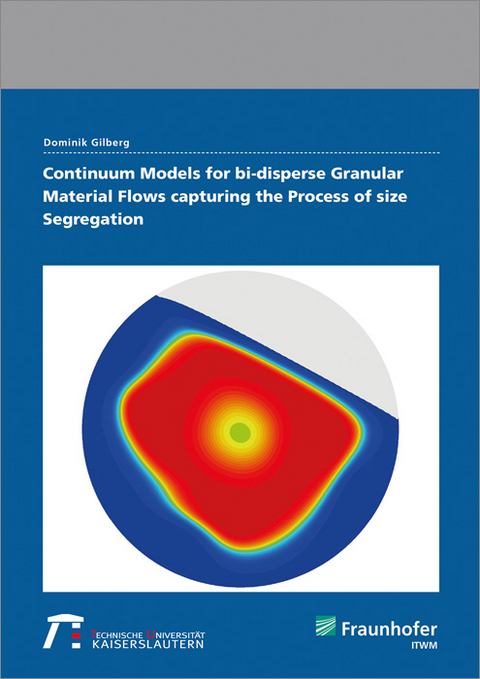
Continuum models for bi-disperse granular material flows capturing the process of size segregation
Seiten
2018
Fraunhofer Verlag
978-3-8396-1411-2 (ISBN)
Fraunhofer Verlag
978-3-8396-1411-2 (ISBN)
- Titel ist leider vergriffen;
keine Neuauflage - Artikel merken
This thesis deals with the topic of segregation in granular materials. The basis for this work is a hydrodynamic model for granular material flows of Navier-Stokes type, which is extended to capture segregation of systems with small and large particles. Numerical methods are presented to solve the whole system. The final model is extensively tested using different frameworks in two- and three-dimensional space.
This thesis deals with the topic of size segregation in granular materials. Mathematical models are developed, describing the granular flow and the segregation process. The granular flow equations consist of a set of Navier-Stokes-like equations as well as an equation for the granular temperature. With the help of the granular temperature equation, the model is able to cover dense and dilute regimes. To derive the segregation equation, special focus is lain on the segregation direction and the packing of binary particle systems. For solving the set of equations, a finite volume approach is chosen. The segregation equation explicitly depends on the volume fraction of the granular system. Since the granular flow model is compressible, the segregation equation requires special numerical treatment. Therefore, a modified Godunov scheme is formulated based on the solutions of the underlying Riemann problems. The method guarantees that the system stays in a physically valid state. The final model is extensively tested using different frameworks in two- and three-dimensional space. Particularly, the influence of the granular flow model on the segregation process is pointed out in detail.
This thesis deals with the topic of size segregation in granular materials. Mathematical models are developed, describing the granular flow and the segregation process. The granular flow equations consist of a set of Navier-Stokes-like equations as well as an equation for the granular temperature. With the help of the granular temperature equation, the model is able to cover dense and dilute regimes. To derive the segregation equation, special focus is lain on the segregation direction and the packing of binary particle systems. For solving the set of equations, a finite volume approach is chosen. The segregation equation explicitly depends on the volume fraction of the granular system. Since the granular flow model is compressible, the segregation equation requires special numerical treatment. Therefore, a modified Godunov scheme is formulated based on the solutions of the underlying Riemann problems. The method guarantees that the system stays in a physically valid state. The final model is extensively tested using different frameworks in two- and three-dimensional space. Particularly, the influence of the granular flow model on the segregation process is pointed out in detail.
| Erscheinungsdatum | 20.12.2018 |
|---|---|
| Zusatzinfo | num., mostly col. illus. and tab. |
| Verlagsort | Stuttgart |
| Sprache | englisch |
| Maße | 148 x 210 mm |
| Themenwelt | Mathematik / Informatik ► Informatik |
| Mathematik / Informatik ► Mathematik ► Angewandte Mathematik | |
| Schlagworte | B • Continuum modelling • Entwicklungsingenieur • Entwicklungsingenieure • Fraunhofer ITWM • granular material flow • Granular material flows • industrial applications of scientific research & technological innovation • Industrial applications of scientific research and • Industrial applications of scientific research and technological innovation • Mathematical Modelling • Mathematiker • Mechanics of Fluids • Particle-size segregation • sedimentology soil science • Verfahrensingenieur • Verfahrensingenieure • Verfahrenstechniker |
| ISBN-10 | 3-8396-1411-2 / 3839614112 |
| ISBN-13 | 978-3-8396-1411-2 / 9783839614112 |
| Zustand | Neuware |
| Informationen gemäß Produktsicherheitsverordnung (GPSR) | |
| Haben Sie eine Frage zum Produkt? |
Mehr entdecken
aus dem Bereich


aus dem Bereich
Buch | Softcover (2025)
Springer Vieweg (Verlag)
CHF 62,95
Buch | Softcover (2025)
Springer Fachmedien Wiesbaden (Verlag)
CHF 69,95
Buch | Softcover (2024)
Springer Vieweg (Verlag)
CHF 53,15


