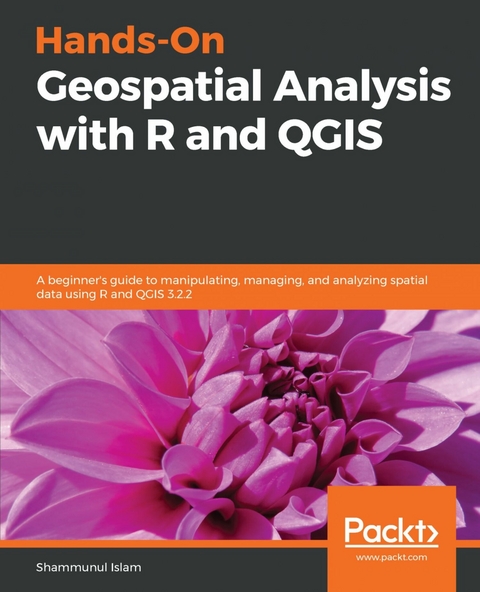
Hands-On Geospatial Analysis with R and QGIS (eBook)
354 Seiten
Packt Publishing (Verlag)
978-1-78899-698-3 (ISBN)
Practical examples with real-world projects in GIS, Remote sensing, Geospatial data management and Analysis using the R programming language
Key Features
- Understand the basics of R and QGIS to work with GIS and remote sensing data
- Learn to manage, manipulate, and analyze spatial data using R and QGIS
- Apply machine learning algorithms to geospatial data using R and QGIS
Book Description
Managing spatial data has always been challenging and it's getting more complex as the size of data increases. Spatial data is actually big data and you need different tools and techniques to work your way around to model and create different workflows. R and QGIS have powerful features that can make this job easier.
This book is your companion for applying machine learning algorithms on GIS and remote sensing data. You'll start by gaining an understanding of the nature of spatial data and installing R and QGIS. Then, you'll learn how to use different R packages to import, export, and visualize data, before doing the same in QGIS. Screenshots are included to ease your understanding.
Moving on, you'll learn about different aspects of managing and analyzing spatial data, before diving into advanced topics. You'll create powerful data visualizations using ggplot2, ggmap, raster, and other packages of R. You'll learn how to use QGIS 3.2.2 to visualize and manage (create, edit, and format) spatial data. Different types of spatial analysis are also covered using R. Finally, you'll work with landslide data from Bangladesh to create a landslide susceptibility map using different machine learning algorithms.
By reading this book, you'll transition from being a beginner to an intermediate user of GIS and remote sensing data in no time.
What you will learn
- Install R and QGIS
- Get familiar with the basics of R programming and QGIS
- Visualize quantitative and qualitative data to create maps
- Find out the basics of raster data and how to use them in R and QGIS
- Perform geoprocessing tasks and automate them using the graphical modeler of QGIS
- Apply different machine learning algorithms on satellite data for landslide susceptibility mapping and prediction
Who this book is for
This book is great for geographers, environmental scientists, statisticians, and every professional who deals with spatial data. If you want to learn how to handle GIS and remote sensing data, then this book is for you. Basic knowledge of R and QGIS would be helpful but is not necessary.
Practical examples with real-world projects in GIS, Remote sensing, Geospatial data management and Analysis using the R programming languageKey FeaturesUnderstand the basics of R and QGIS to work with GIS and remote sensing dataLearn to manage, manipulate, and analyze spatial data using R and QGISApply machine learning algorithms to geospatial data using R and QGISBook DescriptionManaging spatial data has always been challenging and it's getting more complex as the size of data increases. Spatial data is actually big data and you need different tools and techniques to work your way around to model and create different workflows. R and QGIS have powerful features that can make this job easier.This book is your companion for applying machine learning algorithms on GIS and remote sensing data. You'll start by gaining an understanding of the nature of spatial data and installing R and QGIS. Then, you'll learn how to use different R packages to import, export, and visualize data, before doing the same in QGIS. Screenshots are included to ease your understanding.Moving on, you'll learn about different aspects of managing and analyzing spatial data, before diving into advanced topics. You'll create powerful data visualizations using ggplot2, ggmap, raster, and other packages of R. You'll learn how to use QGIS 3.2.2 to visualize and manage (create, edit, and format) spatial data. Different types of spatial analysis are also covered using R. Finally, you'll work with landslide data from Bangladesh to create a landslide susceptibility map using different machine learning algorithms.By reading this book, you'll transition from being a beginner to an intermediate user of GIS and remote sensing data in no time.What you will learnInstall R and QGISGet familiar with the basics of R programming and QGISVisualize quantitative and qualitative data to create mapsFind out the basics of raster data and how to use them in R and QGISPerform geoprocessing tasks and automate them using the graphical modeler of QGISApply different machine learning algorithms on satellite data for landslide susceptibility mapping and predictionWho this book is forThis book is great for geographers, environmental scientists, statisticians, and every professional who deals with spatial data. If you want to learn how to handle GIS and remote sensing data, then this book is for you. Basic knowledge of R and QGIS would be helpful but is not necessary.
| Erscheint lt. Verlag | 30.11.2018 |
|---|---|
| Sprache | englisch |
| Themenwelt | Mathematik / Informatik ► Informatik ► Programmiersprachen / -werkzeuge |
| Schlagworte | Geoprocessing • Geospatial • ggplot2 • Hazard map • Interpolation • Logistic Regression • machine learning • Point Pattern Analysis • polygon data • QGIS • QGIS and R • R • random forest • raster data • spatial analysis • Spatial Autocorrelation • vector data • visualise |
| ISBN-10 | 1-78899-698-4 / 1788996984 |
| ISBN-13 | 978-1-78899-698-3 / 9781788996983 |
| Informationen gemäß Produktsicherheitsverordnung (GPSR) | |
| Haben Sie eine Frage zum Produkt? |
 EPUB (Adobe DRM)
Größe: 22,5 MB
Kopierschutz: Adobe-DRM
Adobe-DRM ist ein Kopierschutz, der das eBook vor Mißbrauch schützen soll. Dabei wird das eBook bereits beim Download auf Ihre persönliche Adobe-ID autorisiert. Lesen können Sie das eBook dann nur auf den Geräten, welche ebenfalls auf Ihre Adobe-ID registriert sind.
Details zum Adobe-DRM
Dateiformat: EPUB (Electronic Publication)
EPUB ist ein offener Standard für eBooks und eignet sich besonders zur Darstellung von Belletristik und Sachbüchern. Der Fließtext wird dynamisch an die Display- und Schriftgröße angepasst. Auch für mobile Lesegeräte ist EPUB daher gut geeignet.
Systemvoraussetzungen:
PC/Mac: Mit einem PC oder Mac können Sie dieses eBook lesen. Sie benötigen eine
eReader: Dieses eBook kann mit (fast) allen eBook-Readern gelesen werden. Mit dem amazon-Kindle ist es aber nicht kompatibel.
Smartphone/Tablet: Egal ob Apple oder Android, dieses eBook können Sie lesen. Sie benötigen eine
Geräteliste und zusätzliche Hinweise
Buying eBooks from abroad
For tax law reasons we can sell eBooks just within Germany and Switzerland. Regrettably we cannot fulfill eBook-orders from other countries.
EPUB (Ohne DRM)Digital Rights Management: ohne DRM
Dieses eBook enthält kein DRM oder Kopierschutz. Eine Weitergabe an Dritte ist jedoch rechtlich nicht zulässig, weil Sie beim Kauf nur die Rechte an der persönlichen Nutzung erwerben.
Dateiformat: EPUB (Electronic Publication)
EPUB ist ein offener Standard für eBooks und eignet sich besonders zur Darstellung von Belletristik und Sachbüchern. Der Fließtext wird dynamisch an die Display- und Schriftgröße angepasst. Auch für mobile Lesegeräte ist EPUB daher gut geeignet.
Systemvoraussetzungen:
PC/Mac: Mit einem PC oder Mac können Sie dieses eBook lesen. Sie benötigen dafür die kostenlose Software Adobe Digital Editions.
eReader: Dieses eBook kann mit (fast) allen eBook-Readern gelesen werden. Mit dem amazon-Kindle ist es aber nicht kompatibel.
Smartphone/Tablet: Egal ob Apple oder Android, dieses eBook können Sie lesen. Sie benötigen dafür eine kostenlose App.
Geräteliste und zusätzliche Hinweise
Buying eBooks from abroad
For tax law reasons we can sell eBooks just within Germany and Switzerland. Regrettably we cannot fulfill eBook-orders from other countries.
aus dem Bereich