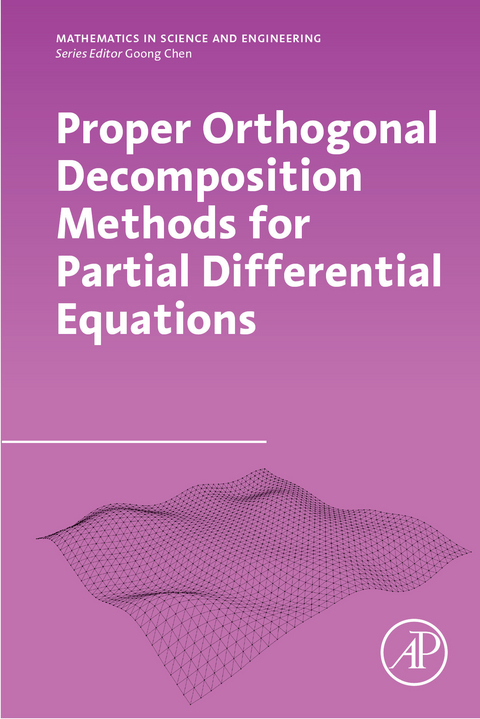
Proper Orthogonal Decomposition Methods for Partial Differential Equations (eBook)
278 Seiten
Elsevier Science (Verlag)
978-0-12-816799-1 (ISBN)
Zhendong Luo is Professor of Mathematics at North China Electric Power University, Beijing, China. Luo is heavily involved in the areas of Optimizing Numerical Methods of PDEs; Finite Element Methods; Finite Difference Scheme; Finite Volume Element Methods; Spectral-Finite Methods; and Computational Fluid Dynamics. For the last 12 years, Luo has worked mainly on Reduced Order Numerical Methods based on Proper Orthogonal Decomposition Technique for Time Dependent Partial Differential Equations.
Proper Orthogonal Decomposition Methods for Partial Differential Equations evaluates the potential applications of POD reduced-order numerical methods in increasing computational efficiency, decreasing calculating load and alleviating the accumulation of truncation error in the computational process. Introduces the foundations of finite-differences, finite-elements and finite-volume-elements. Models of time-dependent PDEs are presented, with detailed numerical procedures, implementation and error analysis. Output numerical data are plotted in graphics and compared using standard traditional methods. These models contain parabolic, hyperbolic and nonlinear systems of PDEs, suitable for the user to learn and adapt methods to their own R&D problems. - Explains ways to reduce order for PDEs by means of the POD method so that reduced-order models have few unknowns- Helps readers speed up computation and reduce computation load and memory requirements while numerically capturing system characteristics- Enables readers to apply and adapt the methods to solve similar problems for PDEs of hyperbolic, parabolic and nonlinear types
| Erscheint lt. Verlag | 26.11.2018 |
|---|---|
| Sprache | englisch |
| Themenwelt | Mathematik / Informatik ► Mathematik ► Analysis |
| ISBN-10 | 0-12-816799-8 / 0128167998 |
| ISBN-13 | 978-0-12-816799-1 / 9780128167991 |
| Informationen gemäß Produktsicherheitsverordnung (GPSR) | |
| Haben Sie eine Frage zum Produkt? |
 EPUB (Adobe DRM)
Kopierschutz: Adobe-DRM
Adobe-DRM ist ein Kopierschutz, der das eBook vor Mißbrauch schützen soll. Dabei wird das eBook bereits beim Download auf Ihre persönliche Adobe-ID autorisiert. Lesen können Sie das eBook dann nur auf den Geräten, welche ebenfalls auf Ihre Adobe-ID registriert sind.
Details zum Adobe-DRM
Dateiformat: EPUB (Electronic Publication)
EPUB ist ein offener Standard für eBooks und eignet sich besonders zur Darstellung von Belletristik und Sachbüchern. Der Fließtext wird dynamisch an die Display- und Schriftgröße angepasst. Auch für mobile Lesegeräte ist EPUB daher gut geeignet.
Systemvoraussetzungen:
PC/Mac: Mit einem PC oder Mac können Sie dieses eBook lesen. Sie benötigen eine
eReader: Dieses eBook kann mit (fast) allen eBook-Readern gelesen werden. Mit dem amazon-Kindle ist es aber nicht kompatibel.
Smartphone/Tablet: Egal ob Apple oder Android, dieses eBook können Sie lesen. Sie benötigen eine
Geräteliste und zusätzliche Hinweise
Buying eBooks from abroad
For tax law reasons we can sell eBooks just within Germany and Switzerland. Regrettably we cannot fulfill eBook-orders from other countries.
aus dem Bereich