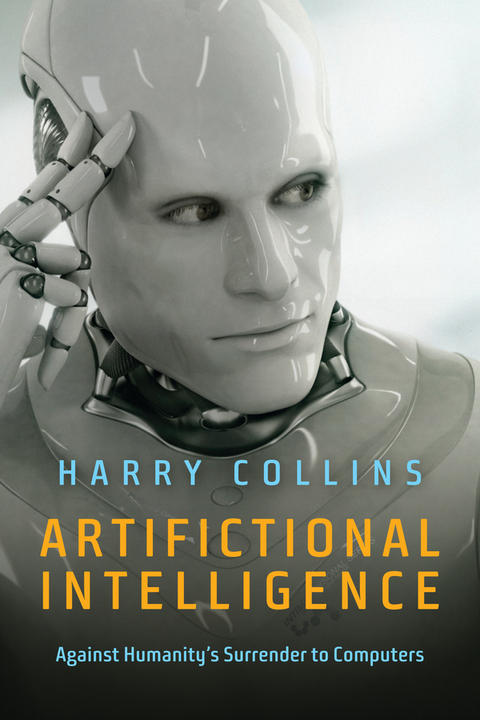
Artifictional Intelligence (eBook)
John Wiley & Sons (Verlag)
978-1-5095-0415-2 (ISBN)
By dissecting the intricacies of language use and meaning, Collins shows how far we have to go before we cannot distinguish between the social understanding of humans and computers. When the stakes are so high, we need to set the bar higher: to rethink 'intelligence' and recognize its inherent social basis. Only if machine learning succeeds on this count can we congratulate ourselves on having produced artificial intelligence.
Harry Collins is a Fellow of the British Academy, and Distinguished Research Professor in the School of Social Sciences at Cardiff University
Recent startling successes in machine intelligence using a technique called deep learning seem to blur the line between human and machine as never before. Are computers on the cusp of becoming so intelligent that they will render humans obsolete? Harry Collins argues we are getting ahead of ourselves, caught up in images of a fantastical future dreamt up in fictional portrayals. The greater present danger is that we lose sight of the very real limitations of artificial intelligence and readily enslave ourselves to stupid computers: the Surrender . By dissecting the intricacies of language use and meaning, Collins shows how far we have to go before we cannot distinguish between the social understanding of humans and computers. When the stakes are so high, we need to set the bar higher: to rethink intelligence and recognize its inherent social basis. Only if machine learning succeeds on this count can we congratulate ourselves on having produced artificial intelligence.
Harry Collins is a Fellow of the British Academy, and Distinguished Research Professor in the School of Social Sciences at Cardiff University
* Chapter 1. Computers in Social Life and the Danger of the 'Surrender'
* Chapter 2. Expertise and Writing about AI: Some Reflections on the Project
* Chapter 3. Language and 'Repair'
* Chapter 4. Humans, Social Contexts and Bodies
* Chapter 5. Six Levels of Artificial Intelligence
* Chapter 6. Deep Learning: Precedent-Based, Pattern-Recognising Computers
* Chapter 7. Kurzweil's Brain and the Sociology of Knowledge
* Chapter 8. How Humans Learn What Computers Can't
* Chapter 9. Two Models of Artificial Intelligence and the Way Forward
* Chapter 10. The Editing Test and Other New Versions of the Turing Test
* Appendix 1: How the Internet Works Today
* Appendix 2: Little Dogs
"In an age when heady promises and dark warnings from advocates of a fast-approaching "Technological Singularity" regularly make front-page news, this book offers timely words of caution."
J. Mark Bishop, Director of the Tungsten Centre for Intelligent Data Analytics, Goldsmiths, University of London
"By highlighting artificial intelligence's fundamental failures, Professor Collins provides an overdue correction to "the market-driven urge to advertise its successes". Authoritative and technically accurate, this book will be essential for students of AI, policy makers, business innovators and the broader public for many years."
Alan Blackwell, Computer Laboratory, University of Cambridge
"[Harry Collins examines] pervasive existential fears over artificial intelligence and its perceived threat in the 'deep learning' era. Collins probes this idea trenchantly and in considerable detail. Pointing to computers' inability to factor in social context, master natural language use well enough to pass a severe Turing test, or wield embodied cognition, he argues that the real danger we face is not a takeover by superior computers, but slavery to stupid ones."
Barbara Kiser, Nature
"[E]ven as a non-industry expert, Collins has still read deeply in this area, and consequently is posing some important, challenging questions. Having already experienced long periods of AI winters this book provides a robust challenge to those techno solutionist optimists who see AI-delivered solutions through overly rose-tinted glasses."
Simon Cocking, Irish Tech News
"If you are looking for a balanced debate on artificial intelligence, or are engaged in a critique of deep learning, concerned with the implications of singularity on society, intrigued by the notion of equivalence of human and machine intelligence, a critical observer of automation vs augmentation debate, perplexed by the ongoing interest in Turing test, or curious about what AI narratives attract AI research funding, then this book, by a critical scholar, a reflective narrator and a far-sighted teacher, Harry Collins, is for you."
Karamjit S. Gill, AI & Society
"Collins has provided a distinctive perspective to the conversation on AI."
Metascience
"[P]resents some interesting questions, most notably about how an embeddedness based on layers of data abstraction may or may not map onto embeddedness in social context. [...] Collins's frameworks often prove useful for questioning and analyzing what tends to be very messy data, and the book is sure to produce lively discussion among students and established scholars alike."
Sarah E. Sachs, Contemporary Sociology
2
Expertise and Writing about AI
Some Reflections on the Project
The trouble with artificial intelligence is everyone thinks they have something sensible to say about it. On the one hand, there are those who say that machines could never be creative or will always lack emotions or consciousness or maybe a soul; on the other, there are those who insist that computers must be capable of doing anything that we do since we are machines ourselves. You can hear all this in the pub or café. At the other end of the spectrum, consider the letter to the newspapers about the Singularity, written by Hawking and others. What special expertise do mathematicians and physicists have to put them in a position to make the kinds of claims made there? As someone working at the frontiers of AI said to me recently: ‘I wish Hawking wouldn’t write about AI; we don’t write about black holes.’ So what about someone like me? In this chapter, among other things, I’ll try to justify what is going on in this book; after all, I don’t actually build intelligent machines so what right do I have to talk about them?
What do I mean by ‘cannot’?
Two central negative claims were set out at the start of this book. It would be understandable if those who have spent their careers writing programs and making machines work better, sometimes in ways that confounded previous generations of outsider sceptics, objected to yet another round of being told by an outsider that their grandest ambitions are misplaced. But, in spite of the recent success, the history of artificial intelligence indicates that quite a few outsiders have made sceptical claims that turned out to be justified even though they were scorned at the time. Disagreement in science is healthy. The advance of science depends on what the sociologist Robert Merton called ‘organized scepticism’ and the best science is often done as a result of triumph over the supposedly impossible; if this is going to happen, someone has to say what’s impossible.
That said, we know that anti-technology prophecies (‘humans cannot travel faster than 30 miles per hour’, ‘heavier-than-air flight will never be achieved by humans’, ‘no human will ever leave the Earth’s atmosphere or gravitational field’) are often confounded by technological breakthroughs. Sometimes critics are confronted with Arthur C. Clarke’s so-called ‘First Law’:
When a distinguished but elderly scientist states that something is possible, he is almost certainly right. When he states that something is impossible, he is very probably wrong.
But physical scientists, who tend to be quite fond of Clarke’s First Law, are not known for their backwardness in stating impossibility principles of their own. There is, it has to be recognized, an unspoken disciplinary snobbishness when it comes to saying what can and cannot be done: so far as I know, no one quotes Clarke’s First Law when someone says it is impossible to travel faster than light or build a perpetual motion machine.
Table 2.1 Some types and examples of impossibility claim
| Types of cannot | Example/s |
| Logical impossibility Scientific principle | We cannot have our cake and eat it too. We cannot travel faster than light. Perpetual motion is impossible because of the second law of thermodynamics. Quantum theory is flawed because the Einstein, Podolsky, Rosen (EPR) paradox shows it would lead to non-local entanglement. Paranormal forces are impossible. |
| Logistic principle | We cannot enumerate and store all possible chess games. |
| Logistic practice | We cannot build a tunnel between England and Australia. |
| Technological impossibility | We cannot converse with anyone more than a mile away. We cannot make rechargeable car batteries with the energy density of a tank of hydrocarbon fuel. |
| Technical competence | We cannot translate the Rosetta Stone. We cannot make room-temperature superconductors. |
In Chapter 1 I talked about my negative claims being similar to claims about death and chromosomes. Table 2.1 presents and classifies more types of impossibility claim from strongest at the top to weakest at the bottom. The table deliberately includes some claims that have proved incorrect.19
The first kind of claim is generally uncontentious barring some esoteric philosophical treatments. Scientific principles of the kind exemplified in the second line are a favourite of physical scientists in spite of Clarke’s First Law. The EPR paradox, which reinforced Einstein in his well-known view that ‘God does not play dice’, turned out not to be false, making the resulting discovery of non-locality still more astonishing. The poor old parapsychologists, of course, are always getting it in the neck from outsiders, not least physicists, who, shamefully, are even ready to praise stage magicians for proving parapsychology wrong. Logistic principle seems to be acceptable and so do lots of things you can dream up which violate conceivable logistic practice. The technological impossibility or technological competence claims are more contentious and two of the ones I have chosen have turned out to be wrong: telephones (or smoke signals) confound the distant conversation claim and the Rosetta Stone has been translated. It is not entirely clear what is going to happen to batteries and super-conductors but, if anyone has a theory about those technological achievements being impossible, the dismissive application of Clarke’s First Law would be quite out of place.
How about my two sceptical claims? It seems to me that the first of these – ‘No computer will be fluent in a natural language, pass a severe Turing Test and have full human-like intelligence unless it is fully embedded in normal human society’ – is simply a scientific principle like those in the second row of Table 2.1. In this case, however, being about a technical matter and coming from a social scientist, it might make some people uncomfortable and more inclined to quote Clarke’s First Law. Incidentally, I think most protagonists of deep learning (Geoffrey Hinton aside, see Chapter 6) accept the first claim.
The second claim – ‘no computer will be fully embedded in human society as a result of incremental progress based on current techniques’ – is much less secure. Nevertheless, it belongs among the kind of claims found in the bottom two lines of Table 2.1 and will be supported in the chapters that follow. I could be wrong, but a negative claim like this makes the future more exciting rather than less. Let us, then, introduce Collins’s First Law:
Arguing that impossibility claims should not be made because they have turned out wrong in the past substitutes academic authority for thought and analysis.
Incidentally, let me make clear that neither of my claims is a ‘prophecy’. A prophecy has to deal with the future, but my claims, along with most of the impossibility claims in Table 2.1, are not prophecies because they deal with the foreseeable future. An impossibility claim is about whether one can get to some point by incremental change given what we know now, and I will say we can’t, whereas deep-learning enthusiasts will say we can. But my first claim could be confounded by some new and unforeseeable principle to do with how human knowledge works. My second claim could be simply wrong: that would be very interesting. I cannot foresee that happening or I would not have written the book.20 One has to be careful about the status of an impossibility claim.
Expertises and academics
Currently, there is a competition between AI enthusiasts on the one side – supported by philosophers of evolution and the like, who believe humans are no more than machines – and the critics on the other. That is potentially a good thing but the interplay of creation and criticism has to be done in a certain way if its productive potential is to be realized; too often, it is done badly. The debate is unproductive when the parties direct their arguments primarily at some wider audience rather than at the scientific opposition. A productive scientific debate has to be primarily inward looking – engaging with opponents in the scientific community rather than sidestepping the hard arguments by aiming outward at the general public; convincing scientific opponents is, as it happens almost impossible, but trying to convince them is the way to sharpen the arguments and enhance the understanding of both sides. Managing such a productive debate can be hard. For example, physics research is often on such a large scale, so expensive, and so esoteric that physicists cannot find anyone to provide serious opposition outside of their own specialist groups. So physicists set up opposed parties within their own teams. In gravitational-wave physics, a field I have studied for forty-five years and will refer to frequently throughout this book, it was always the insiders that were their own harshest critics, casting aside one claimed discovery after another for fifty years until they considered they were ready to agree that they had found the...
| Erscheint lt. Verlag | 30.11.2018 |
|---|---|
| Sprache | englisch |
| Themenwelt | Informatik ► Theorie / Studium ► Künstliche Intelligenz / Robotik |
| Sozialwissenschaften ► Soziologie | |
| Schlagworte | AI, artificial intelligence, intelligent machines, deep learning, machine learning, Turing, Turing Test, computers, computing, STS, sociology, robots, robotics • Artificial Intelligence • Computer Science • Informatik • Künstliche Intelligenz • Philosophie • Philosophie i. d. Technik • Philosophy • Philosophy of Technology • Sociology • Sociology of Science & Technology • Soziologie • Soziologie d. Naturwissenschaft u. Technik |
| ISBN-10 | 1-5095-0415-X / 150950415X |
| ISBN-13 | 978-1-5095-0415-2 / 9781509504152 |
| Informationen gemäß Produktsicherheitsverordnung (GPSR) | |
| Haben Sie eine Frage zum Produkt? |
 EPUB (Adobe DRM)
Kopierschutz: Adobe-DRM
Adobe-DRM ist ein Kopierschutz, der das eBook vor Mißbrauch schützen soll. Dabei wird das eBook bereits beim Download auf Ihre persönliche Adobe-ID autorisiert. Lesen können Sie das eBook dann nur auf den Geräten, welche ebenfalls auf Ihre Adobe-ID registriert sind.
Details zum Adobe-DRM
Dateiformat: EPUB (Electronic Publication)
EPUB ist ein offener Standard für eBooks und eignet sich besonders zur Darstellung von Belletristik und Sachbüchern. Der Fließtext wird dynamisch an die Display- und Schriftgröße angepasst. Auch für mobile Lesegeräte ist EPUB daher gut geeignet.
Systemvoraussetzungen:
PC/Mac: Mit einem PC oder Mac können Sie dieses eBook lesen. Sie benötigen eine
eReader: Dieses eBook kann mit (fast) allen eBook-Readern gelesen werden. Mit dem amazon-Kindle ist es aber nicht kompatibel.
Smartphone/Tablet: Egal ob Apple oder Android, dieses eBook können Sie lesen. Sie benötigen eine
Geräteliste und zusätzliche Hinweise
Buying eBooks from abroad
For tax law reasons we can sell eBooks just within Germany and Switzerland. Regrettably we cannot fulfill eBook-orders from other countries.
aus dem Bereich