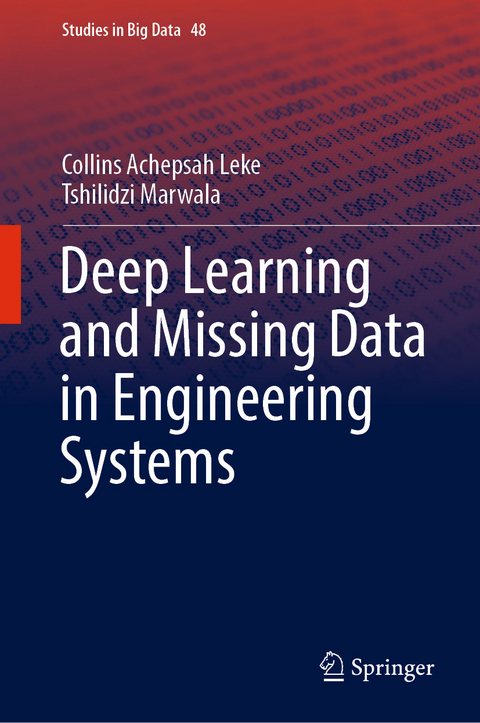
Deep Learning and Missing Data in Engineering Systems (eBook)
XIV, 179 Seiten
Springer International Publishing (Verlag)
978-3-030-01180-2 (ISBN)
- deep autoencoder neural networks;
- deep denoising autoencoder networks;
- the bat algorithm;
- the cuckoo search algorithm; and
- the firefly algorithm.
The hybrid models proposed are used to estimate the missing data in high-dimensional data settings more accurately. Swarm intelligence algorithms are applied to address critical questions such as model selection and model parameter estimation. The authors address feature extraction for the purpose of reconstructing the input data from reduced dimensions by the use of deep autoencoder neural networks. They illustrate new models diagrammatically, report their findings in tables, so as to put their methods on a sound statistical basis. The methods proposed speed up the process of data estimation while preserving known features of the data matrix.
This book is a valuable source of information for researchers and practitioners in data science. Advanced undergraduate and postgraduate students studying topics in computational intelligence and big data, can also use the book as a reference for identifying and introducing new research thrusts in missing data estimation.
Tshilidzi Marwala is the Vice-Chancellor and Principal of the University of Johannesburg. He was previously the Deputy Vice-Chancellor for Research and Internationalisation as well as Dean of Engineering and the Built Environment at the University of Johannesburg. Prior to that he was the Adhominem Professor of Electrical Engineering as well as the Carl and Emily Fuchs Chair of Systems and Control Engineering at the University of the Witwatersrand. He is a Fellow of The World Academy of Sciences of the Developing World (TWAS) as well as a distinguished member of the ACM. He holds a Bachelor of Science in Mechanical Engineering from Case Western Reserve University, USA, a Master of Engineering from the University of Pretoria, South Africa, and a PhD in Engineering from the University of Cambridge, UK. He was a postdoctoral research associate at the Imperial College of Science, Technology and Medicine, and a visiting fellow at Harvard University and Cambridge University.
Collins Leke holds a PhD and Master's degrees from the University of Johannesburg. He also holds a Bachelor's degree in Computer Science and Applied Mathematics from the University of the Witwatersrand. His research interests include the application of machine learning and computational intelligence to electrical and biomedical engineering, as well as in finance and insurance.
Tshilidzi Marwala is the Vice-Chancellor and Principal of the University of Johannesburg. He was previously the Deputy Vice-Chancellor for Research and Internationalisation as well as Dean of Engineering and the Built Environment at the University of Johannesburg. Prior to that he was the Adhominem Professor of Electrical Engineering as well as the Carl and Emily Fuchs Chair of Systems and Control Engineering at the University of the Witwatersrand. He is a Fellow of The World Academy of Sciences of the Developing World (TWAS) as well as a distinguished member of the ACM. He holds a Bachelor of Science in Mechanical Engineering from Case Western Reserve University, USA, a Master of Engineering from the University of Pretoria, South Africa, and a PhD in Engineering from the University of Cambridge, UK. He was a postdoctoral research associate at the Imperial College of Science, Technology and Medicine, and a visiting fellow at Harvard University and Cambridge University. Collins Leke holds a PhD and Master’s degrees from the University of Johannesburg. He also holds a Bachelor’s degree in Computer Science and Applied Mathematics from the University of the Witwatersrand. His research interests include the application of machine learning and computational intelligence to electrical and biomedical engineering, as well as in finance and insurance.
Introduction to Missing Data Estimation.- Introduction to Deep Learning.- Missing Data Estimation Using Bat Algorithm.- Missing Data Estimation Using Cuckoo Search Algorithm.- Missing Data Estimation Using Firefly Algorithm.- Missing Data Estimation Using Ant Colony Optimization Algorithm.- Missing Data Estimation Using Ant-Lion Optimizer Algorithm.- Missing Data Estimation Using Invasive Weed Optimization Algorithm.- Missing Data Estimation Using Swarm Intelligence Algorithms from Reduced Dimensions.- Missing Data Estimation Using Swarm Intelligence Algorithms: Deep Learning Framework Analysis.- Conclusion.
| Erscheint lt. Verlag | 13.12.2018 |
|---|---|
| Reihe/Serie | Studies in Big Data | Studies in Big Data |
| Zusatzinfo | XIV, 179 p. 109 illus., 84 illus. in color. |
| Verlagsort | Cham |
| Sprache | englisch |
| Themenwelt | Mathematik / Informatik ► Informatik ► Datenbanken |
| Informatik ► Theorie / Studium ► Künstliche Intelligenz / Robotik | |
| Technik | |
| Schlagworte | Artificial Intelligence • Deep learning • machine learning • Missing Data Estimation • Model Parameter Estimation • Swarm intelligence |
| ISBN-10 | 3-030-01180-1 / 3030011801 |
| ISBN-13 | 978-3-030-01180-2 / 9783030011802 |
| Informationen gemäß Produktsicherheitsverordnung (GPSR) | |
| Haben Sie eine Frage zum Produkt? |
 PDF (Wasserzeichen)
DRM: Digitales Wasserzeichen
Dieses eBook enthält ein digitales Wasserzeichen und ist damit für Sie personalisiert. Bei einer missbräuchlichen Weitergabe des eBooks an Dritte ist eine Rückverfolgung an die Quelle möglich.
Dateiformat: PDF (Portable Document Format)
Mit einem festen Seitenlayout eignet sich die PDF besonders für Fachbücher mit Spalten, Tabellen und Abbildungen. Eine PDF kann auf fast allen Geräten angezeigt werden, ist aber für kleine Displays (Smartphone, eReader) nur eingeschränkt geeignet.
Systemvoraussetzungen:
PC/Mac: Mit einem PC oder Mac können Sie dieses eBook lesen. Sie benötigen dafür einen PDF-Viewer - z.B. den Adobe Reader oder Adobe Digital Editions.
eReader: Dieses eBook kann mit (fast) allen eBook-Readern gelesen werden. Mit dem amazon-Kindle ist es aber nicht kompatibel.
Smartphone/Tablet: Egal ob Apple oder Android, dieses eBook können Sie lesen. Sie benötigen dafür einen PDF-Viewer - z.B. die kostenlose Adobe Digital Editions-App.
Buying eBooks from abroad
For tax law reasons we can sell eBooks just within Germany and Switzerland. Regrettably we cannot fulfill eBook-orders from other countries.
aus dem Bereich