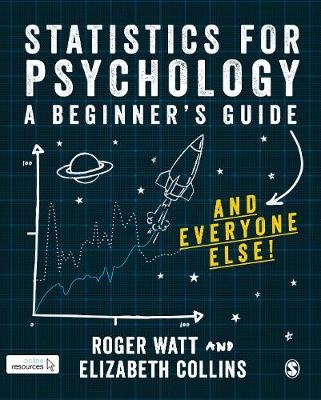
Statistics for Psychology
SAGE Publications Ltd (Verlag)
978-1-5264-4125-6 (ISBN)
- Titel erscheint in neuer Auflage
- Artikel merken
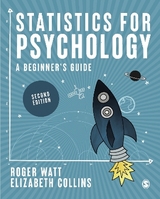
This concise, easy-to-understand and highly visual book helps students to understand the principles behind the many statistical practices. This text helps students to build a mental map to enable them to work their way through tests and procedures with a better level of understanding (and ultimately feel more confident and get better grades). Statistical analysis will also be covered in the book in the same simple-to-follow way, without messy details or complicated formulae. However, this approach does not lead to simple understanding. Instead it allows students to really grasp how to use, and be creative with, statistics.
Key features:
A principles-based approach, helping students to apply and adapt their skills to a variety of situation
Test out principles in practice on the companion website with statistics scenarios
Carefully designed graphics to explain statistical principles
Links to relevant sources / further reading for statistical packages, so the book can be used as a portal to/ springboard for further study.
Developed in conjunction with students means this book answers the key challenges students face.
Based on a BPS commended programme
Supported by a wealth of online resources at www.sagepub.co.uk/statisticsforpsychology
Roger Watt is Emeritus Professor of Psychology at the University of Stirling. He has spent many years rejecting ‘the system’ and instead is persistently stubborn in doing things his own way. He most enjoys his trumpet, his watercolours, and whatever he has managed to grow in his garden. Statistics for Psychology is the culmination of several years of pushing for change in how statistics should be approached by psychologists and students. Dr Elizabeth Collins is a curious psychology researcher, who has spent many years translating indecipherable and anxiety-inducing statistics jargon to her peers and to her students. A keen world traveller, photographer and bookworm, she fell into statistics accidentally after becoming a peer tutor during her undergraduate studies. She has spent several years contributing heavily to undergraduate statistics teaching, and hopes Statistics for Psychology can offer a helping hand to researchers worldwide. .
Chapter 1: Why do we need statistics?
Chapter 2: The Research Cycle
Chapter 3: Variables,
Chapter 4: Relationships between Variables
Chapter 5: Uncertainty in Research
Chapter 6: Null Hypothesis Testing
Chapter 7: Statistical Tests for 1 Independent Variable
Chapter 8: Minimising Uncertainty: Research Design
Chapter 9: Measurements and Uncertainty
Chapter 10: Sampling and Uncertainty
Chapter 11: Hypotheses with More Than One Independent Variable
Chapter 12: Covariations: Relationships Between Two Independent Variables
Chapter 13: Analysing Data with Two or More Independent Variables
Chapter 14: Which Model is Best?
| Erscheinungsdatum | 24.04.2019 |
|---|---|
| Verlagsort | London |
| Sprache | englisch |
| Maße | 186 x 232 mm |
| Gewicht | 790 g |
| Themenwelt | Geisteswissenschaften ► Psychologie |
| Mathematik / Informatik ► Mathematik ► Statistik | |
| ISBN-10 | 1-5264-4125-X / 152644125X |
| ISBN-13 | 978-1-5264-4125-6 / 9781526441256 |
| Zustand | Neuware |
| Informationen gemäß Produktsicherheitsverordnung (GPSR) | |
| Haben Sie eine Frage zum Produkt? |
aus dem Bereich