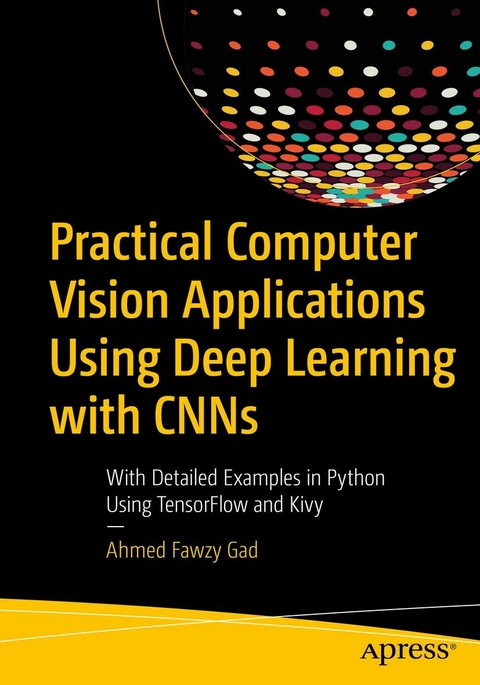
Practical Computer Vision Applications Using Deep Learning with CNNs (eBook)
XXII, 405 Seiten
Apress (Verlag)
978-1-4842-4167-7 (ISBN)
- Understand how ANNs and CNNs work
- Create computer vision applications and CNNs from scratch using Python
- Follow a deep learning project from conception to production using TensorFlow
- Use NumPy with Kivy to build cross-platform data science applications
Deploy deep learning applications into production across multiple platforms. You will work on computer vision applications that use the convolutional neural network (CNN) deep learning model and Python. This book starts by explaining the traditional machine-learning pipeline, where you will analyze an image dataset. Along the way you will cover artificial neural networks (ANNs), building one from scratch in Python, before optimizing it using genetic algorithms. For automating the process, the book highlights the limitations of traditional hand-crafted features for computer vision and why the CNN deep-learning model is the state-of-art solution. CNNs are discussed from scratch to demonstrate how they are different and more efficient than the fully connected ANN (FCNN). You will implement a CNN in Python to give you a full understanding of the model.After consolidating the basics, you will use TensorFlow to build a practical image-recognition model that you will deploy to a web server using Flask, making it accessible over the Internet. Using Kivy and NumPy, you will create cross-platform data science applications with low overheads.This book will help you apply deep learning and computer vision concepts from scratch, step-by-step from conception to production. What You Will Learn Understand how ANNs and CNNs work Create computer vision applications and CNNs from scratch using PythonFollow a deep learning project from conception to production using TensorFlowUse NumPy with Kivy to build cross-platform data science applicationsWho This Book Is ForData scientists, machine learning and deep learning engineers, software developers.
Ahmed Fawzy Gad is a teaching assistant who received his M.Sc. degree in 2018 after receiving his 2015 excellent with honors B.Sc. in information technology from the Faculty of Computers and Information (FCI), Menoufia University, Egypt. Ahmed is interested in deep learning, machine learning, computer vision, and Python. He aims to add value to the data science community by sharing his writings and preparing tutorials.
Table of Contents 5
About the Author 10
About the Technical Reviewers 11
Acknowledgments 12
Introduction 13
Chapter 1: Recognition in Computer Vision 19
Image Recognition Pipeline 20
Feature Extraction 22
Color Histogram 23
Histogram of a Real-World Image 25
HSV Color Space 26
GLCM 29
D Values 30
? Values 30
GLCM Normalization 32
HOG 35
Image Gradients 36
Gradient Direction 37
Contributing to Histogram Bins 37
HOG Steps 39
LBP 54
Feature Selection & Reduction
Filter 58
Wrapper 59
Embedded 61
Regularization 61
Chapter 2: Artificial Neural Networks 63
Introduction to ANNs 64
Linear Models Are the Base of ANNs 65
Graphing ANNs 70
Adjusting Learning Rate for Training ANN 75
Filter Example 75
ANN Architecture 76
Activation Function 77
Python Implementation 77
Learning Rate 80
Testing the Network 81
Weight Optimization Using Backpropagation 82
Backpropagation for NN Without Hidden Layer 82
Weights Update Equation 85
Why Is the Backpropagation Algorithm Important? 87
Forward vs. Backward Passes 87
Partial Derivative 88
Change in Prediction Error wrt Weights 89
Prediction Error to Weights Chain 89
Calculating Chain Partial Derivatives 91
Interpreting Results of Backpropagation 94
Updating Weights 94
Backpropagation for NN with Hidden Layer 95
Partial Derivatives 98
Updating Weights 106
Overfitting 107
Understand Regularization Based on a Regression Example 109
Model Capacity/Complexity 112
L1 Regularization 113
Designing ANN 115
Example 1: ANN Without Hidden Layer 116
Example 2: ANN with a Single Hidden Layer 120
Chapter 3: Recognition Using ANN with Engineered Features 125
Fruits 360 Dataset Feature Mining 125
Feature Mining 126
Feature Reduction 133
Filtering Using ANN 136
ANN Implementation 138
Engineered Feature Limitations 144
Not the End of Engineered Features 145
Chapter 4: ANN Optimization 147
Introduction to Optimization 148
Single- vs. Multiobjective Optimization 148
GA 152
Best-Parents Selection 155
Variation Operators 156
Crossover 156
Mutation 157
Python Implementation of an Example 158
Complete Implementation 166
NSGA-II 169
NSGA-II Steps 170
Dominance 172
Crowding Distance 180
Tournament Selection 183
Crossover 184
Mutation 185
Optimizing ANN Using GA 186
Complete Python Implementation 191
Chapter 5: Convolutional Neural Networks 200
From ANN to CNN 200
The Intuition Behind DL 201
Derivation of Convolution 205
Image Analysis Using FC Network 206
Large Number of Parameters 208
Neuron Grouping 209
Pixel Spatial Correlation 212
Convolution in CNN 213
Designing a CNN 215
Pooling Operation for Parameter Reduction 219
Convolution Operation Example 221
Max Pooling Operation Example 223
Building a CNN Using NumPy from Scratch 224
Reading the Input Image 225
Preparing Filters 226
Conv Layer 226
ReLU Layer 232
Max Pooling Layer 233
Stacking Layers 235
Complete Code 237
Chapter 6: TensorFlow Recognition Application 245
Introduction to TF 245
Tensor 247
TF Core 247
Dataflow Graph 248
Tensor Names 249
Creating a TF Session 251
Parameterized Graph Using Placeholder 255
TF Variables 258
Variable Initialization 260
Graph Visualization Using TB 261
Linear Model 264
GD Optimizer from TF Train API 268
Locating Parameters to Optimize 270
Building FFNN 271
Linear Classification 272
Nonlinear Classification 281
CIFAR10 Recognition Using CNN 286
Preparing Training Data 287
Building the CNN 289
Training CNN 294
Saving the Trained Model 297
Complete Code to Build and Train CNN 298
Preparing Test Data 308
Testing the Trained CNN Model 309
Chapter 7: Deploying Pretrained Models 311
Application Overview 311
Introduction to Flask 312
route() Decorator 314
add_rule_url Method 317
Variable Rules 317
Endpoint 319
HTML Form 321
File Upload 323
HTML Inside Flask Application 325
Flask Templates 326
Dynamic Templates 327
Static Files 330
Deploying Trained Model Using Fruits 360 Dataset 333
Deploying Trained Model Using CIFAR10 Dataset 342
Chapter 8: Cross-Platform Data Science Applications 355
Introduction to Kivy 356
Basic Application Using BoxLayout 357
Kivy Application Life Cycle 358
Widget Size 362
GridLayout 364
More Widgets 366
Widget Tree 367
Handling Events 370
KV Language 372
P4A 377
Installing Buildozer 377
Preparing buildozer.spec File 378
Building Android Application Using Buildozer 381
Image Recognition on Android 383
CNN on Android 389
Appendix A: Installing Your Own Projects Using pip Installer 397
Creating a Simple Python Project 398
Project Structure 398
Project Implementation 398
Running the Project 399
Importing the Module into a File Inside Its Directory 400
Importing the Module into a File Outside Its Directory 400
How Does Python Locate Libraries? 402
Manual Installation by Copying Project Files to Site-Packages 403
How Do Python Installers Locate Libraries? 404
Preparing the Package and Its Files (__init__.py and setup.py) 404
__init__.py 405
setup.py 406
Distributing the Package 407
Uploading the Distribution Files Online to Test PyPI 409
Installing the Distributed Package from Test PyPI 411
Importing and Using the Installed Package 412
Using PyPI Rather Than Test PyPI 412
Index 413
| Erscheint lt. Verlag | 5.12.2018 |
|---|---|
| Zusatzinfo | XXII, 405 p. 200 illus. |
| Verlagsort | Berkeley |
| Sprache | englisch |
| Themenwelt | Mathematik / Informatik ► Informatik ► Programmiersprachen / -werkzeuge |
| Mathematik / Informatik ► Informatik ► Software Entwicklung | |
| Informatik ► Theorie / Studium ► Künstliche Intelligenz / Robotik | |
| Schlagworte | computer vision • convolutional neural network • Deep learning • Image Processing • machine learning • neural network • Python • tensorflow |
| ISBN-10 | 1-4842-4167-3 / 1484241673 |
| ISBN-13 | 978-1-4842-4167-7 / 9781484241677 |
| Informationen gemäß Produktsicherheitsverordnung (GPSR) | |
| Haben Sie eine Frage zum Produkt? |
 PDF (Wasserzeichen)
DRM: Digitales Wasserzeichen
Dieses eBook enthält ein digitales Wasserzeichen und ist damit für Sie personalisiert. Bei einer missbräuchlichen Weitergabe des eBooks an Dritte ist eine Rückverfolgung an die Quelle möglich.
Dateiformat: PDF (Portable Document Format)
Mit einem festen Seitenlayout eignet sich die PDF besonders für Fachbücher mit Spalten, Tabellen und Abbildungen. Eine PDF kann auf fast allen Geräten angezeigt werden, ist aber für kleine Displays (Smartphone, eReader) nur eingeschränkt geeignet.
Systemvoraussetzungen:
PC/Mac: Mit einem PC oder Mac können Sie dieses eBook lesen. Sie benötigen dafür einen PDF-Viewer - z.B. den Adobe Reader oder Adobe Digital Editions.
eReader: Dieses eBook kann mit (fast) allen eBook-Readern gelesen werden. Mit dem amazon-Kindle ist es aber nicht kompatibel.
Smartphone/Tablet: Egal ob Apple oder Android, dieses eBook können Sie lesen. Sie benötigen dafür einen PDF-Viewer - z.B. die kostenlose Adobe Digital Editions-App.
Buying eBooks from abroad
For tax law reasons we can sell eBooks just within Germany and Switzerland. Regrettably we cannot fulfill eBook-orders from other countries.
aus dem Bereich