


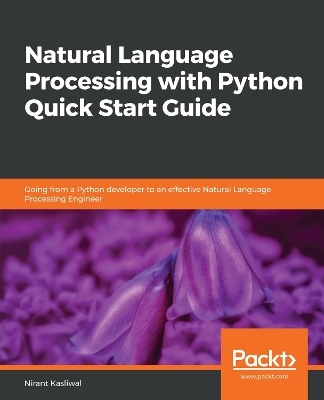
Natural Language Processing with Python Quick Start Guide
Going from a Python developer to an effective Natural Language Processing Engineer
Seiten
2018
Packt Publishing Limited (Verlag)
978-1-78913-038-6 (ISBN)
Packt Publishing Limited (Verlag)
978-1-78913-038-6 (ISBN)
NLP in Python is among the most sought-after skills among data scientists. With code and relevant case studies, this book will show how you can use industry grade tools to implement NLP programs capable of learning from relevant data. We will explore many modern methods ranging from spaCy to word vectors that have reinvented NLP.
Build and deploy intelligent applications for natural language processing with Python by using industry standard tools and recently popular methods in deep learning
Key Features
A no-math, code-driven programmer’s guide to text processing and NLP
Get state of the art results with modern tooling across linguistics, text vectors and machine learning
Fundamentals of NLP methods from spaCy, gensim, scikit-learn and PyTorch
Book DescriptionNLP in Python is among the most sought after skills among data scientists. With code and relevant case studies, this book will show how you can use industry-grade tools to implement NLP programs capable of learning from relevant data. We will explore many modern methods ranging from spaCy to word vectors that have reinvented NLP.
The book takes you from the basics of NLP to building text processing applications. We start with an introduction to the basic vocabulary along with a workflow for building NLP applications.
We use industry-grade NLP tools for cleaning and pre-processing text, automatic question and answer generation using linguistics, text embedding, text classifier, and building a chatbot. With each project, you will learn a new concept of NLP. You will learn about entity recognition, part of speech tagging and dependency parsing for Q and A. We use text embedding for both clustering documents and making chatbots, and then build classifiers using scikit-learn.
We conclude by deploying these models as REST APIs with Flask.
By the end, you will be confident building NLP applications, and know exactly what to look for when approaching new challenges.
What you will learn
Understand classical linguistics in using English grammar for automatically generating questions and answers from a free text corpus
Work with text embedding models for dense number representations of words, subwords and characters in the English language for exploring document clustering
Deep Learning in NLP using PyTorch with a code-driven introduction to PyTorch
Using an NLP project management Framework for estimating timelines and organizing your project into stages
Hack and build a simple chatbot application in 30 minutes
Deploy an NLP or machine learning application using Flask as RESTFUL APIs
Who this book is forProgrammers who wish to build systems that can interpret language. Exposure to Python programming is required. Familiarity with NLP or machine learning vocabulary will be helpful, but not mandatory.
Build and deploy intelligent applications for natural language processing with Python by using industry standard tools and recently popular methods in deep learning
Key Features
A no-math, code-driven programmer’s guide to text processing and NLP
Get state of the art results with modern tooling across linguistics, text vectors and machine learning
Fundamentals of NLP methods from spaCy, gensim, scikit-learn and PyTorch
Book DescriptionNLP in Python is among the most sought after skills among data scientists. With code and relevant case studies, this book will show how you can use industry-grade tools to implement NLP programs capable of learning from relevant data. We will explore many modern methods ranging from spaCy to word vectors that have reinvented NLP.
The book takes you from the basics of NLP to building text processing applications. We start with an introduction to the basic vocabulary along with a workflow for building NLP applications.
We use industry-grade NLP tools for cleaning and pre-processing text, automatic question and answer generation using linguistics, text embedding, text classifier, and building a chatbot. With each project, you will learn a new concept of NLP. You will learn about entity recognition, part of speech tagging and dependency parsing for Q and A. We use text embedding for both clustering documents and making chatbots, and then build classifiers using scikit-learn.
We conclude by deploying these models as REST APIs with Flask.
By the end, you will be confident building NLP applications, and know exactly what to look for when approaching new challenges.
What you will learn
Understand classical linguistics in using English grammar for automatically generating questions and answers from a free text corpus
Work with text embedding models for dense number representations of words, subwords and characters in the English language for exploring document clustering
Deep Learning in NLP using PyTorch with a code-driven introduction to PyTorch
Using an NLP project management Framework for estimating timelines and organizing your project into stages
Hack and build a simple chatbot application in 30 minutes
Deploy an NLP or machine learning application using Flask as RESTFUL APIs
Who this book is forProgrammers who wish to build systems that can interpret language. Exposure to Python programming is required. Familiarity with NLP or machine learning vocabulary will be helpful, but not mandatory.
Nirant Kasliwal maintains an awesome list of NLP natural language processing resources. GitHub's machine learning collection features this as the go-to guide. Nobel Laureate Dr. Paul Romer found his programming notes on Jupyter Notebooks helpful. Nirant won the first ever NLP Google Kaggle Kernel Award. At Soroco, image segmentation and intent categorization are the challenges he works with. His state-of-the-art language modeling results are available as Hindi2vec.
Table of Contents
Getting Started with Text Classification
Tidying your Text
Leveraging Linguistics
Text Representations - Words to Numbers
Modern Methods for Classification
Deep Learning for NLP
Building your own Chatbot
Web Deployments
| Erscheinungsdatum | 05.12.2018 |
|---|---|
| Verlagsort | Birmingham |
| Sprache | englisch |
| Maße | 75 x 93 mm |
| Themenwelt | Mathematik / Informatik ► Informatik ► Programmiersprachen / -werkzeuge |
| Informatik ► Theorie / Studium ► Künstliche Intelligenz / Robotik | |
| ISBN-10 | 1-78913-038-7 / 1789130387 |
| ISBN-13 | 978-1-78913-038-6 / 9781789130386 |
| Zustand | Neuware |
| Informationen gemäß Produktsicherheitsverordnung (GPSR) | |
| Haben Sie eine Frage zum Produkt? |
Mehr entdecken
aus dem Bereich


aus dem Bereich
Eine praxisorientierte Einführung
Buch | Softcover (2025)
Springer Vieweg (Verlag)
CHF 53,15
Künstliche Intelligenz, Macht und das größte Dilemma des 21. …
Buch | Softcover (2025)
C.H.Beck (Verlag)
CHF 25,20
Buch | Softcover (2025)
Reclam, Philipp (Verlag)
CHF 11,20


