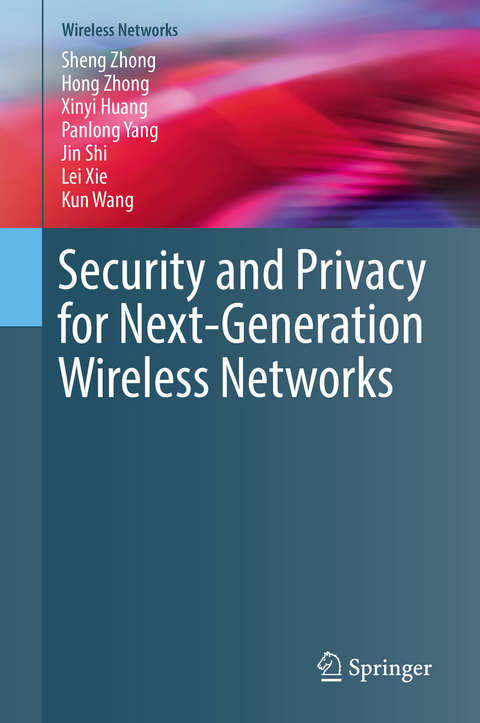
Security and Privacy for Next-Generation Wireless Networks (eBook)
XII, 183 Seiten
Springer International Publishing (Verlag)
978-3-030-01150-5 (ISBN)

This timely book provides broad coverage of security and privacy issues in the macro and micro perspective. In macroperspective, the system and algorithm fundamentals of next-generation wireless networks are discussed. In micro-perspective, this book focuses on the key secure and privacy techniques in different emerging networks from the interconnection view of human and cyber-physical world. This book includes 7 chapters from prominent international researchers working in this subject area. This book serves as a useful reference for researchers, graduate students, and practitioners seeking solutions to wireless security and privacy related issues
Recent advances in wireless communication technologies have enabled the large-scale deployment of next-generation wireless networks, and many other wireless applications are emerging. The next generation of mobile networks continues to transform the way people communicate and access information. As a matter of fact, next-generation emerging networks are exploiting their numerous applications in both military and civil fields. For most applications, it is important to guarantee high security of the deployed network in order to defend against attacks from adversaries, as well as the privacy intrusion.
The key target in the development of next-generation wireless networks is to promote the integration of the human, cyber, and physical worlds. Previous work in Cyber Physical Systems (CPS) considered the connection between the cyber world and the physical world. In the recent studies, human involvement brings new channels and initiatives in this interconnection. In this integration process, security and privacy are critical issues to many wireless network applications, and it is a paramount concern for the growth of next-generation wireless networks. This is due to the open nature of wireless communication and the involvement of humans. New opportunities for tackling these security and privacy issues in next-generation wireless networks will be achieved by leveraging the properties of interaction among human, computers and things.
Preface 6
Contents 9
1 Networking Cyber-Physical Systems: System Fundamentals of Security and Privacy for Next-Generation Wireless Networks 13
1.1 Introduction 13
1.1.1 The Definition, Advantages and Classification of Wireless Network 13
1.1.2 Evolution of Wireless Network Architecture: From 1G to 4G 14
1.2 Next Generation Wireless Network 15
1.2.1 The Construction Goal of the Next Generation Wireless Network 15
1.2.2 The Architecture of the Next Generation Wireless Network 16
1.2.3 Integration of Cloud Computing, Internet of Things and Next Generation Wireless Network Architecture 17
1.2.3.1 Application of Cloud Computing Technology in Next Generation Wireless Networks 17
1.2.3.2 D2D and M2M in IoT 19
1.3 Research on Next-Generation Wireless Network Security 20
1.4 Security and Privacy Problem in Cloud Computing 22
1.4.1 The Introduction of Cloud Computing 22
1.4.1.1 The History of Cloud Computing 22
1.4.2 Network Security of Cloud Computing 23
1.4.3 Virtualization Security of Cloud Computing 24
1.4.4 Data Security of Cloud Computing 26
1.4.4.1 Data Integrity in Cloud Storage 26
1.4.4.2 Data Ownership Proof of Cloud Storage 27
1.4.5 Cloud Computing User Privacy Security 27
1.5 Security Threats in Mobile System 28
1.5.1 Introduction 28
1.5.2 LTE Architecture and the Security Issues 29
1.5.3 Identity Authentication Problems in Mobile Communication Networks 30
1.5.4 SDN Security Issues 32
1.6 Security and Privacy Challenges in Embedded Systems 34
1.6.1 Introduction 34
1.6.2 Security of Embedded System Hardware 35
1.6.3 Security and Privacy of Embedded System Software 37
1.6.4 Security of Embedded Network 39
1.7 What Remains Unsolved: Future Research Trends 40
References 41
2 Networking Cyber-Physical Systems: Algorithm Fundamentals of Security and Privacy for Next-Generation Wireless Networks 45
2.1 Challenges and Opportunities 45
2.2 Algorithms on Security Issues in Wireless Networks 46
2.3 Algorithms on Privacy Issues in Wireless Networks 49
2.4 Future Research Trends 57
References 58
3 Connecting Physical-World to Cyber-World: Security and Privacy Issues in Pervasive Sensing 61
3.1 Connecting Physical-World to Cyber-World: Gains and Pains 61
3.2 Investigating into Security and Privacy Issues in Pervasive Sensing 62
3.3 Challenges and Opportunities 63
3.4 Security Issues in Pervasive Sensing 64
3.4.1 User Authentication 64
3.4.2 Secret Key Extraction 67
3.5 Privacy Issues in Pervasive Sensing 69
3.5.1 Sensitive Information Privacy 69
3.5.2 Location Privacy 71
3.6 What Remains Unsolved: Future Research Trends 72
References 73
4 Connecting Human to Cyber-World: Security and Privacy Issues in Mobile Crowdsourcing Networks 76
4.1 Introduction 76
4.2 Overview of MCNs 77
4.2.1 Characteristics 77
4.2.2 Architecture 79
4.2.3 Key Components 82
4.2.4 Applications 82
4.3 Threats and Challenges in MCNs 82
4.3.1 Basic Description of Several Threats 82
4.3.2 Threat Analysis 84
4.3.2.1 Security Threats 84
4.3.2.2 Reliability 85
4.3.2.3 Integrity 86
4.3.2.4 Availability 87
4.3.3 Privacy Threats 87
4.3.3.1 Sensitive Information Privacy 87
4.3.3.2 Data Privacy 88
4.3.4 Trust Threats 90
4.3.5 Requirements 90
4.4 Security Assuring and Privacy Preserving Solutions 92
4.4.1 Encryption 92
4.4.2 Perturbation 95
4.4.3 Data Lake 96
4.4.4 Incentives 97
4.4.5 Reputation 98
4.4.6 Location Privacy 98
4.5 Future Research Trends 101
4.5.1 Malicious Service Provider 101
4.5.2 Combination with Other Technologies 105
4.5.3 Big Data 106
4.6 Conclusion 106
References 106
5 Connecting Things to Things in Physical-World: Security and Privacy Issues in Vehicular Ad-hoc Networks 112
5.1 Introduction of a Brand-New Network: VANET 112
5.2 Overviews of Security and Privacy 115
5.3 Methods and Strategies 119
5.4 Security Issues in VANET 125
5.4.1 Secret Key Management 125
5.4.2 Message Verification 128
5.4.3 Identity Traceability 131
5.5 Privacy Issues in VANET 134
5.5.1 Identity Traceability 135
5.5.2 Location Privacy 138
5.6 Conclusions and Future Research Directions 141
References 142
6 Connecting Things to Things in Physical-World: Security and Privacy Issues in Mobile Sensor Networks 146
6.1 Sensor Networks 146
6.2 Challenges 147
6.3 Security Issues in Sensor Networks 149
6.3.1 Key Establishment Protocols at Higher Layers 150
6.3.2 Key Establishment Protocols at the Physical Layer 155
6.4 Privacy Issues in Sensor Networks 159
6.4.1 Localization Protocols at Higher Layers 159
6.4.2 Localization Protocols at the Physical Layer 162
6.5 Future Research Trends 164
References 165
7 Connecting Human to Physical-World: Security and Privacy Issues in Mobile Crowdsensing 172
7.1 Overview 172
7.2 Mobile Crowdsensing Basics and How Human Are Connected to Cyber-World 172
7.2.1 Introduction of Mobile Crowd-Sensing 173
7.2.2 Task Allocation Mechanisms in Crowd-Sensing 174
7.2.3 Data Quality and Processing in Crowd-Sensing 176
7.3 Security and Privacy Issues When Using Inertial Sensors 178
7.3.1 Privacy Invasion on Different Inertial Sensors 178
7.3.2 Countermeasures 180
7.4 Security and Privacy Issues When Using Communication Links 181
7.4.1 Localization with Communication Links 181
7.4.2 Imaging with Communications Links 182
7.4.3 Recognizing Human Gesture with Communication Links 183
7.5 Security and Privacy Issues When Using Side Channels 184
7.5.1 Side Channels 184
7.5.2 Coordination 184
7.5.3 Neighbor Discovery 185
7.5.4 Control Message Delivery 185
7.5.5 Smartphone Applications 185
7.6 Future Research Trends 186
References 188
Index 192
| Erscheint lt. Verlag | 22.11.2018 |
|---|---|
| Reihe/Serie | Wireless Networks | Wireless Networks |
| Zusatzinfo | XII, 183 p. 19 illus., 14 illus. in color. |
| Verlagsort | Cham |
| Sprache | englisch |
| Themenwelt | Mathematik / Informatik ► Informatik |
| Technik ► Nachrichtentechnik | |
| Schlagworte | algorithm • Cyber physical • Cyber-World • Human • mobile crowdsensing • Mobile crowdsourcing • Pervasive Sensing • privacy • security • sensor networks • System • vehicular networks |
| ISBN-10 | 3-030-01150-X / 303001150X |
| ISBN-13 | 978-3-030-01150-5 / 9783030011505 |
| Informationen gemäß Produktsicherheitsverordnung (GPSR) | |
| Haben Sie eine Frage zum Produkt? |
 PDF (Wasserzeichen)
DRM: Digitales Wasserzeichen
Dieses eBook enthält ein digitales Wasserzeichen und ist damit für Sie personalisiert. Bei einer missbräuchlichen Weitergabe des eBooks an Dritte ist eine Rückverfolgung an die Quelle möglich.
Dateiformat: PDF (Portable Document Format)
Mit einem festen Seitenlayout eignet sich die PDF besonders für Fachbücher mit Spalten, Tabellen und Abbildungen. Eine PDF kann auf fast allen Geräten angezeigt werden, ist aber für kleine Displays (Smartphone, eReader) nur eingeschränkt geeignet.
Systemvoraussetzungen:
PC/Mac: Mit einem PC oder Mac können Sie dieses eBook lesen. Sie benötigen dafür einen PDF-Viewer - z.B. den Adobe Reader oder Adobe Digital Editions.
eReader: Dieses eBook kann mit (fast) allen eBook-Readern gelesen werden. Mit dem amazon-Kindle ist es aber nicht kompatibel.
Smartphone/Tablet: Egal ob Apple oder Android, dieses eBook können Sie lesen. Sie benötigen dafür einen PDF-Viewer - z.B. die kostenlose Adobe Digital Editions-App.
Buying eBooks from abroad
For tax law reasons we can sell eBooks just within Germany and Switzerland. Regrettably we cannot fulfill eBook-orders from other countries.
aus dem Bereich