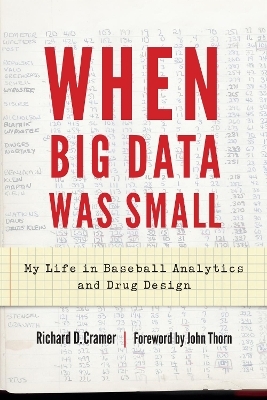
When Big Data Was Small
University of Nebraska Press (Verlag)
978-1-4962-1205-4 (ISBN)
Richard D. Cramer has been doing baseball analytics for just about as long as anyone alive, even before the term “sabermetrics” existed. He started analyzing baseball statistics as a hobby in the mid-1960s, not long after graduating from Harvard and MIT. He was a research scientist for SmithKline and in his spare time used his work computer to test his theories about baseball statistics. One of his earliest discoveries was that clutch hitting-then one of the most sacred pieces of received wisdom in the game-didn’t really exist. In When Big Data Was Small Cramer recounts his life and remarkable contributions to baseball knowledge.
In 1971 Cramer learned about the Society for American Baseball Research (SABR) and began working with Pete Palmer, whose statistical work is credited with providing the foundation on which SABR is built. Cramer cofounded STATS Inc. and began working with the Houston Astros, Oakland A’s, Yankees, and White Sox, with the help of his new Apple II computer.
Yet for Cramer baseball was always a side interest, even if a very intense one for most of the last forty years. His main occupation, which involved other “big data” activities, was that of a chemist who pioneered the use of specialized analytics, often known as computer-aided drug discovery, to help guide the development of pharmaceutical drugs. After a decade-long hiatus, Cramer returned to baseball analytics in 2004 and has done important work with Retrosheet since then. When Big Data Was Small is the story of the earliest days of baseball analytics and computer-aided drug discovery.
Richard D. Cramer started analyzing baseball statistics in the mid-1960s, after graduating from Harvard and MIT, and by 1969 he had discovered (or reinvented) the metric now known as OPS. He is the co-founder of STATS Inc. and has done important work with both SABR and Retrosheet. John Thorn is the official historian for Major League Baseball and the author of Baseball in the Garden of Eden.
Foreword by John Thorn
Acknowledgments
Introduction
Part 1
Chapter 1: Setting the Stage
Chapter 2: Baseball and Science Surface
Chapter 3: College
Chapter 4: Graduate School and the 1960's Computer
Chapter 5: Entering the Real World
Chapter 6: Harvard's ‘Research Computer'
Chapter 7: Becoming a CADD (Computer-Aided Drug Discovery) Specialist
Chapter 8: Sabermetrics' Infancy
Chapter 9: Scientific Recognition
Chapter 10: Twists of Fate
Part 2
Chapter 11: Birth of STATS Inc.
Chapter 12: White Sox and Yankees
Chapter 13: Scientific Career Transition
Chapter 14: STATS' Rebirth
Part 3
Chapter 15: CoMFA (Comparative Molecular Field Analysis) is Sensational
Chapter 16: STATS Soars
Chapter 17: Cheerlessness Began with Lyme Disease
Chapter 18: The Rise and Fall of TRPS
Chapter 19: Repudiated by STATS
Chapter 20: Tidying Up
Chapter 21: IMHO (In My Humble Opinion)
Chapter 22: Summing Up
Appendix: Bamberg Mathematical Analysis of Baseball
| Erscheinungsdatum | 03.04.2019 |
|---|---|
| Vorwort | John Thorn |
| Zusatzinfo | 9 illustrations, 1 appendix, index |
| Verlagsort | Lincoln |
| Sprache | englisch |
| Maße | 152 x 229 mm |
| Themenwelt | Literatur ► Biografien / Erfahrungsberichte |
| Sachbuch/Ratgeber ► Sport ► Ballsport | |
| Mathematik / Informatik ► Informatik ► Datenbanken | |
| ISBN-10 | 1-4962-1205-3 / 1496212053 |
| ISBN-13 | 978-1-4962-1205-4 / 9781496212054 |
| Zustand | Neuware |
| Informationen gemäß Produktsicherheitsverordnung (GPSR) | |
| Haben Sie eine Frage zum Produkt? |
aus dem Bereich