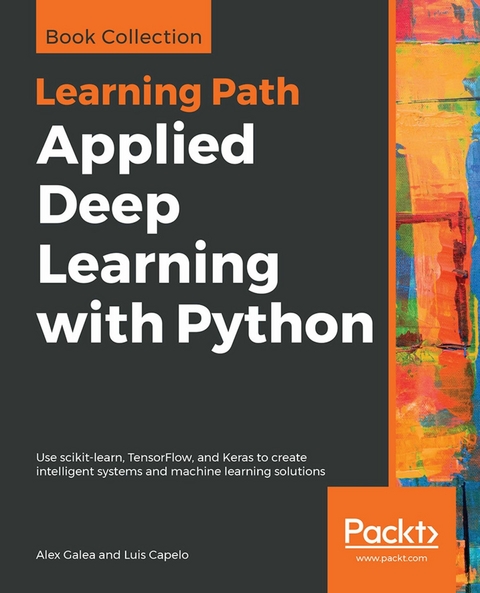
Applied Deep Learning with Python (eBook)
334 Seiten
Packt Publishing (Verlag)
978-1-78980-699-1 (ISBN)
Taking an approach that uses the latest developments in the Python ecosystem, you'll first be guided through the Jupyter ecosystem, key visualization libraries and powerful data sanitization techniques before you train your first predictive model. You'll then explore a variety of approaches to classification such as support vector networks, random decision forests and k-nearest neighbors to build on your knowledge before moving on to advanced topics.
After covering classification, you'll go on to discover ethical web scraping and interactive visualizations, which will help you professionally gather and present your analysis. Next, you'll start building your keystone deep learning application, one that aims to predict the future price of Bitcoin based on historical public data. You'll then be guided through a trained neural network, which will help you explore common deep learning network architectures (convolutional, recurrent, and generative adversarial networks) and deep reinforcement learning. Later, you'll delve into model optimization and evaluation. You'll do all this while working on a production-ready web application that combines TensorFlow and Keras to produce meaningful user-friendly results.
By the end of this book, you'll be equipped with the skills you need to tackle and develop your own real-world deep learning projects confidently and effectively.
A hands-on guide to deep learning that's filled with intuitive explanations and engaging practical examplesKey FeaturesDesigned to iteratively develop the skills of Python users who don't have a data science backgroundCovers the key foundational concepts you'll need to know when building deep learning systemsFull of step-by-step exercises and activities to help build the skills that you need for the real-worldBook DescriptionTaking an approach that uses the latest developments in the Python ecosystem, you'll first be guided through the Jupyter ecosystem, key visualization libraries and powerful data sanitization techniques before we train our first predictive model. We'll explore a variety of approaches to classification like support vector networks, random decision forests and k-nearest neighbours to build out your understanding before we move into more complex territory. It's okay if these terms seem overwhelming; we'll show you how to put them to work.We'll build upon our classification coverage by taking a quick look at ethical web scraping and interactive visualizations to help you professionally gather and present your analysis. It's after this that we start building out our keystone deep learning application, one that aims to predict the future price of Bitcoin based on historical public data.By guiding you through a trained neural network, we'll explore common deep learning network architectures (convolutional, recurrent, generative adversarial) and branch out into deep reinforcement learning before we dive into model optimization and evaluation. We'll do all of this whilst working on a production-ready web application that combines Tensorflow and Keras to produce a meaningful user-friendly result, leaving you with all the skills you need to tackle and develop your own real-world deep learning projects confidently and effectively.What you will learnDiscover how you can assemble and clean your very own datasetsDevelop a tailored machine learning classification strategyBuild, train and enhance your own models to solve unique problemsWork with production-ready frameworks like Tensorflow and KerasExplain how neural networks operate in clear and simple termsUnderstand how to deploy your predictions to the webWho this book is forIf you're a Python programmer stepping into the world of data science, this is the ideal way to get started.
| Erscheint lt. Verlag | 31.8.2018 |
|---|---|
| Sprache | englisch |
| Themenwelt | Mathematik / Informatik ► Informatik ► Programmiersprachen / -werkzeuge |
| ISBN-10 | 1-78980-699-2 / 1789806992 |
| ISBN-13 | 978-1-78980-699-1 / 9781789806991 |
| Informationen gemäß Produktsicherheitsverordnung (GPSR) | |
| Haben Sie eine Frage zum Produkt? |
 EPUB (Ohne DRM)
Digital Rights Management: ohne DRM
Dieses eBook enthält kein DRM oder Kopierschutz. Eine Weitergabe an Dritte ist jedoch rechtlich nicht zulässig, weil Sie beim Kauf nur die Rechte an der persönlichen Nutzung erwerben.
Dateiformat: EPUB (Electronic Publication)
EPUB ist ein offener Standard für eBooks und eignet sich besonders zur Darstellung von Belletristik und Sachbüchern. Der Fließtext wird dynamisch an die Display- und Schriftgröße angepasst. Auch für mobile Lesegeräte ist EPUB daher gut geeignet.
Systemvoraussetzungen:
PC/Mac: Mit einem PC oder Mac können Sie dieses eBook lesen. Sie benötigen dafür die kostenlose Software Adobe Digital Editions.
eReader: Dieses eBook kann mit (fast) allen eBook-Readern gelesen werden. Mit dem amazon-Kindle ist es aber nicht kompatibel.
Smartphone/Tablet: Egal ob Apple oder Android, dieses eBook können Sie lesen. Sie benötigen dafür eine kostenlose App.
Geräteliste und zusätzliche Hinweise
Buying eBooks from abroad
For tax law reasons we can sell eBooks just within Germany and Switzerland. Regrettably we cannot fulfill eBook-orders from other countries.
aus dem Bereich