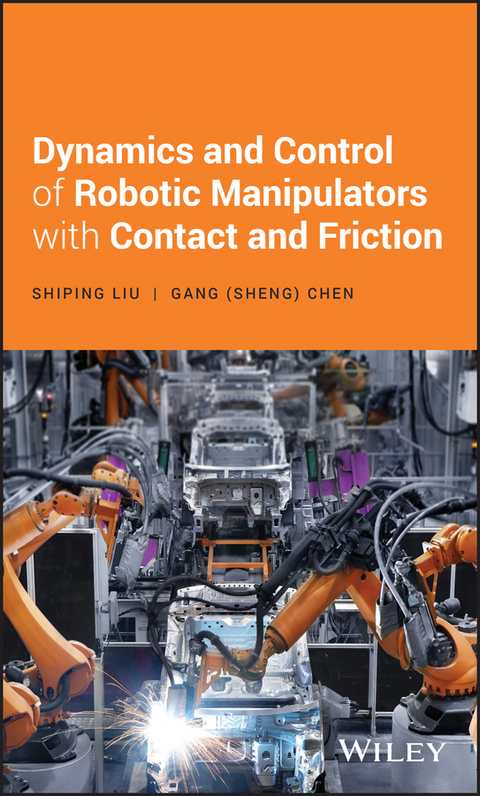
Dynamics and Control of Robotic Manipulators with Contact and Friction (eBook)
272 Seiten
John Wiley & Sons (Verlag)
978-1-119-42249-5 (ISBN)
Dynamics and Control of Robotic Manipulators with Contact and Friction offers an authoritative guide to the basic principles of robot dynamics and control with a focus on contact and friction. The authors discuss problems in interaction between human and real or virtual robot where dynamics with friction and contact are relevant. The book fills a void in the literature with a need for a text that considers the contact and friction generated in robot joints during their movements.
Designed as a practical resource, the text provides the information needed for task planning in view of contact, impact and friction for the designer of a robot control system for high accuracy and long durability. The authors include a review of the most up-to-date advancements in robot dynamics and control. It contains a comprehensive resource to the effective design and fabrication of robot systems and components for engineering and scientific purposes. This important guide:
* Offers a comprehensive reference with systematic treatment and a unified framework
* Includes simulation and experiments used in dynamics and control of robot considering contact, impact and friction
* Discusses the most current tribology methodology used to treat the multiple-scale effects
* Contains valuable descriptions of experiments and software used
* Presents illustrative accounts on the methods employed to handle friction in the closed loop, including the principles, implementation, application scope, merits and demerits
* Offers a cohesive treatment that covers tribology and multi-scales, multi-physics and nonlinear stochastic dynamics control
Written for graduate students of robotics, mechatronics, mechanical engineering, tracking control and practicing professionals and industrial researchers, Dynamics and Control of Robotic Manipulators with Contact and Friction offers a review to effective design and fabrication of stable and durable robot system and components.
DR. SHIPING LIU is an Associate Professor in School of Mechanical Engineering & Science, Huazhong University of Science and Technology in Wuhan, Hubei, China. DR. GANG (SHENG) CHEN is a Professor in College of Information Technology and Engineering, Marshall University, Huntington, WV, USA.
Ch1 Introduction
1.1 Friction modeling and parameter identification of robot joints
1.2 Contact perception in virtual environment
1.3 Organization of the Book
References
Ch2 Fundamentals of robot dynamics and control
2.1 Robot kinematics
2.1.1 Matrix description of robot kinematics
2.1.2 Homogenous transformation matrices
2.1.3 Forward kinematics
2.1.4 Inverse kinematics
2.1.5 Velocity kinematics
2.2 Robot dynamics
2.3 Robot control
2.3.1 introduction
2.3.2 Trajectory control
A. point to point control
B. Trajectories for Paths Specified by Points
C. Computed Torque Control
2.3.3 Interaction control
A. Impedance Control
B. Hybrid Force-Position Control
References
Ch 3. Friction and Contact of Solid Interfaces
3.1 Introduction
3.2 Contact Between Two Solid Surfaces
3.2.1. Description of surfaces
3.2.2 Contact Mechanics of Two Solid Surfaces
3.3 Friction Between Two Solid Surfaces
3.3.1 Adhesion
3.3.2 Dry Friction
3.3.2.1 Friction mechanisms
3.3.2.2 Friction transitions and wear
3.3.2.3 Static friction, hysteresis, time and displacement dependence
3.3.2.4 Effects of environmental and operational condition on friction
3.3.3 Liquid mediated friction
3.3.3.1 Stribeck curve
3.3.3.2 Unsteady Liquid-Mediated Friction
3.3.3.3 Negative Slope of Friction-velocity Curve
3.3.4 Friction Models
References
Ch 4 Friction Dynamics of Manipulator
4.1 Friction models of robot manipulator joints
4.2 Modeling friction with varied effects
4.2.1 The General Motion Equation of Robot Manipulator
4.2.2 The Motion Equation of Two-Link Robot Manipulator
4.3 Nonlinear Dynamics and Chaos of Manipulators
4.4 Parameters Identification
4.4.1 Identification of dynamic parameters
4.4.2 Identification of parameters of friction models
4.4.3 Uncertainty Analysis
4.5 Friction Compensation and Control of Robot Manipulator Dynamics
Reference
5. Force feedback and haptic rendering
5.1 Overview of robot force feedback
5.2 Generating methods of feedback force
5.2.1 Serial mechanism
A. Kinematics
B. Inverse Kinematics
C. Dynamics
5.2.2 Parallel mechanism
A. Kinematics Model
B Forward kinematics
C Inverse kinematics
D Dynamics based on virtual work
5.2.3 Friction compensation
5.3 Calculation of virtual force
5.3.1 Collision detection
A. The construction of the bounding box
B. Calculation of Distance between Bounding Boxes
B1. Bounding box is a Sphere
B2 Bounding box is center axis based bounding box.
5.3.2 Calculating model of virtual force
A. One-DOF interaction
B. Two-DOF interaction
C. Three-DOF interaction
D. Six-DOF interaction
5.4 Haptic display based on point haptic device
5.4.1 Human tactile perception
5.4.2 Haptic texture display methods
Reference
Ch6 Virtual simulation of robot control
6.1 Overview of robot simulation
6.2 3D graphic environment
6.3 Virtual reality based robot control
6.3.1 Overview of Virtual reality
6.3.2 Overview of teleoperation
6.3.3 Virtual reality based teleoperation
6.4 Augmented Reality based teleoperation.
6.4.1 Overview of Augmented reality
6.4.2 Augmented Reality based teleoperation
6.5 Task planning in virtual environment
6.5.1 Overview
6.5.2 Interactive graphic mode
Reference
| Erscheint lt. Verlag | 29.10.2018 |
|---|---|
| Sprache | englisch |
| Themenwelt | Informatik ► Theorie / Studium ► Künstliche Intelligenz / Robotik |
| Technik ► Elektrotechnik / Energietechnik | |
| Technik ► Maschinenbau | |
| Schlagworte | Control Process & Measurements • Electrical & Electronics Engineering • Elektrotechnik u. Elektronik • Festkörpermechanik • Maschinenbau • mechanical engineering • Mess- u. Regeltechnik • Robotics • Robotik • solid mechanics |
| ISBN-10 | 1-119-42249-3 / 1119422493 |
| ISBN-13 | 978-1-119-42249-5 / 9781119422495 |
| Informationen gemäß Produktsicherheitsverordnung (GPSR) | |
| Haben Sie eine Frage zum Produkt? |
 PDF (Adobe DRM)
Kopierschutz: Adobe-DRM
Adobe-DRM ist ein Kopierschutz, der das eBook vor Mißbrauch schützen soll. Dabei wird das eBook bereits beim Download auf Ihre persönliche Adobe-ID autorisiert. Lesen können Sie das eBook dann nur auf den Geräten, welche ebenfalls auf Ihre Adobe-ID registriert sind.
Details zum Adobe-DRM
Dateiformat: PDF (Portable Document Format)
Mit einem festen Seitenlayout eignet sich die PDF besonders für Fachbücher mit Spalten, Tabellen und Abbildungen. Eine PDF kann auf fast allen Geräten angezeigt werden, ist aber für kleine Displays (Smartphone, eReader) nur eingeschränkt geeignet.
Systemvoraussetzungen:
PC/Mac: Mit einem PC oder Mac können Sie dieses eBook lesen. Sie benötigen eine
eReader: Dieses eBook kann mit (fast) allen eBook-Readern gelesen werden. Mit dem amazon-Kindle ist es aber nicht kompatibel.
Smartphone/Tablet: Egal ob Apple oder Android, dieses eBook können Sie lesen. Sie benötigen eine
Geräteliste und zusätzliche Hinweise
Buying eBooks from abroad
For tax law reasons we can sell eBooks just within Germany and Switzerland. Regrettably we cannot fulfill eBook-orders from other countries.
aus dem Bereich