


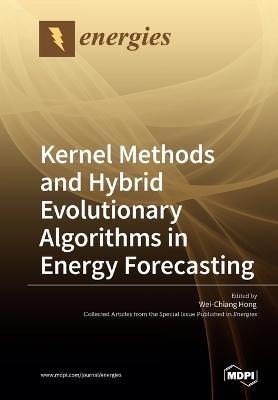
Kernel Methods and Hybrid Evolutionary Algorithms in Energy Forecasting
Seiten
2018
MDPI (Verlag)
978-3-03897-292-1 (ISBN)
MDPI (Verlag)
978-3-03897-292-1 (ISBN)
- Keine Verlagsinformationen verfügbar
- Artikel merken
The development of kernel methods and hybrid evolutionary algorithms (HEAs) to support experts in energy forecasting is of great importance to improving the accuracy of the actions derived from an energy decision maker, and it is crucial that they are theoretically sound. In addition, more accurate or more precise energy demand forecasts are required when decisions are made in a competitive environment. Therefore, this is of special relevance in the Big Data era. These forecasts are usually based on a complex function combination. These models have resulted in over-reliance on the use of informal judgment and higher expense if lacking the ability to catch the data patterns. The novel applications of kernel methods and hybrid evolutionary algorithms can provide more satisfactory parameters in forecasting models.
We aimed to attract researchers with an interest in the research areas described above. Specifically, we were interested in contributions towards the development of HEAs with kernel methods or with other novel methods (e.g., chaotic mapping mechanism, fuzzy theory, and quantum computing mechanism), which, with superior capabilities over the traditional optimization approaches, aim to overcome some embedded drawbacks and then apply these new HEAs to be hybridized with original forecasting models to significantly improve forecasting accuracy.
We aimed to attract researchers with an interest in the research areas described above. Specifically, we were interested in contributions towards the development of HEAs with kernel methods or with other novel methods (e.g., chaotic mapping mechanism, fuzzy theory, and quantum computing mechanism), which, with superior capabilities over the traditional optimization approaches, aim to overcome some embedded drawbacks and then apply these new HEAs to be hybridized with original forecasting models to significantly improve forecasting accuracy.
School of Computer Science and Technology, Jiangsu Normal University, China
| Erscheinungsdatum | 05.03.2022 |
|---|---|
| Mitarbeit |
Gast Herausgeber: Wei-Chiang Hong |
| Verlagsort | Basel |
| Sprache | englisch |
| Maße | 170 x 244 mm |
| Themenwelt | Informatik ► Theorie / Studium ► Algorithmen |
| Technik ► Maschinenbau | |
| Schlagworte | chaotic mapping mechanism • Empirical Mode Decomposition • Energy forecasting • Extreme Learning Machine • Fuzzy time series • Hybrid Models • Kernel Methods • quantum computing mechanism • spiking neural networks • support vector regression / support vector machines • wavelet transform |
| ISBN-10 | 3-03897-292-4 / 3038972924 |
| ISBN-13 | 978-3-03897-292-1 / 9783038972921 |
| Zustand | Neuware |
| Informationen gemäß Produktsicherheitsverordnung (GPSR) | |
| Haben Sie eine Frage zum Produkt? |
Mehr entdecken
aus dem Bereich


aus dem Bereich
Buch | Softcover (2025)
Lehmanns Media (Verlag)
CHF 62,95
die Welt der generativen KI verstehen
Buch | Hardcover (2025)
Hanser (Verlag)
CHF 48,95


