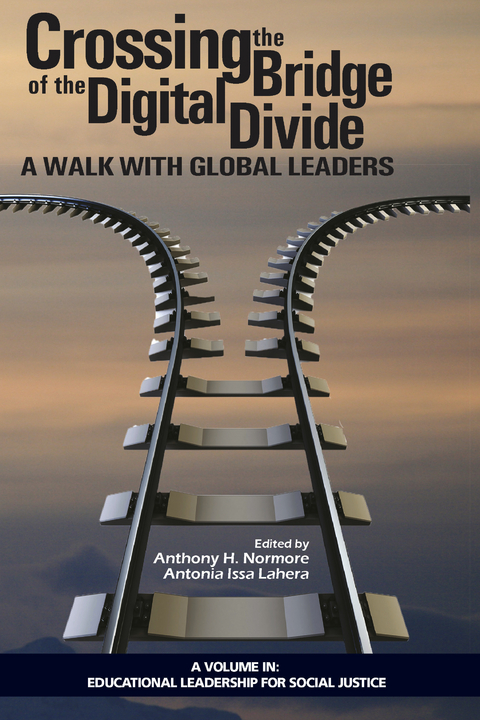
The contributing authors- representing Unites States, Canada, South Africa, New Zealand, and the UK - posit that education institutions can serve as the bridge to close the digital divide for students who do not have access to information technology in their homes. At a time when more computers are made available in schools than ever before, the digital divide continues to widen and fewer people in the lowest SES groups are given the opportunity to join the world of computer technology and the internet. As a result, the influence of leadership activity on institutional racism, gender discrimination, inequality of opportunity, inequity of educational processes, digital exclusion, and justice have gained currency and attention
The contributing national and international authors examine the digital divide in terms of social justice leadership, equity and access. It is within this context that the authors offer discussions from a lens of their choice, i.e. conceptual, review of literature, epistemological, etc. By adopting an educational approach to bridging the digital divide, researchers and practitioners can connect and extend long established lines of conceptual and empirical inquiry aimed at improving organizational practices and thereby gain insights that might be otherwise overlooked, or assumed. This holds great promise for generating, refining, and testing theories of leadership for equity and access, and helps strengthen already vibrant lines of inquiry on social justice.
Crossing the Bridge of the Digital Divide: A Walk with Global Leaders explores the combined effect of the rapid growth of information as an increasingly fragmented information base, a large component of which is available only to people with money and/or acceptable institutional affiliations. In the recent past, the outcome of these challenges has been characterized as the "e;digital divide"e; between the information "e;haves"e; and "e;have nots"e; along racial and socio economic lines that seem to widen as time passes. To address the issues of digital equity and digital inequality in an effort to bridge the digital divide, educational scholars, researchers and practitioners are in positions to ensure equitable opportunities are made available for people of all ages, races, ability, sexual orientation, and ethnicity in support of social justice for bridging the digital divide. The digital divide addresses issues concerning equal opportunity, equity and access that have an effect on the development of marginalized and otherwise disenfranchised populations within and across systems nationally and internationally.The contributing authors- representing Unites States, Canada, South Africa, New Zealand, and the UK - posit that education institutions can serve as the bridge to close the digital divide for students who do not have access to information technology in their homes. At a time when more computers are made available in schools than ever before, the digital divide continues to widen and fewer people in the lowest SES groups are given the opportunity to join the world of computer technology and the internet. As a result, the influence of leadership activity on institutional racism, gender discrimination, inequality of opportunity, inequity of educational processes, digital exclusion, and justice have gained currency and attention.The contributing national and international authors examine the digital divide in terms of social justice leadership, equity and access. It is within this context that the authors offer discussions from a lens of their choice, i.e. conceptual, review of literature, epistemological, etc. By adopting an educational approach to bridging the digital divide, researchers and practitioners can connect and extend long established lines of conceptual and empirical inquiry aimed at improving organizational practices and thereby gain insights that might be otherwise overlooked, or assumed. This holds great promise for generating, refining, and testing theories of leadership for equity and access, and helps strengthen already vibrant lines of inquiry on social justice.
| Erscheint lt. Verlag | 1.9.2018 |
|---|---|
| Sprache | englisch |
| Themenwelt | Schulbuch / Wörterbuch ► Lexikon / Chroniken |
| Mathematik / Informatik ► Informatik | |
| Sozialwissenschaften ► Soziologie | |
| Technik ► Elektrotechnik / Energietechnik | |
| ISBN-10 | 1-64113-392-9 / 1641133929 |
| ISBN-13 | 978-1-64113-392-0 / 9781641133920 |
| Informationen gemäß Produktsicherheitsverordnung (GPSR) | |
| Haben Sie eine Frage zum Produkt? |
 PDF (Adobe DRM)
Größe: 7,5 MB
Kopierschutz: Adobe-DRM
Adobe-DRM ist ein Kopierschutz, der das eBook vor Mißbrauch schützen soll. Dabei wird das eBook bereits beim Download auf Ihre persönliche Adobe-ID autorisiert. Lesen können Sie das eBook dann nur auf den Geräten, welche ebenfalls auf Ihre Adobe-ID registriert sind.
Details zum Adobe-DRM
Dateiformat: PDF (Portable Document Format)
Mit einem festen Seitenlayout eignet sich die PDF besonders für Fachbücher mit Spalten, Tabellen und Abbildungen. Eine PDF kann auf fast allen Geräten angezeigt werden, ist aber für kleine Displays (Smartphone, eReader) nur eingeschränkt geeignet.
Systemvoraussetzungen:
PC/Mac: Mit einem PC oder Mac können Sie dieses eBook lesen. Sie benötigen eine
eReader: Dieses eBook kann mit (fast) allen eBook-Readern gelesen werden. Mit dem amazon-Kindle ist es aber nicht kompatibel.
Smartphone/Tablet: Egal ob Apple oder Android, dieses eBook können Sie lesen. Sie benötigen eine
Geräteliste und zusätzliche Hinweise
Buying eBooks from abroad
For tax law reasons we can sell eBooks just within Germany and Switzerland. Regrettably we cannot fulfill eBook-orders from other countries.
 EPUB (Adobe DRM)
Kopierschutz: Adobe-DRM
Adobe-DRM ist ein Kopierschutz, der das eBook vor Mißbrauch schützen soll. Dabei wird das eBook bereits beim Download auf Ihre persönliche Adobe-ID autorisiert. Lesen können Sie das eBook dann nur auf den Geräten, welche ebenfalls auf Ihre Adobe-ID registriert sind.
Details zum Adobe-DRM
Dateiformat: EPUB (Electronic Publication)
EPUB ist ein offener Standard für eBooks und eignet sich besonders zur Darstellung von Belletristik und Sachbüchern. Der Fließtext wird dynamisch an die Display- und Schriftgröße angepasst. Auch für mobile Lesegeräte ist EPUB daher gut geeignet.
Systemvoraussetzungen:
PC/Mac: Mit einem PC oder Mac können Sie dieses eBook lesen. Sie benötigen eine
eReader: Dieses eBook kann mit (fast) allen eBook-Readern gelesen werden. Mit dem amazon-Kindle ist es aber nicht kompatibel.
Smartphone/Tablet: Egal ob Apple oder Android, dieses eBook können Sie lesen. Sie benötigen eine
Geräteliste und zusätzliche Hinweise
Buying eBooks from abroad
For tax law reasons we can sell eBooks just within Germany and Switzerland. Regrettably we cannot fulfill eBook-orders from other countries.
aus dem Bereich