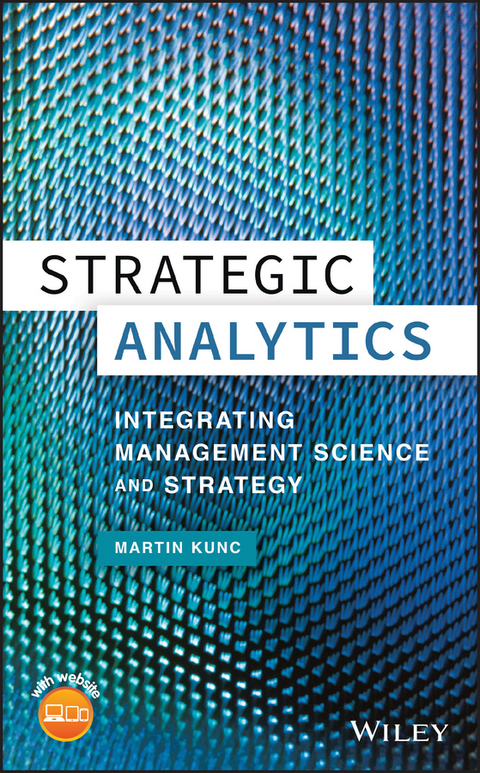
Defines common ground at the interface of strategy and management science and unites the topics with an original approach vital for strategy students, researchers and managers
Strategic Analytics: Integrating Management Science and Strategy combines strategy content with strategy process through the lenses of management science, masterfully defining the common ground that unites both fields. Each chapter starts with the perspective of a certain strategy problem, such as competition, but continues with an explanation of the strategy process using management science tools such as simulation. Facilitating the process of strategic decision making through the lens of management science, the author integrates topics that are usually in conflict for MBAs: strategy and quantitative methods. Strategic Analytics features multiple international real-life case studies and examples, business issues for further research and theory review questions and exercises at the end of each chapter.
Strategic Analytics starts by introducing readers to strategic management. It then goes on to cover: managerial capabilities for a complex world; politics, economy, society, technology, and environment; external environments known as exogenous factors (PESTE) and endogenous factors (industry); industry dynamics; industry evolution; competitive advantage; dynamic resource management; organisational design; performance measurement system; the life cycle of organisations from start-ups; maturity for maintaining profitability and growth; and finally, regeneration.
- Developed from the author's own Strategy Analytics course at Warwick Business School, personal experience as consultant, and in consultation with other leading scholars
- Uses management science to facilitate the process of strategic decision making
- Chapters structured with chapter objectives, summaries, short case studies, tables, student exercises, references and management science models
- Accompanied by a supporting website
Aimed at both academics and practitioners, Strategic Analytics is an ideal text for postgraduates and advanced undergraduate students of business and management.
MARTIN KUNC, PhD, is Associate Professor of Management Science, Warwick Business School, University of Warwick. He is a member of Operational Research Society, INFORMS System Dynamics Society, and Arthur Andersen Alumni. Martin Kunc has extensive experience in consulting and published more than 50 articles.
Defines common ground at the interface of strategy and management science and unites the topics with an original approach vital for strategy students, researchers and managers Strategic Analytics: Integrating Management Science and Strategy combines strategy content with strategy process through the lenses of management science, masterfully defining the common ground that unites both fields. Each chapter starts with the perspective of a certain strategy problem, such as competition, but continues with an explanation of the strategy process using management science tools such as simulation. Facilitating the process of strategic decision making through the lens of management science, the author integrates topics that are usually in conflict for MBAs: strategy and quantitative methods. Strategic Analytics features multiple international real-life case studies and examples, business issues for further research and theory review questions and exercises at the end of each chapter. Strategic Analytics starts by introducing readers to strategic management. It then goes on to cover: managerial capabilities for a complex world; politics, economy, society, technology, and environment; external environments known as exogenous factors (PESTE) and endogenous factors (industry); industry dynamics; industry evolution; competitive advantage; dynamic resource management; organisational design; performance measurement system; the life cycle of organisations from start-ups; maturity for maintaining profitability and growth; and finally, regeneration. Developed from the author's own Strategy Analytics course at Warwick Business School, personal experience as consultant, and in consultation with other leading scholars Uses management science to facilitate the process of strategic decision making Chapters structured with chapter objectives, summaries, short case studies, tables, student exercises, references and management science models Accompanied by a supporting website Aimed at both academics and practitioners, Strategic Analytics is an ideal text for postgraduates and advanced undergraduate students of business and management.
MARTIN KUNC, PhD, is Professor of Business Analytics/Management Science at Southampton Business School, University of Southampton. He is a member of Operational Research Society, INFORMS System Dynamics Society, and Arthur Andersen Alumni. Martin Kunc has extensive experience in consulting and published more than 50 articles.
1
Introduction to Strategic Analytics
Objectives
- To explain Strategic Analytics
- To introduce the main pillars of the book: the fields of analytics, management science, information technology, statistics and strategic management
- To explain the fields of analytics, management science, information technology, big data analytics and strategic management
Learning outcomes and managerial capabilities developed
- Managers can learn to tackle complex problems in strategy through the integration of analytics within strategic management processes
- Principles of Analytics: tools, support systems and methods
- Identification of strategic problems
In today's environment, managers face turbulence and crisis. More information than ever is generated continuously: social media, financial performance management systems, customer relationship management systems, and internal and external reports. There are powerful trends: measuring and quantifying everything and skills in quantitative subjects are widely available. The problem for managers is not only to make sense of abundant quantitative information but also to engage with staff possessing analytical skills. Simultaneously managing multiple factors under pressure requires new managerial capabilities. Managers need to develop their strategies using clear strategy processes supported by the increasing availability of data. This situation calls for a different approach to strategy, such as an integration with analytics, as the science of extracting value from data and structuring complex problems.
Managers' decision processes can fall into a continuum which has on one hand pure analysis, which relies on established processes, and pure synthesis that involves identification of patterns and new ideas (Pidd, 2009). Strategic planning involves a mix between both extremes: analysis to identify problems and synthesis to observe trends and emerging situations before competitors. However, there is not a clear process when combining the two. Sometimes, emerging situations are discovered and then analysis is employed to confirm their impact while transforming them into new emergent strategies. In other circumstances, there is a careful planning process involving extensive data gathering and the construction of complex financial, operational and other type models to validate the new strategies.
The idea behind “Strategic Analytics” is to answer a simple question: how can quantitative and qualitative information be used to make strategic decisions? Strategic Analytics does not imply turning managers into quantitative analysts or quantitative analysts into expert strategists. Organizations need interdisciplinary teams comprised by members who can talk to each other sharing a common language. Thus, Strategic Analytics works on the basis of providing a reasonable understanding of how a variety of quantitative methods, in conjunction with structured and unstructured data, can be used to help strategic decision making in any organization. There is also the intent to show the real and practical benefit of Strategic Analytics. Strategic Analytics does not pretend to offer easy solutions to strategic problems but different ways of analyzing and solving strategic problems beyond the traditional qualitative approach to strategic management. Strategic Analytics is also an understanding of the context and processes in which analytics skills can be applied to support strategic management.
Future managers are taught a wide variety of concepts in strategy subjects but they are not taught how to apply them or even to connect them to related problems. Future managers need to develop capabilities to tackle problems that are not structured in a neat way like case studies are. In that sense, each chapter focuses on a case study with limited information that has to be solved applying a combination of theoretical concepts and analytical methods (quantitative and qualitative). The aim of this founding principle is to integrate strategic concepts with analytical tools in a unique set of capabilities (skills) to help future managers to tackle strategic problem using multiple sources of information. The main benefit is that quantitative methods, which are usually seen as a difficult experience for managers, are connected with a hands‐on subject like strategy. Therefore, managers can learn capabilities to tackle complex problems in strategy through the integration of analytics (quantitative/qualitative methods to extract value from data) within strategic management processes. Therefore, the book will provide a bridge to integrate quantitative methods with their application in strategy adding rigorous methods to solve real issues in strategy.
The rest of the chapter introduces the main pillars of the book: the fields of analytics, management science, information technology, statistics and strategic management.
1.1 What is Analytics?
Organizations are competing using analytics because there is an increasing amount of data, people with capabilities to use data and, in a highly competitive environment, it is more difficult to compete effectively. While organizations can use basic descriptive statistics from any of their existing data, organizations using analytics apply modeling to understand their environments, predict the behavior of key actors, e.g. customers and suppliers, and optimize operations. Organizations can obtain competitive advantage using multiples analytics applications but it requires a new type of organization and management (Davenport, 2006):
a companywide embrace of analytics impels changes in culture, processes, behavior and skills for many employees. And so, like any major transition, it requires leadership from executives at the very top who have a passion for the quantitative approach… CEOs leading the analytics charge require both an appreciation of and a familiarity with the subject. A background in statistics isn't necessary, but those leaders must understand the theory behind various quantitative methods so that they recognize those methods' limitations‐which factors are weighed and which ones aren't… Of course, not all decision should be grounded in analytics… For analytics‐minded leaders, then, the challenge boils down to knowing when to run with the numbers and when to run with their guts (Davenport, 2006: pages 102–103)
An analytical perspective is important, when data has become a key strategic asset of organizations in recent years, and analytics creates value by delivering systematic decision support in a well‐timed way (Laursen and Thorlund, 2010; Holsapple et al., 2014). Business analytics, one of the multiple branches in Analytics, comprises three key elements: Information Systems, Human Competencies, and Business Processes (Laursen and Thorlund, 2010). Business analytics reflects the convergence of three disciplines: statistics, information systems, and management science (Laursen and Thorlund, 2010). While the supporting disciplines are traditional, the innovation lies in their intersections. For example, data mining aims to understand characteristics and patterns among variables in large databases using a variety of statistical analysis, e.g. correlation and regression analysis. Information technology provides data and supports decision support systems, which are sustained by management science tools together with statistical analysis, for the development of analytics. Business analytics is rooted in advances of information technology systems, which involve the acquisition, generation, assimilation, selection and presentation of data, together with tools, statistics and management science, to develop the data into knowledge to support decision making. In a similar definition, Mortenson et al. (2015) suggest analytics is the intersection of basic disciplines: technologies (electrical engineering and computer science), decision making (psychology and behavioral science) and quantitative methods (mathematics, statistics and economics); and their applications: information systems, artificial intelligence and operational research. Figure 1.1 shows Mortenson et al.'s (2015) representation of the concept of analytics.
Figure 1.1 The analytics field..
Source: Mortenson et al. (2015: figure 1, page 586). Reproduced with permission of Elsevier
In terms of types of analytics, Davenport proposes three types: descriptive, predictive, and prescriptive (Davenport, 2013), which are described below.
- Descriptive Analytics. It employs traditional statistical skills to present data collected from internal organizational activities and external data. It is utilized to understand what happened during their past business activities in order to disclose whether the current business objectives have been obtained. Then the next step is to investigate the reasons behind the results by drilling down into more detailed data and explore scientifically, e.g. test and validate or reject hypotheses. It is characterized traditionally as data mining, business intelligence and dashboards.
- Predictive Analytics. It involves statistical and mathematic techniques to predict future unknown events or behaviors based on historical data to support operations. Some of the popular techniques in this area cover decision tree, text analytics, neural networks, regression modeling, and time‐series forecasting. Predictive analytics also relies on...
| Erscheint lt. Verlag | 11.10.2018 |
|---|---|
| Sprache | englisch |
| Themenwelt | Mathematik / Informatik ► Mathematik |
| Wirtschaft ► Betriebswirtschaft / Management ► Unternehmensführung / Management | |
| Schlagworte | Betriebswirtschaft u. Operationsforschung • Business & Management • Business Statistics & Math • Business Strategy • business strategy process • corporate resources • Finanz- u. Wirtschaftsstatistik • group decision making • leadership strategies • <i>Strategic Analytics: Integrating Management Science and Strategy</i></p> • <p>strategic analytics • Management Decision Making • Management Science • Management Science/Operational Research • management science tools • management strategy • managerial science • Operations Research • Scenario Planning • Statistics • Statistics for Finance, Business & Economics • Statistik • Strategic development • Strategic Management • strategic management methods • strategic optimisation • strategic optimization • strategic simulation • strategy analytics • strategy content for management • strategy design • Wirtschaftsmathematik u. -statistik • Wirtschaft u. Management |
| ISBN-13 | 9781118943687 / 9781118943687 |
| Informationen gemäß Produktsicherheitsverordnung (GPSR) | |
| Haben Sie eine Frage zum Produkt? |
 EPUB (Adobe DRM)
Kopierschutz: Adobe-DRM
Adobe-DRM ist ein Kopierschutz, der das eBook vor Mißbrauch schützen soll. Dabei wird das eBook bereits beim Download auf Ihre persönliche Adobe-ID autorisiert. Lesen können Sie das eBook dann nur auf den Geräten, welche ebenfalls auf Ihre Adobe-ID registriert sind.
Details zum Adobe-DRM
Dateiformat: EPUB (Electronic Publication)
EPUB ist ein offener Standard für eBooks und eignet sich besonders zur Darstellung von Belletristik und Sachbüchern. Der Fließtext wird dynamisch an die Display- und Schriftgröße angepasst. Auch für mobile Lesegeräte ist EPUB daher gut geeignet.
Systemvoraussetzungen:
PC/Mac: Mit einem PC oder Mac können Sie dieses eBook lesen. Sie benötigen eine
eReader: Dieses eBook kann mit (fast) allen eBook-Readern gelesen werden. Mit dem amazon-Kindle ist es aber nicht kompatibel.
Smartphone/Tablet: Egal ob Apple oder Android, dieses eBook können Sie lesen. Sie benötigen eine
Geräteliste und zusätzliche Hinweise
Buying eBooks from abroad
For tax law reasons we can sell eBooks just within Germany and Switzerland. Regrettably we cannot fulfill eBook-orders from other countries.
aus dem Bereich