


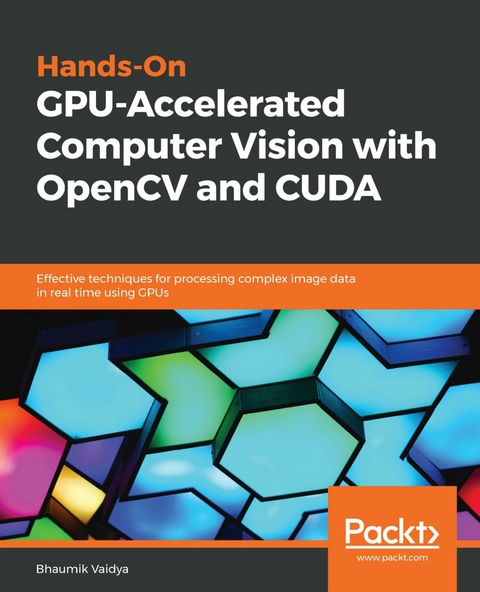
Hands-On GPU-Accelerated Computer Vision with OpenCV and CUDA (eBook)
380 Seiten
Packt Publishing (Verlag)
9781789343687 (ISBN)
Discover how CUDA allows OpenCV to handle complex and rapidly growing image data processing in computer and machine vision by accessing the power of GPU
Key Features
- Explore examples to leverage the GPU processing power with OpenCV and CUDA
- Enhance the performance of algorithms on embedded hardware platforms
- Discover C++ and Python libraries for GPU acceleration
Book Description
Computer vision has been revolutionizing a wide range of industries, and OpenCV is the most widely chosen tool for computer vision with its ability to work in multiple programming languages. Nowadays, in computer vision, there is a need to process large images in real time, which is difficult to handle for OpenCV on its own. This is where CUDA comes into the picture, allowing OpenCV to leverage powerful NVDIA GPUs. This book provides a detailed overview of integrating OpenCV with CUDA for practical applications.
To start with, you'll understand GPU programming with CUDA, an essential aspect for computer vision developers who have never worked with GPUs. You'll then move on to exploring OpenCV acceleration with GPUs and CUDA by walking through some practical examples.
Once you have got to grips with the core concepts, you'll familiarize yourself with deploying OpenCV applications on NVIDIA Jetson TX1, which is popular for computer vision and deep learning applications. The last chapters of the book explain PyCUDA, a Python library that leverages the power of CUDA and GPUs for accelerations and can be used by computer vision developers who use OpenCV with Python.
By the end of this book, you'll have enhanced computer vision applications with the help of this book's hands-on approach.
What you will learn
- Understand how to access GPU device properties and capabilities from CUDA programs
- Learn how to accelerate searching and sorting algorithms
- Detect shapes such as lines and circles in images
- Explore object tracking and detection with algorithms
- Process videos using different video analysis techniques in Jetson TX1
- Access GPU device properties from the PyCUDA program
- Understand how kernel execution works
Who this book is for
This book is a go-to guide for you if you are a developer working with OpenCV and want to learn how to process more complex image data by exploiting GPU processing. A thorough understanding of computer vision concepts and programming languages such as C++ or Python is expected.
Discover how CUDA allows OpenCV to handle complex and rapidly growing image data processing in computer and machine vision by accessing the power of GPUKey FeaturesExplore examples to leverage the GPU processing power with OpenCV and CUDAEnhance the performance of algorithms on embedded hardware platformsDiscover C++ and Python libraries for GPU accelerationBook DescriptionComputer vision has been revolutionizing a wide range of industries, and OpenCV is the most widely chosen tool for computer vision with its ability to work in multiple programming languages. Nowadays, in computer vision, there is a need to process large images in real time, which is difficult to handle for OpenCV on its own. This is where CUDA comes into the picture, allowing OpenCV to leverage powerful NVDIA GPUs. This book provides a detailed overview of integrating OpenCV with CUDA for practical applications. To start with, you'll understand GPU programming with CUDA, an essential aspect for computer vision developers who have never worked with GPUs. You'll then move on to exploring OpenCV acceleration with GPUs and CUDA by walking through some practical examples.Once you have got to grips with the core concepts, you'll familiarize yourself with deploying OpenCV applications on NVIDIA Jetson TX1, which is popular for computer vision and deep learning applications. The last chapters of the book explain PyCUDA, a Python library that leverages the power of CUDA and GPUs for accelerations and can be used by computer vision developers who use OpenCV with Python.By the end of this book, you'll have enhanced computer vision applications with the help of this book's hands-on approach.What you will learnUnderstand how to access GPU device properties and capabilities from CUDA programsLearn how to accelerate searching and sorting algorithmsDetect shapes such as lines and circles in imagesExplore object tracking and detection with algorithmsProcess videos using different video analysis techniques in Jetson TX1Access GPU device properties from the PyCUDA programUnderstand how kernel execution worksWho this book is forThis book is a go-to guide for you if you are a developer working with OpenCV and want to learn how to process more complex image data by exploiting GPU processing. A thorough understanding of computer vision concepts and programming languages such as C++ or Python is expected.
| Erscheint lt. Verlag | 26.9.2018 |
|---|---|
| Sprache | englisch |
| Themenwelt | Mathematik / Informatik ► Informatik ► Programmiersprachen / -werkzeuge |
| Schlagworte | cuda • GPU • NVIDIA Jetson TX1 • OpenCV • PyCUDA |
| ISBN-13 | 9781789343687 / 9781789343687 |
| Informationen gemäß Produktsicherheitsverordnung (GPSR) | |
| Haben Sie eine Frage zum Produkt? |
 EPUB (Adobe DRM)
Größe: 16,0 MB
Kopierschutz: Adobe-DRM
Adobe-DRM ist ein Kopierschutz, der das eBook vor Mißbrauch schützen soll. Dabei wird das eBook bereits beim Download auf Ihre persönliche Adobe-ID autorisiert. Lesen können Sie das eBook dann nur auf den Geräten, welche ebenfalls auf Ihre Adobe-ID registriert sind.
Details zum Adobe-DRM
Dateiformat: EPUB (Electronic Publication)
EPUB ist ein offener Standard für eBooks und eignet sich besonders zur Darstellung von Belletristik und Sachbüchern. Der Fließtext wird dynamisch an die Display- und Schriftgröße angepasst. Auch für mobile Lesegeräte ist EPUB daher gut geeignet.
Systemvoraussetzungen:
PC/Mac: Mit einem PC oder Mac können Sie dieses eBook lesen. Sie benötigen eine
eReader: Dieses eBook kann mit (fast) allen eBook-Readern gelesen werden. Mit dem amazon-Kindle ist es aber nicht kompatibel.
Smartphone/Tablet: Egal ob Apple oder Android, dieses eBook können Sie lesen. Sie benötigen eine
Geräteliste und zusätzliche Hinweise
Buying eBooks from abroad
For tax law reasons we can sell eBooks just within Germany and Switzerland. Regrettably we cannot fulfill eBook-orders from other countries.
EPUB (Ohne DRM)Digital Rights Management: ohne DRM
Dieses eBook enthält kein DRM oder Kopierschutz. Eine Weitergabe an Dritte ist jedoch rechtlich nicht zulässig, weil Sie beim Kauf nur die Rechte an der persönlichen Nutzung erwerben.
Dateiformat: EPUB (Electronic Publication)
EPUB ist ein offener Standard für eBooks und eignet sich besonders zur Darstellung von Belletristik und Sachbüchern. Der Fließtext wird dynamisch an die Display- und Schriftgröße angepasst. Auch für mobile Lesegeräte ist EPUB daher gut geeignet.
Systemvoraussetzungen:
PC/Mac: Mit einem PC oder Mac können Sie dieses eBook lesen. Sie benötigen dafür die kostenlose Software Adobe Digital Editions.
eReader: Dieses eBook kann mit (fast) allen eBook-Readern gelesen werden. Mit dem amazon-Kindle ist es aber nicht kompatibel.
Smartphone/Tablet: Egal ob Apple oder Android, dieses eBook können Sie lesen. Sie benötigen dafür eine kostenlose App.
Geräteliste und zusätzliche Hinweise
Buying eBooks from abroad
For tax law reasons we can sell eBooks just within Germany and Switzerland. Regrettably we cannot fulfill eBook-orders from other countries.
aus dem Bereich


