


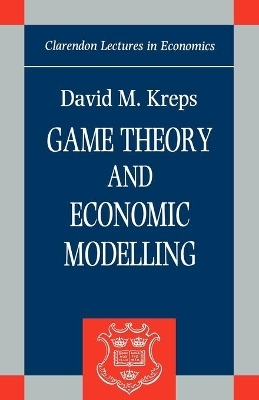
Game Theory and Economic Modelling
Seiten
1990
Oxford University Press (Verlag)
978-0-19-828381-2 (ISBN)
Oxford University Press (Verlag)
978-0-19-828381-2 (ISBN)
The advent of noncooperative game theory over the past two decades has brought about a mild revolution in economics. This book presents an accessible, non-technical discussion of the basic concepts from noncooperative theory, and explores the strengths, weaknesses, and future of the theory as a tool for economists.
Over the past two decades, academic economics has undergone a mild revolution in methodology. The language, concepts and techniques of noncooperative game theory have become central to the discipline.
This book provides the reader with some basic concepts from noncooperative theory, and then goes on to explore the strengths, weaknesses, and future of the theory as a tool of economic modelling and analysis. The central theses are that noncooperative game theory has been a remarkably popular tool in economics over the past decade because it allows analysts to capture essential features of dynamic competition and competition where some parties have proprietary information. The theory is weakest in providing a sense of when it - and equilibrium analysis in particular - can be applied and what to do when equilibrium analysis is inappropriate. Many of these weaknesses can be addressed by the consideration of individuals who are boundedly rational and learn imperfectly from the past.
Written in a non-technical style and working by analogy, the book, first given as part of the Clarendon Lectures in Economics, is readily accessible to a broad audience and will be of interest to economists and students alike. Knowledge of game theory is not required as the concepts are developed as the book progresses.
Over the past two decades, academic economics has undergone a mild revolution in methodology. The language, concepts and techniques of noncooperative game theory have become central to the discipline.
This book provides the reader with some basic concepts from noncooperative theory, and then goes on to explore the strengths, weaknesses, and future of the theory as a tool of economic modelling and analysis. The central theses are that noncooperative game theory has been a remarkably popular tool in economics over the past decade because it allows analysts to capture essential features of dynamic competition and competition where some parties have proprietary information. The theory is weakest in providing a sense of when it - and equilibrium analysis in particular - can be applied and what to do when equilibrium analysis is inappropriate. Many of these weaknesses can be addressed by the consideration of individuals who are boundedly rational and learn imperfectly from the past.
Written in a non-technical style and working by analogy, the book, first given as part of the Clarendon Lectures in Economics, is readily accessible to a broad audience and will be of interest to economists and students alike. Knowledge of game theory is not required as the concepts are developed as the book progresses.
Introduction ; 1. The standard ; 2. Basic notions of noncooperative game theory ; 3. The successes of game theory ; 4. The problems of game theory ; 5. Bounded rationality and retrospection ; Bibliography ; Index
| Erscheint lt. Verlag | 4.10.1990 |
|---|---|
| Reihe/Serie | Clarendon Lectures in Economics |
| Zusatzinfo | 40 line figures |
| Verlagsort | Oxford |
| Sprache | englisch |
| Maße | 139 x 217 mm |
| Gewicht | 270 g |
| Themenwelt | Mathematik / Informatik ► Mathematik ► Angewandte Mathematik |
| Mathematik / Informatik ► Mathematik ► Finanz- / Wirtschaftsmathematik | |
| Wirtschaft ► Allgemeines / Lexika | |
| Wirtschaft ► Volkswirtschaftslehre | |
| ISBN-10 | 0-19-828381-4 / 0198283814 |
| ISBN-13 | 978-0-19-828381-2 / 9780198283812 |
| Zustand | Neuware |
| Informationen gemäß Produktsicherheitsverordnung (GPSR) | |
| Haben Sie eine Frage zum Produkt? |
Mehr entdecken
aus dem Bereich



aus dem Bereich
für Ingenieure und Naturwissenschaftler
Buch | Softcover (2024)
Springer Vieweg (Verlag)
CHF 48,95
Buch | Softcover (2025)
Springer Vieweg (Verlag)
CHF 62,95
Buch | Softcover (2025)
Springer Fachmedien Wiesbaden (Verlag)
CHF 69,95


