


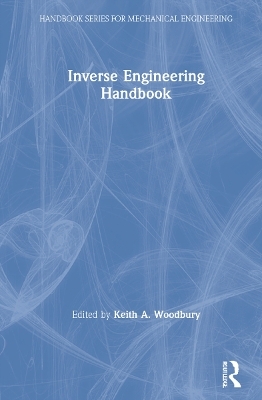
Inverse Engineering Handbook
Seiten
2002
Crc Press Inc (Verlag)
978-0-8493-0861-1 (ISBN)
Crc Press Inc (Verlag)
978-0-8493-0861-1 (ISBN)
- Titel erscheint in neuer Auflage
- Artikel merken
Zu diesem Artikel existiert eine Nachauflage
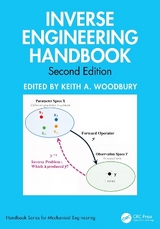
Allows readers to understand, implement, and benefit from a variety of inverse problem-solving techniques. This book addresses techniques such as sequential function estimation, mollification, space marching techniques, and adjoint, Monte Carlo, and gradient-based methods.
Inverse problems have been the focus of a growing number of research efforts over the last 40 years-and rightly so. The ability to determine a "cause" from an observed "effect" is a powerful one. Researchers now have at their disposal a variety of techniques for solving inverse problems, techniques that go well beyond those useful for relatively simple parameter estimation problems. The question is, where can one find a single, comprehensive resource that details these methods?
The answer is the Inverse Engineering Handbook. Leading experts in inverse problems have joined forces to produce the definitive reference that allows readers to understand, implement, and benefit from a variety of problem-solving techniques. Each chapter details a method developed or refined by its contributor, who provides clear explanations, examples, and in many cases, software algorithms. The presentation begins with methods for parameter estimation, which build a bridge to boundary function estimation problems. The techniques addressed include sequential function estimation, mollification, space marching techniques, and adjoint, Monte Carlo, and gradient-based methods. Discussions also cover important experimental aspects, including experiment design and the effects of uncertain parameters.
While many of the examples presented focus on heat transfer, the techniques discussed are applicable to a wide range of inverse problems. Anyone interested in inverse problems, regardless of their specialty, will find the Inverse Engineering Handbook to be a unique and invaluable compendium of up-to-date techniques.
Inverse problems have been the focus of a growing number of research efforts over the last 40 years-and rightly so. The ability to determine a "cause" from an observed "effect" is a powerful one. Researchers now have at their disposal a variety of techniques for solving inverse problems, techniques that go well beyond those useful for relatively simple parameter estimation problems. The question is, where can one find a single, comprehensive resource that details these methods?
The answer is the Inverse Engineering Handbook. Leading experts in inverse problems have joined forces to produce the definitive reference that allows readers to understand, implement, and benefit from a variety of problem-solving techniques. Each chapter details a method developed or refined by its contributor, who provides clear explanations, examples, and in many cases, software algorithms. The presentation begins with methods for parameter estimation, which build a bridge to boundary function estimation problems. The techniques addressed include sequential function estimation, mollification, space marching techniques, and adjoint, Monte Carlo, and gradient-based methods. Discussions also cover important experimental aspects, including experiment design and the effects of uncertain parameters.
While many of the examples presented focus on heat transfer, the techniques discussed are applicable to a wide range of inverse problems. Anyone interested in inverse problems, regardless of their specialty, will find the Inverse Engineering Handbook to be a unique and invaluable compendium of up-to-date techniques.
Woodbury/, Keith A.
Sequential Methods in Parameter Estimation. Function Estimation Using the Sequential Function Specification Method. Numerical Solutions of Inverse Problems. Mollification and Space Marching. Inverse Heat Conduction Using Monte Carlo Method. Boundary Element Techniques for Inverse Problems. The Effect of Correlations and Uncertain Parameters on the Efficiency of Estimating and the Precision of Estimated Parameters. Optimal Experiment Design to Solve Inverse Heat Transfer Problems. Iterative Regularization
| Erscheint lt. Verlag | 25.9.2002 |
|---|---|
| Reihe/Serie | Handbook Series for Mechanical Engineering |
| Zusatzinfo | 60 Tables, black and white; 184 Illustrations, black and white |
| Verlagsort | Bosa Roca |
| Sprache | englisch |
| Maße | 156 x 234 mm |
| Gewicht | 780 g |
| Themenwelt | Mathematik / Informatik ► Mathematik ► Analysis |
| Technik ► Maschinenbau | |
| Technik ► Umwelttechnik / Biotechnologie | |
| ISBN-10 | 0-8493-0861-5 / 0849308615 |
| ISBN-13 | 978-0-8493-0861-1 / 9780849308611 |
| Zustand | Neuware |
| Informationen gemäß Produktsicherheitsverordnung (GPSR) | |
| Haben Sie eine Frage zum Produkt? |
Mehr entdecken
aus dem Bereich


aus dem Bereich
Festigkeits- und Verformungslehre, Baudynamik, Wärmeübertragung, …
Buch | Hardcover (2025)
De Gruyter Oldenbourg (Verlag)
CHF 125,90


