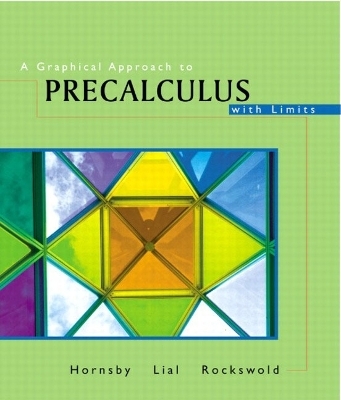
A Graphical Approach to Precalculus with Limits
Pearson (Verlag)
978-0-201-73513-0 (ISBN)
- Titel erscheint in neuer Auflage
- Artikel merken
This series is the culmination of many years of teaching experience with the graphing calculator. The books were written from the beginning for use with the graphing calculator. Throughout the text, the authors emphasize the power of technology but provide numerous warnings of its limitations: they stress that only through understanding the mathematical concepts can students fully appreciate the power of graphing calculators and use technology appropriately.
Additionally, the authors consistently use the same four-step process when introducing the different classes of functions. This allows students to easily make connections between graphs of functions and their associated equations and inequalities.
John Hornsby- When John Hornsby enrolled as an undergraduate at Louisiana State University, he was uncertain whether he wanted to study mathematics, education, or journalism. His ultimate decision was to become a teacher, but after twenty-five years of teaching at the high school and university levels and ten years of writing mathematics textbooks, both of his goals have been realized. His love for teaching and for mathematics is evident in his passion for working with students and fellow teachers as well. His specific professional interests are recreational mathematics, mathematics history, and incorporating graphing calculators into the curriculum. John's personal life is busy as he devotes time to his family (wife Gwen, and sons Chris, Jack, and Josh). He has been a rabid baseball fan all of his life. John's other hobbies include numismatics (the study of coins) and record collecting. He loves the music of the 1960s and has an extensive collection of the recorded works of Frankie Valli and the Four Seasons. Marge Lial was always interested in math; it was her favorite subject in the first grade! Marge's intense desire to educate both her students and herself has inspired the writing of numerous best-selling textbooks. Marge, who received Bachelor's and Master's degrees from California State University at Sacramento, is now affiliated with American River College. Marge is an avid reader and traveler. Her travel experiences often find their way into her books as applications, exercise sets, and feature sets. She is particularly interested in archeology. Trips to various digs and ruin sites have produced some fascinating problems for her textbooks involving such topics as the building of Mayan pyramids and the acoustics of ancient ball courts in the Yucatan. Gary Rockswold- Dr. Gary Rockswold has been teaching mathematics for 25 years at all levels from seventh grade to graduate school, including junior high and high school students, talented youth, vocational, undergraduate, and graduate students, and adult education classes. He is currently employed at Minnesota State University, Mankato, where he is a full professor of mathematics and the chair of the mathematics department. He graduated with majors in mathematics and physics from St. Olaf College in Northfield, Minnesota, where he was elected to Phi Beta Kappa. He received his Ph.D. in applied mathematics from Iowa State University. He has an interdisciplinary background and has also taught physical science, astronomy, and computer science. Dr. Rockswold has been writing for mathematics textbooks for over ten years. Currently he is an author for Addison Wesley, writing textbooks that integrate modeling, visualization, applications, and the graphing calculator into the curriculum.
1. Linear Functions, Equations, and Inequalities.
Real Numbers and Coordinate Systems.
Introduction to Relations and Functions.
Linear Functions.
Equations of Lines and Linear Models.
Linear Equations and Inequalities.
Applications of Linear Functions.
2. Analysis of Graphs of Functions.
Graphs of Basic Functions and Relations; Symmetry.
Vertical and Horizontal Shifts of Graphs.
Stretching, Shrinking, and Reflecting Graphs.
Absolute Value Functions: Graphs, Equations, Inequalities, and Applications.
Piecewise-Defined Functions.
Operations and Composition.
3. Polynomial Functions.
Complex Numbers.
Quadratic Functions and Graphs.
Quadratic Equations and Inequalities.
Further Applications of Quadratic Functions and Models.
Higher Degree Polynomial Functions and Graphs.
Topics in the Theory of Polynomial Functions (I).
Topics in the Theory of Polynomial Functions (II).
Polynomial Equations and Inequalities; Further Applications and Models.
4. Rational, Power, and Root Functions.
Rational Functions and Graphs.
More on Graphs of Rational Functions.
Rational Equations, Inequalities, Applications, and Models.
Functions Defined by Powers and Roots.
Equations, Inequalities, and Applications Involving Root Functions.
5. Inverse, Exponential, and Logarithmic Functions.
Inverse Functions.
Exponential Functions.
Logarithms and Their Properties.
Logarithmic Functions.
Exponential and Logarithmic Equations and Inequalities.
Applications and Modeling with Exponential and Logarithmic Functions.
6. Analytic Geometry.
Circles and Parabolas.
Ellipses and Hyperbolas.
Summary of the Conic Sections.
Parametric Equations.
7. Matrices and Systems of Equations and Inequalities.
Systems of Equations.
Solution of Linear Systems by the Echelon Method.
Solution of Linear Systems by Row Transformations.
Matrix Properties and Operations.
Determinants and Cramer's Rule.
Solution of Linear Systems by Matrix Inverses.
Systems of Inequalities and Linear Programming.
Partial Fractions.
8. Trigonometric Functions and Applications.
Angles and Arcs
The Unit Circle
Graphs of the Sine and Cosine Functions
Graphs of the Other Circular Functions
Functions of Angles and Fundamental Identities
Evaluating Trigonometry Functions
Applications of Right Triangles
Harmonic Motion
9. Trigonometric Identities and Equations.
Identities.
Further Identities.
The Inverse Circular Functions.
Trigonometric Equations and Inequalities.
Further Equations and Inequalities.
10. Applications of Trigonometry; Vectors.
The Law of Sines.
The Law of Cosines and Area Formulas.
Vectors and Their Applications.
Trigonometric (Polar) Form of Complex Numbers.
Powers and Roots of Complex Numbers.
Polar Equations, Graphs, and Applications.
More Parametric Equations.
11. Further Topics in Algebra.
Sequences and Series.
Arithmetic Sequences and Series.
Geometric Sequences and Series.
The Binomial Theorem.
Mathematical Induction.
Counting Theory.
Probability.
12. An Introduction to Calculus: Limits and Derivatives.
An Introduction to Limits.
Techniques for Calculating Limits.
One-Sided Limits; Limits Involving Infinity.
Tangent Lines and Derivatives.
Area Under a Curve.
R. Reference: Basic Algebraic Concepts and Geometry Formulas.
Review of Exponents and Polynomials.
Review of Factoring.
Review of Rational Expressions.
Review of Negative and Rational Exponents.
Review of Radicals.
Review of Geometry Formulas.
Appendix A. Vectors in Space.
Appendix B. Polar Form of Conic Sections.
Appendix C. Rotation of Axes.
| Erscheint lt. Verlag | 3.12.2003 |
|---|---|
| Sprache | englisch |
| Maße | 216 x 254 mm |
| Gewicht | 2313 g |
| Themenwelt | Mathematik / Informatik ► Mathematik |
| ISBN-10 | 0-201-73513-X / 020173513X |
| ISBN-13 | 978-0-201-73513-0 / 9780201735130 |
| Zustand | Neuware |
| Informationen gemäß Produktsicherheitsverordnung (GPSR) | |
| Haben Sie eine Frage zum Produkt? |
aus dem Bereich