


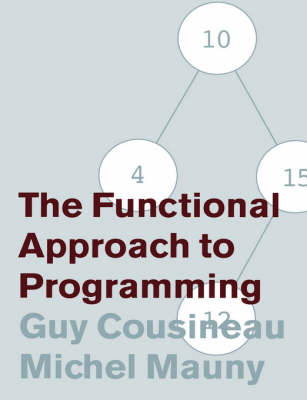
The Functional Approach to Programming
Seiten
1998
Cambridge University Press (Verlag)
9780521576819 (ISBN)
Cambridge University Press (Verlag)
9780521576819 (ISBN)
The authors introduce functional programming via examples and explain what programs compute and how to reason about them. They implement the ideas in Caml and in Standard ML, and give examples of how complex programs can be developed in close agreement with their specifications. Many exercises and examples are included throughout the book; solutions are also available.
A programming course should concentrate as much as possible on a program's logical structure and design rather than simply show how to write code. The Functional Approach to Programming achieves this aim because logical concepts are evident and programs are transparent so can be written quickly and cleanly. In this book the authors emphasise the notions of function and function application which relate programming to familiar concepts from mathematics and logic. They introduce functional programming via examples but also explain what programs compute and how to reason about them. They show how the ideas can be implemented in the Caml language, a dialect of the ML family, and give examples of how complex programs from a variety of areas (such as arithmetic, tree algorithms, graph algorithms, text parsing and geometry) can be developed in close agreement with their specifications. Many exercises and examples are included throughout the book; solutions are also available.
A programming course should concentrate as much as possible on a program's logical structure and design rather than simply show how to write code. The Functional Approach to Programming achieves this aim because logical concepts are evident and programs are transparent so can be written quickly and cleanly. In this book the authors emphasise the notions of function and function application which relate programming to familiar concepts from mathematics and logic. They introduce functional programming via examples but also explain what programs compute and how to reason about them. They show how the ideas can be implemented in the Caml language, a dialect of the ML family, and give examples of how complex programs from a variety of areas (such as arithmetic, tree algorithms, graph algorithms, text parsing and geometry) can be developed in close agreement with their specifications. Many exercises and examples are included throughout the book; solutions are also available.
Introduction; Part I. Basic Principles: 1. Expressions; 2. Data structures; 3. Semantics; 4. Imperative aspects; Part II. Applications: 5. Exact arithmetic; 6. Formal terms, filtering, and unification; 7. Balanced trees; 8. Graphs and problem resolution; 9. Syntactic analysis; 10. Geometry and designs; Part III. Implementation: 11. Evaluation; 12. Compilation; 13. Types and typing; Appendix 1. Help for Caml Light 0.6; Appendix 2. How to Get Caml, MLgraph, and the examples; Bibliography; Index.
| Erscheint lt. Verlag | 29.10.1998 |
|---|---|
| Übersetzer | K. Callaway |
| Zusatzinfo | 55 Line drawings, unspecified |
| Verlagsort | Cambridge |
| Sprache | englisch |
| Maße | 189 x 246 mm |
| Gewicht | 820 g |
| Themenwelt | Mathematik / Informatik ► Informatik ► Software Entwicklung |
| ISBN-13 | 9780521576819 / 9780521576819 |
| Zustand | Neuware |
| Informationen gemäß Produktsicherheitsverordnung (GPSR) | |
| Haben Sie eine Frage zum Produkt? |
Mehr entdecken
aus dem Bereich

aus dem Bereich
Entwurfsmuster für effektive Softwareentwicklung
Buch | Softcover (2024)
Springer Vieweg (Verlag)
CHF 27,95
Praxishandbuch für Java- und Webservice-Entwickler
Buch | Softcover (2025)
dpunkt (Verlag)
CHF 62,85


