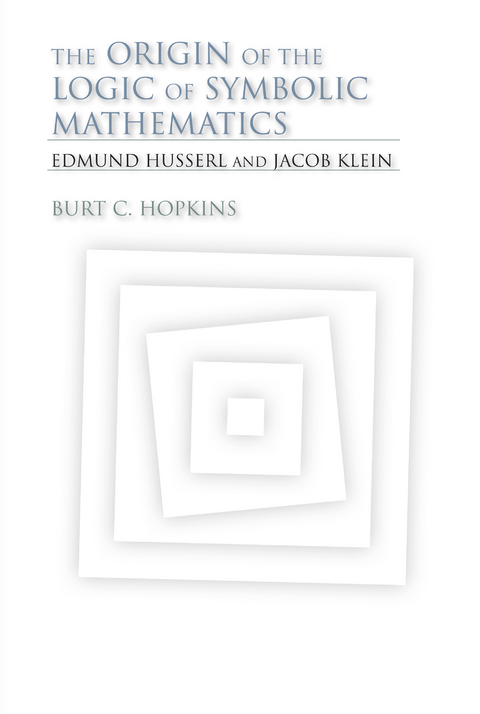
Origin of the Logic of Symbolic Mathematics (eBook)
592 Seiten
Indiana University Press (Verlag)
978-0-253-00527-4 (ISBN)
Burt C. Hopkins is Professor of Philosophy at Seattle University. He is author of Intentionality in Husserl and Heidegger and The Philosophy of Husserl. He is founding editor (with Steven G. Crowell) of The New Yearbook for Phenomenology and Phenomenological Philosophy and is permanent secretary of the Husserl Circle.
Preface by Eva Brann
Introduction: The Subject Matter, Thesis, and Structure of the Study
Part One. Klein on Husserl's Phenomenology and the History of Science
1. Klein's and Husserl's Investigations of the Origination of Mathematical Physics
2. Klein's Account of the Essential Connection between Intentional and Actual History
3. The Liberation of the Problem of Origin from its Naturalistic Distortion: The Phenomenological Problem of Constitution
4. The Essential Connection between Intentional History and Actual History
5. The Historicity of the Intelligibility of Ideal Significations and the Possibility of Actual History
6. Sedimentation and the Link between Intentional History and the Constitution of a Historical Tradition
7. Klein's Departure from the Content but Not the Method of Husserl's Intentional-Historical Analysis of Modern Science
Part Two. Husserl and Klein on the Method and Task of Desedimenting the Mathematization of Nature
8. Klein's Historical-Mathematical Investigations in the Context of Husserl's Phenomenology of Science
9. The Basic Problem and Method of Klein's Mathematical Investigations
10.Husserl's Formulation of the Nature and Roots of the Crisis of European Sciences
11. The "Zigzag" Movement Implicit in Klein's Mathematical Investigations
12. Husserl and Klein on the Logic of Symbolic Mathematics
Part Three. Non-Symbolic and Symbolic Numbers in Husserl and Klein
13. Authentic and Symbolic Numbers in Husserl's Philosophy of Arithmetic
14. Klein's Desedimentation of the Origin Algebra and Husserl's Failure to Ground Symbolic Calculation
15. Logistic and Arithmetic in Neoplatonic Mathematics and in Plato
16. Theoretical Logistic and the Problem of Fractions
17. The Concept of
18. Plato's Ontological Conception of
19. Klein's Reactivation of Plato's Theory of
20. Aristotle's Critique of the Platonic Chorismos Thesis and the Possibility of a Theoretical Logistic
21. Klein's Interpretation of Diophantus's Arithmetic
22. Klein's Account of Vieta's Reinterpretation of the Diophantine Procedure and the Consequent Establishment of Algebra as the General Analytical Art
23. Klein's Account of the Concept of Number and the Number Concepts in Stevin, Descartes, and Wallis
Part Four. Husserl and Klein on the Origination of the Logic of Symbolic Mathematics
24. Husserl and Klein on the Fundamental Difference between Symbolic and Non-Symbolic Numbers
25. Husserl and Klein on the Origin and Structure of Non-Symbolic Numbers
26. Structural Differences in Husserl's and Klein's Accounts of the Mode of Being of Non-Symbolic Numbers
27. Digression: The Development of Husserl's Thought, after Philosophy of Arithmetic, on the "Logical" Status of the Symbolic Calculus, the Constitution of Collective Unity, and the Phenomenological Foundation of the Mathesis Universalis
28. Husserl's Accounts of the Symbolic Calculus, the Critique of Psychologism, and the
29. Husserl's Critique of Symbolic Calculation in his Schröder Review
30. The Separation of Logic from Symbolic Calculation in Husserl's Later Works
31. Husserl on the Shortcomings of the Appeal to the "Reflexion" on Acts to Account for the Origin of Logical Relations in the Works Leading Up to the Logical Investigations
32. Husserl's Attempt in the Logical Investigations to Establish a Relationship between "Mere" Thought and the "In Itself " of Pure Logical Validity by Appealing to Concrete, Universal, and Formalizing Modes of Abstraction and Categorial Intuition
33. Husserl's Account of the Constitution of the Collection, Number, and the 'Universal Whatever' in
Experience and Judgment
34. Husserl's Investigation of the Unitary Domain of Formal Logic and Formal Ontology in Formal and Transcendental Logic
35. Klein and Husserl on the Origination of the Logic of Symbolic Numbers
Coda: Husserl's "Platonism" within the Context of Plato's Own Platonism
Glossary
Bibliography
Index of Names
Index of Subjects
| Erscheint lt. Verlag | 6.6.2024 |
|---|---|
| Reihe/Serie | Studies in Continental Thought |
| Studies in Continental Thought | Studies in Continental Thought |
| Verlagsort | Bloomington |
| Sprache | englisch |
| Maße | 150 x 150 mm |
| Gewicht | 60 g |
| Themenwelt | Geisteswissenschaften ► Philosophie ► Allgemeines / Lexika |
| Geisteswissenschaften ► Philosophie ► Logik | |
| Geisteswissenschaften ► Philosophie ► Philosophie der Neuzeit | |
| Mathematik / Informatik ► Mathematik | |
| Schlagworte | Continental • Philosophy |
| ISBN-10 | 0-253-00527-2 / 0253005272 |
| ISBN-13 | 978-0-253-00527-4 / 9780253005274 |
| Informationen gemäß Produktsicherheitsverordnung (GPSR) | |
| Haben Sie eine Frage zum Produkt? |
 EPUB (Adobe DRM)
Kopierschutz: Adobe-DRM
Adobe-DRM ist ein Kopierschutz, der das eBook vor Mißbrauch schützen soll. Dabei wird das eBook bereits beim Download auf Ihre persönliche Adobe-ID autorisiert. Lesen können Sie das eBook dann nur auf den Geräten, welche ebenfalls auf Ihre Adobe-ID registriert sind.
Details zum Adobe-DRM
Dateiformat: EPUB (Electronic Publication)
EPUB ist ein offener Standard für eBooks und eignet sich besonders zur Darstellung von Belletristik und Sachbüchern. Der Fließtext wird dynamisch an die Display- und Schriftgröße angepasst. Auch für mobile Lesegeräte ist EPUB daher gut geeignet.
Systemvoraussetzungen:
PC/Mac: Mit einem PC oder Mac können Sie dieses eBook lesen. Sie benötigen eine
eReader: Dieses eBook kann mit (fast) allen eBook-Readern gelesen werden. Mit dem amazon-Kindle ist es aber nicht kompatibel.
Smartphone/Tablet: Egal ob Apple oder Android, dieses eBook können Sie lesen. Sie benötigen eine
Geräteliste und zusätzliche Hinweise
Buying eBooks from abroad
For tax law reasons we can sell eBooks just within Germany and Switzerland. Regrettably we cannot fulfill eBook-orders from other countries.
aus dem Bereich