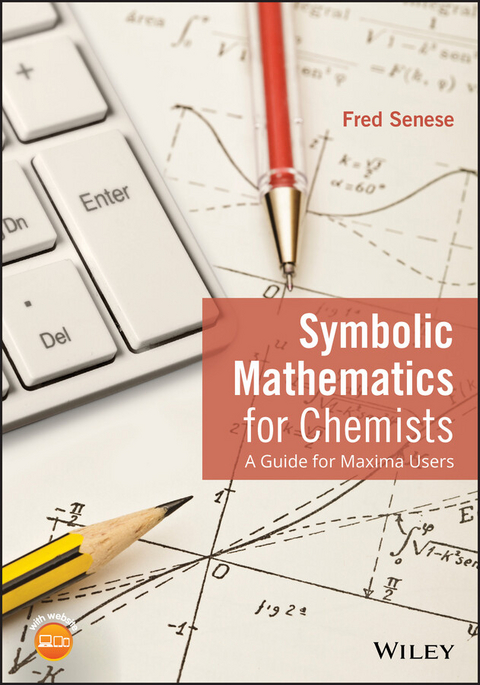
Symbolic Mathematics for Chemists (eBook)
John Wiley & Sons (Verlag)
978-1-119-27323-3 (ISBN)
An essential guide to using Maxima, a popular open source symbolic mathematics engine to solve problems, build models, analyze data and explore fundamental concepts
Symbolic Mathematics for Chemists offers students of chemistry a guide to Maxima, a popular open source symbolic mathematics engine that can be used to solve problems, build models, analyze data, and explore fundamental chemistry concepts. The author - a noted expert in the field - focuses on the analysis of experimental data obtained in a laboratory setting and the fitting of data and modeling experiments. The text contains a wide variety of illustrative examples and applications in physical chemistry, quantitative analysis and instrumental techniques.
Designed as a practical resource, the book is organized around a series of worksheets that are provided in a companion website. Each worksheet has clearly defined goals and learning objectives and a detailed abstract that provides motivation and context for the material. This important resource:
- Offers an text that shows how to use popular symbolic mathematics engines to solve problems
- Includes a series of worksheet that are prepared in Maxima
- Contains step-by-step instructions written in clear terms and includes illustrative examples to enhance critical thinking, creative problem solving and the ability to connect concepts in chemistry
- Offers hints and case studies that help to master the basics while proficient users are offered more advanced avenues for exploration
Written for advanced undergraduate and graduate students in chemistry and instructors looking to enhance their lecture or lab course with symbolic mathematics materials, Symbolic Mathematics for Chemists: A Guide for Maxima Users is an essential resource for solving and exploring quantitative problems in chemistry.
Professor Fred Senese is a computational chemist at Frostburg State University with a particular focus on chemical education. His research interests include applications of artificial intelligence in chemical education, development of web-based narratives and construction kits for chemical education, remote control and access of instrumentation, and environmental chemical analysis applied to problems in ethnobotany.
An essential guide to using Maxima, a popular open source symbolic mathematics engine to solve problems, build models, analyze data and explore fundamental concepts Symbolic Mathematics for Chemists offers students of chemistry a guide to Maxima, a popular open source symbolic mathematics engine that can be used to solve problems, build models, analyze data, and explore fundamental chemistry concepts. The author a noted expert in the field focuses on the analysis of experimental data obtained in a laboratory setting and the fitting of data and modeling experiments. The text contains a wide variety of illustrative examples and applications in physical chemistry, quantitative analysis and instrumental techniques. Designed as a practical resource, the book is organized around a series of worksheets that are provided in a companion website. Each worksheet has clearly defined goals and learning objectives and a detailed abstract that provides motivation and context for the material. This important resource: Offers an text that shows how to use popular symbolic mathematics engines to solve problems Includes a series of worksheet that are prepared in Maxima Contains step-by-step instructions written in clear terms and includes illustrative examples to enhance critical thinking, creative problem solving and the ability to connect concepts in chemistry Offers hints and case studies that help to master the basics while proficient users are offered more advanced avenues for exploration Written for advanced undergraduate and graduate students in chemistry and instructors looking to enhance their lecture or lab course with symbolic mathematics materials, Symbolic Mathematics for Chemists: A Guide for Maxima Users is an essential resource for solving and exploring quantitative problems in chemistry.
Professor Fred Senese is a computational chemist at Frostburg State University with a particular focus on chemical education. His research interests include applications of artificial intelligence in chemical education, development of web-based narratives and construction kits for chemical education, remote control and access of instrumentation, and environmental chemical analysis applied to problems in ethnobotany.
| Erscheint lt. Verlag | 24.8.2018 |
|---|---|
| Sprache | englisch |
| Themenwelt | Mathematik / Informatik ► Mathematik ► Angewandte Mathematik |
| Naturwissenschaften ► Chemie ► Allgemeines / Lexika | |
| Schlagworte | Applied Mathematics in Science • Calculus in Maxima • Chemie • Chemistry • Computational Chemistry & Molecular Modeling • Computational Chemistry u. Molecular Modeling • Computeralgebra • Differential Equations in Maxima • Equation Solving in Maxima</p> • Fourier Transforms in Maxima • <p>Symbolic Mathematics for Chemists • Mathematics • Mathematics & Statistics for Chemistry • Mathematik • Mathematik in den Naturwissenschaften • Mathematik u. Statistik i. d. Chemie • Matrix Algebra in Maxima • Maxima • Maxima for Chemists • Maxima Guide • Maxima Guide for Chemists • Nanomaterial • Operators in Maxima • Plotting in Maxima • Statistics in Maxima • Surface Plotting in Maxima • Symbolic Mathematics for Data Analysis • Symbolic Mathematics for Model Building • Symbolic Mathematics in Chemistry • Symbolic Mathematics in Problem Solving • Symbolische Mathematik • Text to Symbolic Mathematics for Chemists • Vectors in Maxima |
| ISBN-10 | 1-119-27323-4 / 1119273234 |
| ISBN-13 | 978-1-119-27323-3 / 9781119273233 |
| Informationen gemäß Produktsicherheitsverordnung (GPSR) | |
| Haben Sie eine Frage zum Produkt? |
 PDF (Adobe DRM)
Kopierschutz: Adobe-DRM
Adobe-DRM ist ein Kopierschutz, der das eBook vor Mißbrauch schützen soll. Dabei wird das eBook bereits beim Download auf Ihre persönliche Adobe-ID autorisiert. Lesen können Sie das eBook dann nur auf den Geräten, welche ebenfalls auf Ihre Adobe-ID registriert sind.
Details zum Adobe-DRM
Dateiformat: PDF (Portable Document Format)
Mit einem festen Seitenlayout eignet sich die PDF besonders für Fachbücher mit Spalten, Tabellen und Abbildungen. Eine PDF kann auf fast allen Geräten angezeigt werden, ist aber für kleine Displays (Smartphone, eReader) nur eingeschränkt geeignet.
Systemvoraussetzungen:
PC/Mac: Mit einem PC oder Mac können Sie dieses eBook lesen. Sie benötigen eine
eReader: Dieses eBook kann mit (fast) allen eBook-Readern gelesen werden. Mit dem amazon-Kindle ist es aber nicht kompatibel.
Smartphone/Tablet: Egal ob Apple oder Android, dieses eBook können Sie lesen. Sie benötigen eine
Geräteliste und zusätzliche Hinweise
Buying eBooks from abroad
For tax law reasons we can sell eBooks just within Germany and Switzerland. Regrettably we cannot fulfill eBook-orders from other countries.
aus dem Bereich