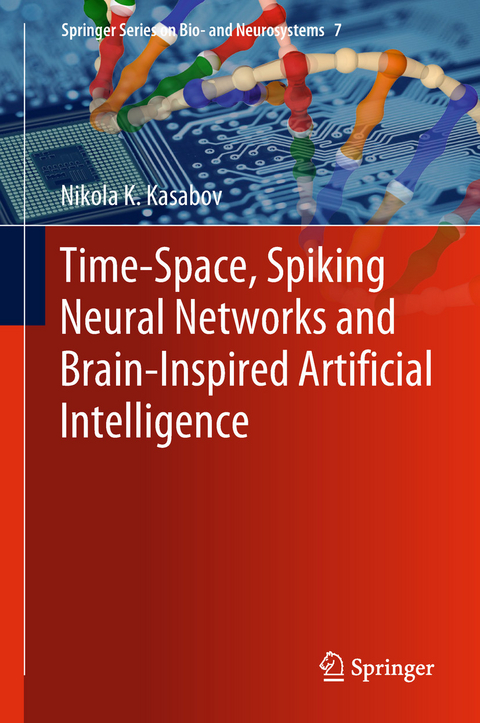
Time-Space, Spiking Neural Networks and Brain-Inspired Artificial Intelligence (eBook)
XXXIV, 738 Seiten
Springer Berlin Heidelberg (Verlag)
978-3-662-57715-8 (ISBN)
Spiking neural networks (SNN) are biologically inspired computational models that represent and process information internally as trains of spikes. This monograph book presents the classical theory and applications of SNN, including original author's contribution to the area. The book introduces for the first time not only deep learning and deep knowledge representation in the human brain and in brain-inspired SNN, but takes that further to develop new types of AI systems, called in the book brain-inspired AI (BI-AI). BI-AI systems are illustrated on: cognitive brain data, including EEG, fMRI and DTI; audio-visual data; brain-computer interfaces; personalized modelling in bio-neuroinformatics; multisensory streaming data modelling in finance, environment and ecology; data compression; neuromorphic hardware implementation. Future directions, such as the integration of multiple modalities, such as quantum-, molecular- and brain information processing, is presented in the last chapter. The book is a research book for postgraduate students, researchers and practitioners across wider areas, including computer and information sciences, engineering, applied mathematics, bio- and neurosciences.
Nikola Kirilov Kasabov is Professor of neural networks and knowledge engineering and Director of the Knowledge Engineering and Discovery Research Institute (KEDRI) at the Auckland University of Technology (AUT), New Zealand. Born in Bulgaria, he has worked previously at the TU Sofia, University of Essex and University of Otago. He is fellow of IEEE, Fellow of the Royal Society (Academy) of New Zealand (RSNZ), Distinguished Fellow of the Royal Academy of Engineering UK and Visiting Professor at several universities, including: Shanghai Jia-Tong University; ETH and University of Zurich; RGU Scotland UK; University of Trento; University of Kaiserslautern; Universities of Twente and Maastricht. Prof Kasabov originated methods and systems for intelligent information processing, including: evolving connectionist systems, hybrid neuro-fuzzy systems, evolving- and brain -inspired spiking neural network architectures, quantum-inspired methods, methods for personalised modelling in bio and neuroinformatics, published in more than 600 works. He is Past President of the International Neural Network Society (INNS) and the current President of the Asia-Pacific Neural Network Society (APNNS). Prof Kasabov has received the INNS Ada Lovelace and Gabor Awards, APNNS Outstanding Achievements Award, RSNZ Medal, AUT Medal, Honourable Fellowship of the Bulgarian and the Greek Computer Societies, Pavlikeni Honourable Citizenship and other awards. He has been the editor of the Springer Handbook of Bio-/Neuro-informatics published by Springer in 2014 and of the related book series Springer Series on Bio- and Neurosystems.
Nikola Kirilov Kasabov is Professor of neural networks and knowledge engineering and Director of the Knowledge Engineering and Discovery Research Institute (KEDRI) at the Auckland University of Technology (AUT), New Zealand. Born in Bulgaria, he has worked previously at the TU Sofia, University of Essex and University of Otago. He is fellow of IEEE, Fellow of the Royal Society (Academy) of New Zealand (RSNZ), Distinguished Fellow of the Royal Academy of Engineering UK and Visiting Professor at several universities, including: Shanghai Jia-Tong University; ETH and University of Zurich; RGU Scotland UK; University of Trento; University of Kaiserslautern; Universities of Twente and Maastricht. Prof Kasabov originated methods and systems for intelligent information processing, including: evolving connectionist systems, hybrid neuro-fuzzy systems, evolving- and brain –inspired spiking neural network architectures, quantum-inspired methods, methods for personalised modelling in bio and neuroinformatics, published in more than 600 works. He is Past President of the International Neural Network Society (INNS) and the current President of the Asia-Pacific Neural Network Society (APNNS). Prof Kasabov has received the INNS Ada Lovelace and Gabor Awards, APNNS Outstanding Achievements Award, RSNZ Medal, AUT Medal, Honourable Fellowship of the Bulgarian and the Greek Computer Societies, Pavlikeni Honourable Citizenship and other awards. He has been the editor of the Springer Handbook of Bio-/Neuro-informatics published by Springer in 2014 and of the related book series Springer Series on Bio- and Neurosystems.
Part I. Time-Space and AI.- Part II. The Human Brain.- Part III. Spiking Neural Networks.- Part IV. SNN for Deep Learning and Deep Knowledge Representation of Brain Data.- Part V. SNN for Audio-Visual Data and Brain-Computer Interfaces.- Part VI. SNN in Bio- and Neuroinformatics.- Part VII. SNN for Deep in Time-Space Learning and Deep Knowledge Representation of Multisensory Streaming Data.- Part VIII. Future development in BI-SNN and BI-AI.
| Erscheint lt. Verlag | 29.8.2018 |
|---|---|
| Reihe/Serie | Springer Series on Bio- and Neurosystems | Springer Series on Bio- and Neurosystems |
| Zusatzinfo | XXXIV, 738 p. 340 illus., 256 illus. in color. |
| Verlagsort | Berlin |
| Sprache | englisch |
| Themenwelt | Mathematik / Informatik ► Informatik |
| Technik ► Maschinenbau | |
| Schlagworte | Convolutional ANN • Deep knowledge representation • Deep learning of Time-Space data • Evolving connectionist systems (ECOS) • Evolving Fuzzy Neural Networks • Evolving self-organizing maps • Evolving spatio-temporal processes • Integration of human intelligence and artificial intelligence • Interactions in Time-Space • Knowledge-based ANN • Neural Representation of Information • Quantum-inspired computation • Reservoir architectures • Spike-Driven Synaptic Plasticity • Spike-time learning • Supervised learning in ANN • Takagi-Sugeno fuzzy inference • Time-space in the brain • Training multilayer perceptron • Transductive inference methods |
| ISBN-10 | 3-662-57715-1 / 3662577151 |
| ISBN-13 | 978-3-662-57715-8 / 9783662577158 |
| Informationen gemäß Produktsicherheitsverordnung (GPSR) | |
| Haben Sie eine Frage zum Produkt? |
 PDF (Wasserzeichen)
DRM: Digitales Wasserzeichen
Dieses eBook enthält ein digitales Wasserzeichen und ist damit für Sie personalisiert. Bei einer missbräuchlichen Weitergabe des eBooks an Dritte ist eine Rückverfolgung an die Quelle möglich.
Dateiformat: PDF (Portable Document Format)
Mit einem festen Seitenlayout eignet sich die PDF besonders für Fachbücher mit Spalten, Tabellen und Abbildungen. Eine PDF kann auf fast allen Geräten angezeigt werden, ist aber für kleine Displays (Smartphone, eReader) nur eingeschränkt geeignet.
Systemvoraussetzungen:
PC/Mac: Mit einem PC oder Mac können Sie dieses eBook lesen. Sie benötigen dafür einen PDF-Viewer - z.B. den Adobe Reader oder Adobe Digital Editions.
eReader: Dieses eBook kann mit (fast) allen eBook-Readern gelesen werden. Mit dem amazon-Kindle ist es aber nicht kompatibel.
Smartphone/Tablet: Egal ob Apple oder Android, dieses eBook können Sie lesen. Sie benötigen dafür einen PDF-Viewer - z.B. die kostenlose Adobe Digital Editions-App.
Buying eBooks from abroad
For tax law reasons we can sell eBooks just within Germany and Switzerland. Regrettably we cannot fulfill eBook-orders from other countries.
aus dem Bereich