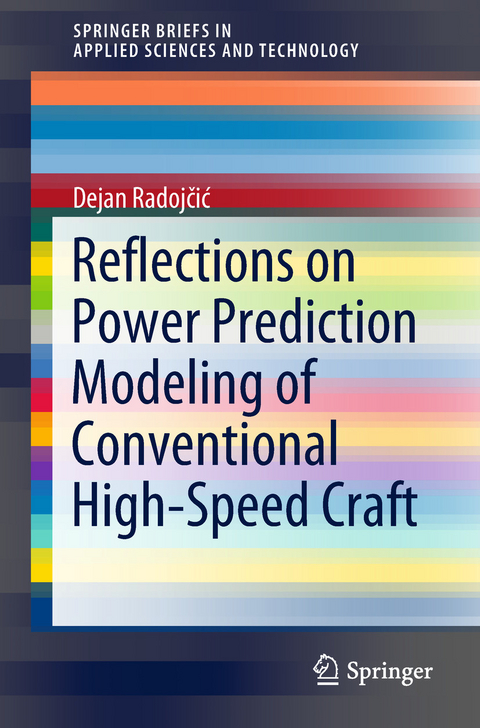
Reflections on Power Prediction Modeling of Conventional High-Speed Craft (eBook)
XXIV, 93 Seiten
Springer International Publishing (Verlag)
978-3-319-94899-7 (ISBN)
This SpringerBrief focuses on modeling and power evaluation of high-speed craft. The various power prediction methods, a principal design objective for high-speed craft of displacement, semi-displacement, and planing type, are addressed. At the core of the power prediction methods are mathematical models for resistance and propulsion efficiency. The models are based on the experimental data of various high-speed hull and propeller series. The regression analysis and artificial neural network (ANN) methods are used as an extraction tool for this kind of mathematical models. A variety of mathematical models of this type are discussed in the book.
Once these mathematical models have been developed and validated, they can be readily programmed into software tools, thereby enabling the parametric analyses required for the optimization of a high-speed craft design. This book provides the foundational reference for these software tools, and their use in the design of high-speed craft. High-speed craft are very different from conventional ships. Current professional literature leaves a gap in the documentation of best design practices for high-speed craft.This book is aimed at naval architects who design and develop various types of high-speed vessels.
1 Introduction.- 1.1 Objectives.- 1.2 Conventional High-Speed Craft (HSC).- 1.3 Resistance, Propulsion, and Power Prediction.- 1.4 Common Mistakes.- 1.5 Excluded Topics.- References.- 2 Mathematical Modeling.- 2.1 Statistical Modeling.- 2.2 Model Extraction Tools.- 2.3 Hardware.- 2.4 Conclusions on Mathematical Modeling.- References.- 3 Resistance And Dynamic Trim Predictions.- 3.1 An Overview of Early Resistance Prediction Mathematical Models.- 3.2 Types of Mathematical Models for Resistance Prediction.- 3.3 Systematic Series Applicable to Conventional High-Speed Craft.- 3.4 Mathematical Modeling of Resistance and Dynamic Trim for High-Speed Craft.- 3.5 Future Work – Stepped Hulls.- 3.6 Mathematical Model Use.- 3.7 Recommended Mathematical Models for Resistance and Dynamic Trim Prediction.- References.- 4 Propeller’s Open-Water Efficiency Prediction.- 4.1 An Overview of Modeling Propeller’s Hydrodynamic Characteristics.- 4.2 Mathematical Modeling of KT, KQ, and ηO of High-Speed Propellers.- 4.3 Loading Criteria for High-Speed Propellers.- 4.4 Recommended Mathematical Models for High-Speed Propellers.- References.- 5 Additional Resistance Components And Propulsive Coefficients.- 5.1 Evaluation of In-Service Power Performance.- 5.2 Resistance Components – Calm and Deep Water.- 5.3 Resistance in a Seaway.- 5.4 Resistance in Shallow Water.- 5.5 Propulsive Coefficients.- 5.6 Recommended References for Evaluation of Additional Resistance Components and Propulsive Coefficients.- References.- 6 Power Prediction.- 6.1 Power and Performance Predictions for High-Speed Craft.- 6.2 Classics.- 6.3 Modernism.- 6.4 Another Perspective.- References.- 7 Concluding Remarks.- References.
| Erscheint lt. Verlag | 25.8.2018 |
|---|---|
| Reihe/Serie | SpringerBriefs in Applied Sciences and Technology | SpringerBriefs in Applied Sciences and Technology |
| Zusatzinfo | XXIV, 93 p. 17 illus. |
| Verlagsort | Cham |
| Sprache | englisch |
| Themenwelt | Mathematik / Informatik ► Mathematik |
| Technik ► Maschinenbau | |
| Schlagworte | Artificial Neural Network • Hard-Chine and Round-Bilge Hulls • High Speed Craft • High speed vessels • Military Vessels • modelling techniques • Planing Craft • Power Prediction • Regression Analysis • Semidisplacement Craft • Ship Hydrodynamics |
| ISBN-10 | 3-319-94899-7 / 3319948997 |
| ISBN-13 | 978-3-319-94899-7 / 9783319948997 |
| Informationen gemäß Produktsicherheitsverordnung (GPSR) | |
| Haben Sie eine Frage zum Produkt? |
 PDF (Wasserzeichen)
DRM: Digitales Wasserzeichen
Dieses eBook enthält ein digitales Wasserzeichen und ist damit für Sie personalisiert. Bei einer missbräuchlichen Weitergabe des eBooks an Dritte ist eine Rückverfolgung an die Quelle möglich.
Dateiformat: PDF (Portable Document Format)
Mit einem festen Seitenlayout eignet sich die PDF besonders für Fachbücher mit Spalten, Tabellen und Abbildungen. Eine PDF kann auf fast allen Geräten angezeigt werden, ist aber für kleine Displays (Smartphone, eReader) nur eingeschränkt geeignet.
Systemvoraussetzungen:
PC/Mac: Mit einem PC oder Mac können Sie dieses eBook lesen. Sie benötigen dafür einen PDF-Viewer - z.B. den Adobe Reader oder Adobe Digital Editions.
eReader: Dieses eBook kann mit (fast) allen eBook-Readern gelesen werden. Mit dem amazon-Kindle ist es aber nicht kompatibel.
Smartphone/Tablet: Egal ob Apple oder Android, dieses eBook können Sie lesen. Sie benötigen dafür einen PDF-Viewer - z.B. die kostenlose Adobe Digital Editions-App.
Buying eBooks from abroad
For tax law reasons we can sell eBooks just within Germany and Switzerland. Regrettably we cannot fulfill eBook-orders from other countries.
aus dem Bereich