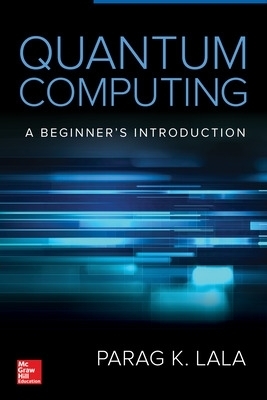
Quantum Computing
McGraw-Hill Education (Verlag)
9781260123111 (ISBN)
A self-contained, reader-friendly introduction to the principles and applications of quantum computing
Especially valuable to those without a prior knowledge of quantum mechanics, this electrical engineering text presents the concepts and workings of quantum information processing systems in a clear, straightforward, and practical manner. The book is written in a style that helps readers who are not familiar with non-classical information processing more easily grasp the essential concepts; only prior exposure to classical physics, basic digital design, and introductory linear algebra is assumed.
Quantum Computing: A Beginner’s Introduction presents each topic in a tutorial style with examples, illustrations, and diagrams to clarify the material. Written by an experienced electrical engineering educator and author, this is a self-contained resource, with all the necessary pre-requisite material included within the text.
Coverage includes:
• Complex Numbers, Vector Space, and Dirac Notation
• Basics of Quantum Mechanics
• Matrices and Operators
• Boolean Algebra, Logic Gates and Quantum Information Processing
• Quantum Gates and Circuit
• Tensor Products, Superposition and Quantum Entanglement
• Teleportation and Superdense Coding
• Quantum Error Correction
• Quantum Algorithms
• Quantum Cryptography
Parag K. Lala, is an electrical engineering professor at Texas A&M University - Texarkana and is the author or co-author of seven books and more than 145 technical papers. His current research interests are in quantum computing and cryptography, hardware-based DNA sequence matching, and biologically-inspired design of programmable digital systems. He is a Life Fellow of the IEEE.
Preface
1 Complex Numbers, Vector Space, and Dirac Notation
1.1 Complex Numbers
1.2 Complex Conjugation
1.3 Vector Space
1.4 Basis Set
1.5 Dirac Notation
1.5.1 Ket
1.5.2 Bra
1.6 Inner Product
1.7 Linearly Dependent and Independent Vectors
1.8 Dual Vector Space
1.9 Computational Basis
1.10 Outer Product
References
2 Basics of Quantum Mechanics
2.1 Limitations of Classical Physics
2.1.1 Blackbody Radiation
2.1.2 Planck’s Constant
2.2 Photoelectric Effect
2.3 Classical Electromagnetic Theory
2.4 Rutherford’s Model of the Atom
2.5 Bohr’s Model of Atoms
2.6 Particle and Wave Nature of Light
2.7 Wave Function
2.8 Postulates of Quantum Mechanics
References
3 Matrices and Operators
3.1 Matrices
3.2 Square Matrices
3.3 Diagonal (or Triangular) Matrix
3.4 Operators
3.4.1 Rules for Operators
3.5 Linear Operator
3.6 Commutator
3.7 Matrix Representation of a Linear Operator
3.8 Symmetric Matrix
3.9 Transpose Operation
3.10 Orthogonal Matrices
3.11 Identity Operator
3.12 Adjoint Operator
3.13 Hermitian Operator
3.14 Unitary Operators
3.14.1 Properties of Unitary Operators
3.15 Projection Operator
References
4 Boolean Algebra, Logic Gates, and Quantum Information Processing
4.1 Boolean Algebra
4.2 Classical Circuit Computation Model
4.3 Universal Logic Gates
4.4 Quantum Computation
4.5 The Quantum Bit and Its Representations
4.6 Superposition in Quantum Systems
4.7 Quantum Register
References
5 Quantum Gates and Circuits
5.1 X Gate
5.2 Y Gate
5.3 Z Gate
5.4 (Square Root of NOT) Gate
5.5 Hadamard Gate
5.6 Phase Gate
5.7 T Gate
5.8 Reversible Logic
5.9 CNOT Gate
5.10 Controlled-U Gate
5.11 Reversible Gates
5.11.1 Fredkin Gate (Controlled Swap Gate)
5.11.2 Toffoli Gate (Controlled-Controlled-NOT)
5.11.3 Peres Gate
References
6 Tensor Products, Superposition, and Quantum Entanglement
6.1 Tensor Products
6.2 Multi-Qubit Systems
6.3 Superposition
6.4 Entanglement
6.5 Decoherence
References
7 Teleportation and Superdense Coding
7.1 Quantum Teleportation
7.2 No-Cloning Theorem
7.3 Superdense Coding
References
8 Quantum Error Correction
8.1 Classical Error-Correcting Codes
8.2 Quantum Error-Correcting Codes
8.3 Shor’s 3-Qubit Bit-Flop Code
8.4 Error Correction
8.4.1 Bit-Flip Error Correction
8.4.2 Phase Error Correction
8.5 Shor’s 9 Qubit Code
References
9 Quantum Algorithms
9.1 Deutsch’s Algorithm
9.2 Deutsch–Jozsa Algorithm
9.3 Grover’s Search Algorithm
9.3.1 Details of Grover’s Algorithm
9.4 Shor’s Factoring Algorithm
References
10 Quantum Cryptography
10.1 Principles of Information Security
10.2 One-Time Pad
10.3 Public Key Cryptography
10.4 RSA Coding Scheme
10.5 Quantum Cryptography
10.6 Quantum Key Distribution
10.7 BB84
10.8 Ekart 91
References
Index
| Erscheinungsdatum | 25.01.2019 |
|---|---|
| Zusatzinfo | 150 Illustrations |
| Verlagsort | OH |
| Sprache | englisch |
| Maße | 152 x 229 mm |
| Gewicht | 211 g |
| Themenwelt | Mathematik / Informatik ► Informatik ► Theorie / Studium |
| ISBN-13 | 9781260123111 / 9781260123111 |
| Zustand | Neuware |
| Informationen gemäß Produktsicherheitsverordnung (GPSR) | |
| Haben Sie eine Frage zum Produkt? |
aus dem Bereich