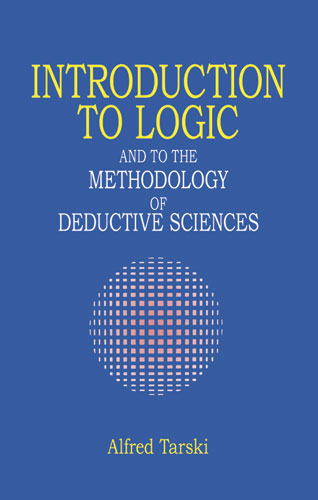
First published in Polish in 1936, this classic work was originally written as a popular scientific book — one that would present to the educated lay reader a clear picture of certain powerful trends of thought in modern logic. According to the author, these trends sought to create a unified conceptual apparatus as a common basis for the whole of human knowledge.Because these new developments in logical thought tended to perfect and sharpen the deductive method, an indispensable tool in many fields for deriving conclusions from accepted assumptions, the author decided to widen the scope of the work. In subsequent editions he revised the book to make it also a text on which to base an elementary college course in logic and the methodology of deductive sciences. It is this revised edition that is reprinted here.Part One deals with elements of logic and the deductive method, including the use of variables, sentential calculus, theory of identity, theory of classes, theory of relations and the deductive method. The Second Part covers applications of logic and methodology in constructing mathematical theories, including laws of order for numbers, laws of addition and subtraction, methodological considerations on the constructed theory, foundations of arithmetic of real numbers, and more. The author has provided numerous exercises to help students assimilate the material, which not only provides a stimulating and thought-provoking introduction to the fundamentals of logical thought, but is the perfect adjunct to courses in logic and the foundation of mathematics.
PREFACEFROM THE PREFACE TO THE ORIGINAL EDITIONFIRST PART ELEMENTS OF LOGIC. DEDUCTIVE METHODI. ON THE USE OF VARIABLES 1. Constants and variables 2. Expressions containing variables-sentential and designatory functions 3. Formation of sentences by means of variables-universal and existential sentences 4. Universal and existential quantifiers; free and bound variables 5. The importance of variables in mathematics ExercisesII. ON THE SENTENTIAL CALCULUS 6. Logical constants; the old logic and the new logic 7. "Sentential calculus; negation of a sentence, conjunction and disjunction of sentences" 8. Implication or conditional sentence; implication in material meaning 9. The use of implication in mathematics 10. Equivalence of sentences 11. The formulation of definitions and its rules 12. Laws of sentential calculus 13. Symbolism of sentential calculus; truth functions and truth tables 14. Application of laws of sentential calculus in inference 15. "Rules of inference, complete proofs" ExercisesIII. ON THE THEORY OF IDENTITY 16. Logical concepts outside sentential calculus; concept of identity 17. Fundamental laws of the theory of identity 18. Identity of things and identity of their designations; use of quotation marks 19. "Equality in arithmetic and geometry, and its relation to logical identity" 20. Numerical quantifiers ExercisesIV. ON THE THEORY OF CLASSES 21. Classes and their elements 22. Classes and sentential functions with one free variable 23. Universal class and null class 24. Fundamental relations among classes 25. Operations on classes 26. "Equinumerous classes, cardinal number of a class, finite and infinite classes; arithmetic as a part of logic" ExercisesV. ON THE THEORY OF RELATIONS 27. "Relations, their domains and counter-domains; relations and sentential functions with two free variables" 28. Calculus of relations 29. Some properties of relations 30 "Relations which are reflexive, symmetrical and transitive" 31. Ordering relations; examples of other relations 32. One-many relations or functions 33. "One-one relations or biunique functions, and one-to-one correspondences" 34. Many-termed relations; functions of several variables and operations 35. The importance of logic for other sciences ExercisesVI. ON THE DEDUCTIVE METHOD 36. "Fundamental constituents of a deductive theory-primitive and defined terms, axioms and theorems" 37. Model and interpretation of a deductive theory 38. Law of deduction; formal character of deductive sciences 39. Selection of axioms and primitive terms; their independence 40. "Formalization of definitions and proofs, formalized deductive theories" 41. Consistency and completeness of a deductive theory; decision problem 42. The widened conception of the methodology of deductive sciences ExercisesSECOND PART APPLICATIONS OF LOGIC AND METHODOLOGY IN CONSTRUCTING MATHEMATICAL THEORIESVII. CONSTRUCTION OF A MATHEMATICAL THEORY: LAWS OF ORDER FOR NUMBERS 43. Primitive terms of the theory under construction; axioms concerning fundamental relations among numbers 44. Laws of irreflexivity for the fundamental relations; indirect proofs 45. Further theorems on the fundamental relations 46. Other relations among numbers ExercisesVIII. CONSTRUCTION OF A MATHEMATICAL THEORY: LAWS OF ADDITION AND SUBTRACTION 47. "Axioms concerning addition; general properties of operations, concepts of a group and of an Abelian group" 48. Commutative and associative laws for a larger number of summands 49. Laws of monotony for addition and their converses 50. Closed systems of sentences 51. Consequences of the laws of monotony 52. Definition of subtraction; inverse operations 53. Definitions whose definiendum contains the identity sign 54. Theorems on subtraction ExercisesIX. METHODOLOGICAL CONSIDERATIONS ON THE CONSTRUCTED THEORY 55. Elimination of superfluous axioms in the original axiom system 56. Independence of the axioms of the simplified system 57. Elimination of superfluous primitive terms and subsequent simplification of the axiom system; concept of an ordered Abelian group 58. Further simplification of the axiom system; possible transformations of the system of primitive terms 59. Problem of the consistency of the constructed theory 60. Problem of the completeness of the constructed theory ExercisesX. EXTENSION OF THE CONSTRUCTED THEORY. FOUNDATIONS OF ARITHMETIC OF REAL NUMBERS 61. First axiom system for the arithmetic of real numbers 62. Closer characterization of the first axiom system; its methodological advantages and didactical disadvantages 63. Second axiom system for the arithmetic of real numbers 64. Closer characterization of the second axiom system; concepts of a field and of an ordered field 65. Equipollence of the two axiom systems; methodological disadvantages and didactical advantages of the second system ExercisesSUGGESTED READINGSINDEX
| Erscheint lt. Verlag | 4.7.2013 |
|---|---|
| Sprache | englisch |
| Themenwelt | Mathematik / Informatik ► Mathematik |
| Schlagworte | 1940 • 1967 • Abstract • Analytics • Apparatus • Aristotle • arithmetic • arithmetical • Axiom • books on mathematics • Calculus • Circuit Design • common basis • concentrated • Conceptual • deductive method • Ebbinghaus • Everyday language • Exercises • Flum • Formal Logic • Fragment • hodges • Human knowledge • infer • inference • introductory • Laymen • logical theory • Logicians • logics • mathematical discipline • Mathematical Logic • mathematician • Mathematics • Mendelson • modern master • Philosopher • popular scientific • practical importance • Primer • professional mathematicians • Qualification • Sciences • serious students • Theorems • uc berkeley |
| ISBN-13 | 9780486318899 / 9780486318899 |
| Informationen gemäß Produktsicherheitsverordnung (GPSR) | |
| Haben Sie eine Frage zum Produkt? |
 EPUB (Adobe DRM)
Kopierschutz: Adobe-DRM
Adobe-DRM ist ein Kopierschutz, der das eBook vor Mißbrauch schützen soll. Dabei wird das eBook bereits beim Download auf Ihre persönliche Adobe-ID autorisiert. Lesen können Sie das eBook dann nur auf den Geräten, welche ebenfalls auf Ihre Adobe-ID registriert sind.
Details zum Adobe-DRM
Dateiformat: EPUB (Electronic Publication)
EPUB ist ein offener Standard für eBooks und eignet sich besonders zur Darstellung von Belletristik und Sachbüchern. Der Fließtext wird dynamisch an die Display- und Schriftgröße angepasst. Auch für mobile Lesegeräte ist EPUB daher gut geeignet.
Systemvoraussetzungen:
PC/Mac: Mit einem PC oder Mac können Sie dieses eBook lesen. Sie benötigen eine
eReader: Dieses eBook kann mit (fast) allen eBook-Readern gelesen werden. Mit dem amazon-Kindle ist es aber nicht kompatibel.
Smartphone/Tablet: Egal ob Apple oder Android, dieses eBook können Sie lesen. Sie benötigen eine
Geräteliste und zusätzliche Hinweise
Buying eBooks from abroad
For tax law reasons we can sell eBooks just within Germany and Switzerland. Regrettably we cannot fulfill eBook-orders from other countries.
aus dem Bereich