


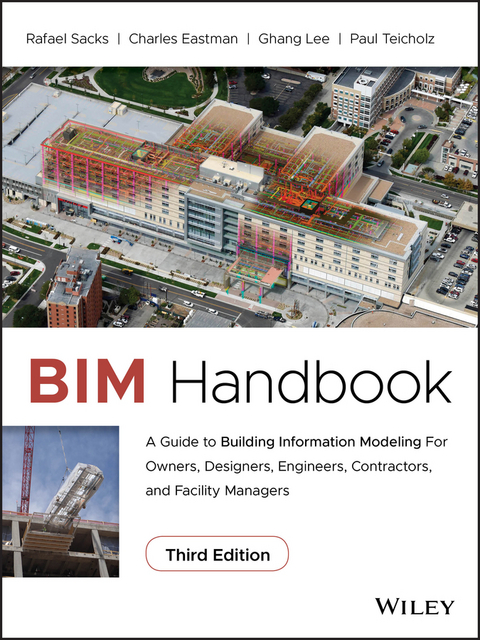
BIM Handbook (eBook)
688 Seiten
John Wiley & Sons (Verlag)
978-1-119-28754-4 (ISBN)
Building Information Modeling (BIM) offers a novel approach to design, construction, and facility management in which a digital representation of the building product and process is used to facilitate the exchange and interoperability of information in digital format. BIM is beginning to change the way buildings look, the way they function, and the ways in which they are designed and built.
The BIM Handbook, Third Edition provides an in-depth understanding of BIM technologies, the business and organizational issues associated with its implementation, and the profound advantages that effective use of BIM can provide to all members of a project team. Updates to this edition include:
* Information on the ways in which professionals should use BIM to gain maximum value
* New topics such as collaborative working, national and major construction clients, BIM standards and guides
* A discussion on how various professional roles have expanded through the widespread use and the new avenues of BIM practices and services
* A wealth of new case studies that clearly illustrate exactly how BIM is applied in a wide variety of conditions
Painting a colorful and thorough picture of the state of the art in building information modeling, the BIM Handbook, Third Edition guides readers to successful implementations, helping them to avoid needless frustration and costs and take full advantage of this paradigm-shifting approach to construct better buildings that consume fewer materials and require less time, labor, and capital resources.
Rafael Sacks is a Professor of Civil Engineering and leads the Virtual Construction Lab at the Technion - Israel Institute of Technology. Charles Eastman is Professor Emeritus in the College of Architecture at Georgia Tech. He founded the Digital Building Laboratory. Ghang Lee is a Professor and the Director of the Building Informatics Group at Yonsei University in Seoul, Korea. Paul Teicholz is Professor Emeritus at Stanford University. He founded the Center for Integrated Facility Engineering at Stanford University.
| Erscheint lt. Verlag | 3.7.2018 |
|---|---|
| Sprache | englisch |
| Themenwelt | Mathematik / Informatik ► Informatik ► Theorie / Studium |
| Technik ► Architektur | |
| Technik ► Bauwesen | |
| Schlagworte | Architecture • Architektur • Bauentwurf • Bauingenieur- u. Bauwesen • Building Design • Building information modeling (BIM) • Civil Engineering & Construction • Computer Science • Informatik • Informationstechnologie • Information Technologies • Structural & Building Engineering • Tief- u. Hochbau / Massivbau |
| ISBN-10 | 1-119-28754-5 / 1119287545 |
| ISBN-13 | 978-1-119-28754-4 / 9781119287544 |
| Informationen gemäß Produktsicherheitsverordnung (GPSR) | |
| Haben Sie eine Frage zum Produkt? |
 PDF (Adobe DRM)
Kopierschutz: Adobe-DRM
Adobe-DRM ist ein Kopierschutz, der das eBook vor Mißbrauch schützen soll. Dabei wird das eBook bereits beim Download auf Ihre persönliche Adobe-ID autorisiert. Lesen können Sie das eBook dann nur auf den Geräten, welche ebenfalls auf Ihre Adobe-ID registriert sind.
Details zum Adobe-DRM
Dateiformat: PDF (Portable Document Format)
Mit einem festen Seitenlayout eignet sich die PDF besonders für Fachbücher mit Spalten, Tabellen und Abbildungen. Eine PDF kann auf fast allen Geräten angezeigt werden, ist aber für kleine Displays (Smartphone, eReader) nur eingeschränkt geeignet.
Systemvoraussetzungen:
PC/Mac: Mit einem PC oder Mac können Sie dieses eBook lesen. Sie benötigen eine
eReader: Dieses eBook kann mit (fast) allen eBook-Readern gelesen werden. Mit dem amazon-Kindle ist es aber nicht kompatibel.
Smartphone/Tablet: Egal ob Apple oder Android, dieses eBook können Sie lesen. Sie benötigen eine
Geräteliste und zusätzliche Hinweise
Buying eBooks from abroad
For tax law reasons we can sell eBooks just within Germany and Switzerland. Regrettably we cannot fulfill eBook-orders from other countries.
aus dem Bereich


