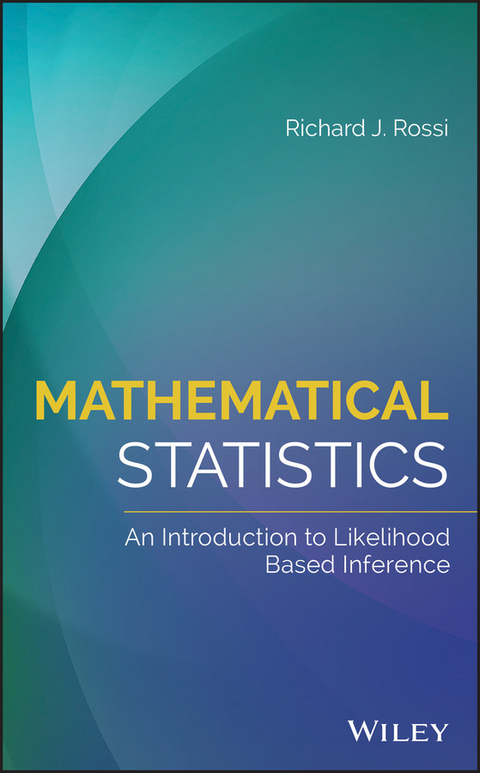
Mathematical Statistics (eBook)
John Wiley & Sons (Verlag)
978-1-118-77116-7 (ISBN)
Presents a unified approach to parametric estimation, confidence intervals, hypothesis testing, and statistical modeling, which are uniquely based on the likelihood function
This book addresses mathematical statistics for upper-undergraduates and first year graduate students, tying chapters on estimation, confidence intervals, hypothesis testing, and statistical models together to present a unifying focus on the likelihood function. It also emphasizes the important ideas in statistical modeling, such as sufficiency, exponential family distributions, and large sample properties. Mathematical Statistics: An Introduction to Likelihood Based Inference makes advanced topics accessible and understandable and covers many topics in more depth than typical mathematical statistics textbooks. It includes numerous examples, case studies, a large number of exercises ranging from drill and skill to extremely difficult problems, and many of the important theorems of mathematical statistics along with their proofs.
In addition to the connected chapters mentioned above, Mathematical Statistics covers likelihood-based estimation, with emphasis on multidimensional parameter spaces and range dependent support. It also includes a chapter on confidence intervals, which contains examples of exact confidence intervals along with the standard large sample confidence intervals based on the MLE's and bootstrap confidence intervals. There's also a chapter on parametric statistical models featuring sections on non-iid observations, linear regression, logistic regression, Poisson regression, and linear models.
- Prepares students with the tools needed to be successful in their future work in statistics data science
- Includes practical case studies including real-life data collected from Yellowstone National Park, the Donner party, and the Titanic voyage
- Emphasizes the important ideas to statistical modeling, such as sufficiency, exponential family distributions, and large sample properties
- Includes sections on Bayesian estimation and credible intervals
- Features examples, problems, and solutions
Mathematical Statistics: An Introduction to Likelihood Based Inference is an ideal textbook for upper-undergraduate and graduate courses in probability, mathematical statistics, and/or statistical inference.
Richard J. Rossi, PhD, is Director of the Statistics Program and Co-Director of the Data Science Program at Montana Tech of The University of Montana, in Butte, MT. He acted as President of the Montana Chapter of the American Statistical Association in 2001 and as Associate Editor for Biometrics from 1997-2000. Dr. Rossi is a member of the American Mathematical Society, the Institute of Mathematical Statistics, and the American Statistical Association.
Richard J. Rossi, PhD, is Director of the Statistics Program and Co-Director of the Data Science Program at Montana Tech of The University of Montana, in Butte, MT. He acted as President of the Montana Chapter of the American Statistical Association in 2001 and as Associate Editor for Biometrics from 1997-2000. Dr. Rossi is a member of the American Mathematical Society, the Institute of Mathematical Statistics, and the American Statistical Association.
Chapter 1
Probability
The mathematical foundation upon which mathematical statistics and likelihood inference are built is probability theory. Modern probability theory is primarily due to the foundational work of the Russian mathematician Andrei Nikolaevich Kolmogorov (1903–1987). Kolmogorov published his treatise on probability in 1933 [1], which framed probability theory in a rigorous mathematical framework. Kolmogorov's work provided probability theory with an axiomatic mathematical structure that produces a consistent and coherent theory of probability. Specifically, Kolmogorov's structure is based on measure theory, which deals with assigning numerical values to sets (i.e. measuring a set) and the theory of integration and differentiation.
1.1 Sample Spaces, Events, and ‐Algebras
The structure under which probabilities are relevant and can be assigned in a consistent and coherent fashion requires a probability model consisting of a chance experiment, the collection of all possible outcomes of the chance experiment, and a function that assigns probabilities to collections of outcomes of the chance experiment.
Definition 1.1
A chance experiment is any task for which the outcome of the task is unknown until the task is actually performed.
Experiments where the outcome is known before the experiment is actually performed are called deterministic experiments and are not interesting with regard to probability. Probability theory, probability assignments, and statistics only apply to chance experiments. The set of possible outcomes of a chance experiment is called the sample space, and the sample space defines one component of a probability model.
Definition 1.2
The sample space associated with a chance experiment is the set of all possible outcomes of a chance experiment. The sample space will be denoted by .
The sample space consists of the outcomes that are considered feasible and interesting. Probabilities can only be assigned to outcomes or subsets of outcomes in the sample space.
Example 1.1
Suppose that a chance experiment consists of flipping a two‐sided coin with heads on one side and tails on the other side. The most commonly used sample space is ; however, another possible sample space that could be used is ; these two sample spaces produce two different probability models for the same chance experiment. As long as Kolmogorov's measure theoretic approach is used, both probability models will produce consistent and coherent probability assignments.
Chance experiments cover a wide range of everyday tasks such as dealing a hand of cards, forecasting weather, driving in excess of the speed limit at the risk of getting a speeding ticket, and buying a lottery ticket. In each of these cases there is a chance experiment where the outcome is unknown until the experiment is actually completed.
Example 1.2
Suppose that a chance experiment consists of weighing a brown trout randomly selected from the Big Hole River in Montana. A reasonable sample space for this chance experiment is since the largest known brown trout to come from the river is less than 50 lb. If the upper limit on the weight of a Big Hole brown trout is unknown, it would also be reasonable to use for the sample space. Choosing the probability assignment takes care of probabilities for likely and unlikely values of the weight of a Big Hole River brown trout.
Note that in many chance experiments, the limits of the sample space will be unknown, and in this case, the sample space can be taken to be an infinite length subset of . The sample space is only the list of possible outcomes, while the choice of the function used to make the probability assignments controls the probabilities of the values in the sample space. The three components required of a probability model are the sample space, a collection of subsets of the sample space for which probabilities will be assigned, and the function used to assign the probabilities to subsets of the sample space.
Under Kolmogorov's probability structure, not all subsets of the sample space can be assigned probabilities. The collection of subsets of the sample space that can be assigned probabilities must have a particular structure so that the probability assignments are coherent and consistent. In particular, the collection of subsets of that can be assigned probabilities must be a ‐algebra.
Definition 1.3
Let be a collection of events of . is said to be a ‐algebra of events if and only if
- .
- whenever .
- whenever .
A subset of that is in a ‐algebra associated with is called an event.
Definition 1.4
An event of a sample space is any subset in a ‐algebra associated with . An event is said to have occurred when the chance experiment results in an outcome in .
A ‐algebra associated with a sample space contains the only events that probabilities can be assigned to. There are many ‐algebras of subsets associated with a sample space (see Example 1.3); however, the appropriate ‐algebra must be chosen so that it is large enough to contain all of the relevant events to be considered. It is important to note that in order to have a consistent and coherent probability assignment, not all events of can be assigned probabilities.
Example 1.3
Examples of ‐algebras associated with a sample space include the following:
- The trivial ‐algebra . This is the smallest ‐algebra possible and not very useful for a probability model.
- , where is a subset of . This is the smallest ‐algebra that includes the event .
- The Borel ‐algebra, which is the smallest ‐algebra containing all of the open intervals of . The Borel ‐algebra can only be used when the elements of are real numbers, and in this case, it is a commonly used ‐algebra.
The ‐algebra of events associated with will also include all of the compound events that can constructed using the basic set operations intersection, union, and complementation. The definitions for the compound events are given in Definitions 1.5–1.7.
Definition 1.5
Let and be events of . The event formed by the intersection of the events and is denoted by and is defined to be .
Definition 1.6
Let and be events of . The event formed by the union of the events and is denoted by and is defined to be .
Definition 1.7
Let be an event of . The event that is the complement of the event is denoted by and is defined to be .
Note that union and intersection are commutative operations. That is, and . Also, with complementation, . Another set operation that is used to create a compound event is the set difference. The set difference between two sets and consists of the elements of that are not elements of .
Definition 1.8
Let and be events of . The set difference is defined to be .
Set difference is not a commutative operation, and can also be written as . The following example illustrates how compound events can be created using the set operations union, intersection, complementation, and set difference.
Example 1.4
Suppose that a card will be drawn from a standard deck of 52 playing cards. Then, the sample space is
where in the outcome , is the denomination of the card () and is the suit of the card (). Let be the event that a heart is selected, and let be the event that an ace is selected. Then, , and
Events that share no common elements are called disjoint events ormutually exclusive events.
Definition 1.9
Two events and of are said to be disjoint when .
When two events and are disjoint, the chance experiment cannot result in an outcome where both the events and occur. The events and are always disjoint events as are and .
Compound events can also be constructed using the set operations intersection, union, and complementation on a family of sets, say , where the index set is a finite or countably infinite set. In most cases, will be taken to be a subset of , and the compound events created using intersection and union are
Example 1.5
Suppose that a two‐sided coin will be flipped until the first head appears. Let be the event that the first head appears on the th flip, be the event that it takes at least two flips of the coin to observe the first head, and let be the event that it takes less than 10 flips to observe the first head. Then,
and
The set laws given in Theorems 1.1 and 1.2 can often be used to simplify the computation of the probability of a compound event.
Theorem 1.1 (De Morgan's Laws)
If is a family of events of , is a subset of , and , then
- .
- .
Corollary 1.1
If and are events of , then
- .
- .
Note that the complement of a union is the intersection of the complements, and the complement of an intersection is the union of the complements.
Theorem 1.2 (Distributive...
| Erscheint lt. Verlag | 14.6.2018 |
|---|---|
| Sprache | englisch |
| Themenwelt | Mathematik / Informatik ► Mathematik ► Analysis |
| Mathematik / Informatik ► Mathematik ► Statistik | |
| Mathematik / Informatik ► Mathematik ► Wahrscheinlichkeit / Kombinatorik | |
| Schlagworte | Angew. Wahrscheinlichkeitsrechn. u. Statistik / Modelle • Applied Probability & Statistics - Models • confidence intervals • data collection • Data Interpretation • estimation</p> • hypothesis testing • inference • Inferential statistics • inferential statistics text • likelihood based inference • linear models • linear regression • Logistic Regression • <p>the likelihood function • Mathematical Statistics • Mathematics • Mathematische Statistik • nichtparametrische Verfahren • non-iid observations • Nonparametric Analysis • parametric estimation • parametric statistical models • poisson regression • Probability • Probability & Mathematical Statistics • Probability Theory • sampling variation • statistical induction • Statistical Inference • statistical inference textbook • statistical modeling • Statistical Theory • Statistics • statistics for financial mathematics • statistics text • Statistik • Wahrscheinlichkeitsrechnung • Wahrscheinlichkeitsrechnung u. mathematische Statistik |
| ISBN-10 | 1-118-77116-8 / 1118771168 |
| ISBN-13 | 978-1-118-77116-7 / 9781118771167 |
| Informationen gemäß Produktsicherheitsverordnung (GPSR) | |
| Haben Sie eine Frage zum Produkt? |
 EPUB (Adobe DRM)
Kopierschutz: Adobe-DRM
Adobe-DRM ist ein Kopierschutz, der das eBook vor Mißbrauch schützen soll. Dabei wird das eBook bereits beim Download auf Ihre persönliche Adobe-ID autorisiert. Lesen können Sie das eBook dann nur auf den Geräten, welche ebenfalls auf Ihre Adobe-ID registriert sind.
Details zum Adobe-DRM
Dateiformat: EPUB (Electronic Publication)
EPUB ist ein offener Standard für eBooks und eignet sich besonders zur Darstellung von Belletristik und Sachbüchern. Der Fließtext wird dynamisch an die Display- und Schriftgröße angepasst. Auch für mobile Lesegeräte ist EPUB daher gut geeignet.
Systemvoraussetzungen:
PC/Mac: Mit einem PC oder Mac können Sie dieses eBook lesen. Sie benötigen eine
eReader: Dieses eBook kann mit (fast) allen eBook-Readern gelesen werden. Mit dem amazon-Kindle ist es aber nicht kompatibel.
Smartphone/Tablet: Egal ob Apple oder Android, dieses eBook können Sie lesen. Sie benötigen eine
Geräteliste und zusätzliche Hinweise
Buying eBooks from abroad
For tax law reasons we can sell eBooks just within Germany and Switzerland. Regrettably we cannot fulfill eBook-orders from other countries.
aus dem Bereich