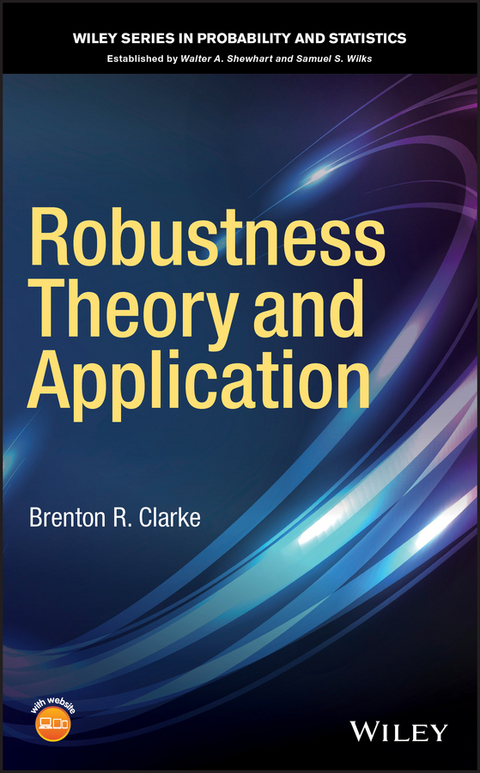
Robustness Theory and Application (eBook)
John Wiley & Sons (Verlag)
978-1-118-66937-2 (ISBN)
Brenton R. Clarke, PhD is an experienced academic in Mathematics and Statistics at Murdoch University, Perth, WA, Australia. A former president of the Western Australian Branch of the Statistical Society of Australia, Dr. Clarke has published numerous journal articles in his areas of research interest, which include linear models, robust statistics, and time series analysis.
Foreword xi
Preface xv
Acknowledgments xvii
Notation xix
Acronyms xxi
About the Companion Website xxiii
1 Introduction to Asymptotic Convergence 1
1.1 Introduction, 1
1.2 Probability Spaces and Distribution Functions, 2
1.3 Laws of Large Numbers, 3
1.3.1 Convergence in Probability and Almost Sure, 3
1.3.2 Expectation and Variance, 4
1.3.3 Statements of the Law of Large Numbers, 4
1.3.4 Some History and an Example, 5
1.3.5 Some More Asymptotic Theory and Application, 6
1.4 The Modus Operandi Related by Location Estimation, 8
1.5 Efficiency of Location Estimators, 17
1.6 Estimation of Location and Scale, 20
2 The Functional Approach 27
2.1 Estimation and Conditions A, 27
2.2 Consistency, 37
2.3 Weak Continuity and Weak Convergence, 41
2.4 Fréchet Differentiability, 44
2.5 The Influence Function, 48
2.6 Efficiency for Multivariate Parameters, 51
2.7 Other Approaches, 52
3 More Results on Differentiability 59
3.1 Further Results on Fréchet Differentiability, 59
3.2 M-Estimators: Their Introduction, 59
3.2.1 Non-Smooth Analysis and Conditions A', 61
3.2.2 Existence and Uniqueness for Solutions of Equations, 65
3.2.3 Results for M-estimators with Non-Smooth Psi, 67
3.3 Regression M-Estimators, 70
3.4 Stochastic Fréchet Expansions and Further Considerations, 73
3.5 Locally Uniform Fréchet Expansion, 74
3.6 Concluding Remarks, 76
4 Multiple Roots 79
4.1 Introduction to Multiple Roots, 79
4.2 Asymptotics for Multiple Roots, 80
4.3 Consistency in the Face of Multiple Roots, 82
4.3.1 Preliminaries, 83
4.3.2 Asymptotic Properties of Roots and Tests, 92
4.3.3 Application of Asymptotic Theory, 94
4.3.4 Normal Mixtures and Conclusion, 97
5 Differentiability and Bias Reduction 99
5.1 Differentiability, Bias Reduction, and Variance Estimation, 99
5.1.1 The Jackknife Bias and Variance Estimation, 99
5.1.2 Simple Location and Scale Bias Adjustments, 102
5.1.3 The Bootstrap, 105
5.1.4 The Choice to Jackknife or Bootstrap, 107
5.2 Further Results on the Newton Algorithm, 108
6 Minimum Distance Estimation and Mixture Estimation 113
6.1 Minimum Distance Estimation and Revisiting Mixture Modeling, 113
6.2 The L2-Minimum Distance Estimator for Mixtures, 125
6.2.1 The L2-Estimator for Mixing Proportions, 126
6.2.2 The L2-Estimator for Switching Regressions, 130
6.2.3 An Example Application of Switching Regressions, 133
6.3 Other Minimum Distance Estimation Applications, 135
6.3.1 Mixtures of Exponential Distributions, 136
6.3.2 Gamma Distributions and Quality Assurance, 139
7 L-Estimates and Trimmed Likelihood Estimates 147
7.1 A Preview of Estimation Using Order Statistics, 147
7.1.1 The Functional Form of L-Estimators of Location, 150
7.2 The Trimmed Likelihood Estimator, 152
7.2.1 LTS and Breakdown Point, 154
7.2.2 TLE Asymptotics for the Normal Distribution, 156
7.3 Adaptive Trimmed Likelihood and Identification of Outliers, 160
7.4 Adaptive Trimmed Likelihood in Regression, 163
7.5 What to do if n is Large?, 169
7.5.1 TLE Asymptotics for Location and Regression, 170
8 Trimmed Likelihood for Multivariate Data 175
8.1 Identification of Multivariate Outliers, 175
9 Further Directions and Conclusion 181
9.1 A Way Forward, 181
Appendix A Specific Proof of Theorem 2.1 187
Appendix B Specific Calculations in Examples 4.1 and 4.2 189
Appendix C Calculation of Moments in Example 4.2 193
Bibliography 195
Index 211
| Erscheint lt. Verlag | 21.6.2018 |
|---|---|
| Reihe/Serie | Wiley Series in Probability and Statistics |
| Wiley Series in Probability and Statistics | Wiley Series in Probability and Statistics |
| Sprache | englisch |
| Themenwelt | Mathematik / Informatik ► Mathematik ► Statistik |
| Mathematik / Informatik ► Mathematik ► Wahrscheinlichkeit / Kombinatorik | |
| Schlagworte | Bias reduction • Computational & Graphical Statistics • Data Analysis • Datenanalyse • Differentiability • Distribution functions • efficiency for multivariate parameters • estimating location parameters • estimating regression coefficients • estimating scale parameters • estimation of model-states in models expressed in state<a title="State space (controls)" href="https://en.wikipedia.org/wiki/State_space_(controls)">-</a>space form • Frechet differentiability • frontiers in robust statistics • gamma distributions and quality assurance</p> • Interquartile range • Kalman Filter • Linear Series • <p>Statistics • m-estimators • probability spaces • problems in robust statistics • Rechnergestützte u. graphische Statistik • Robust Estimator • Robustheit • robust measure of central tendency • Robustness • Robust Statistics • robust statistics data sets • robust statistics examples • robust statistics new methodologies • robust statistics R subroutines • Spezialthemen Statistik • Statistics • Statistics Special Topics • Statistik • Stochastic Frechet Expansions • the jackknife bias and variance estimation • the median absolute deviation • the newton algorithm • Time Series Analysis • trimmed estimators • variance estimation • winsorised estimators |
| ISBN-10 | 1-118-66937-1 / 1118669371 |
| ISBN-13 | 978-1-118-66937-2 / 9781118669372 |
| Informationen gemäß Produktsicherheitsverordnung (GPSR) | |
| Haben Sie eine Frage zum Produkt? |
 EPUB (Ohne DRM)
Digital Rights Management: ohne DRM
Dieses eBook enthält kein DRM oder Kopierschutz. Eine Weitergabe an Dritte ist jedoch rechtlich nicht zulässig, weil Sie beim Kauf nur die Rechte an der persönlichen Nutzung erwerben.
Dateiformat: EPUB (Electronic Publication)
EPUB ist ein offener Standard für eBooks und eignet sich besonders zur Darstellung von Belletristik und Sachbüchern. Der Fließtext wird dynamisch an die Display- und Schriftgröße angepasst. Auch für mobile Lesegeräte ist EPUB daher gut geeignet.
Systemvoraussetzungen:
PC/Mac: Mit einem PC oder Mac können Sie dieses eBook lesen. Sie benötigen dafür die kostenlose Software Adobe Digital Editions.
eReader: Dieses eBook kann mit (fast) allen eBook-Readern gelesen werden. Mit dem amazon-Kindle ist es aber nicht kompatibel.
Smartphone/Tablet: Egal ob Apple oder Android, dieses eBook können Sie lesen. Sie benötigen dafür eine kostenlose App.
Geräteliste und zusätzliche Hinweise
Buying eBooks from abroad
For tax law reasons we can sell eBooks just within Germany and Switzerland. Regrettably we cannot fulfill eBook-orders from other countries.
aus dem Bereich