


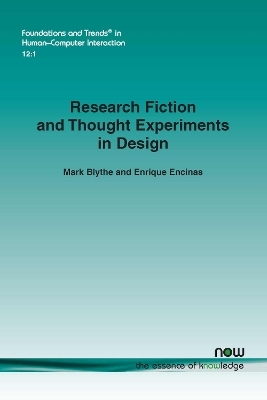
Research Fiction and Thought Experiments in Design
Seiten
2018
now publishers Inc (Verlag)
978-1-68083-418-5 (ISBN)
now publishers Inc (Verlag)
978-1-68083-418-5 (ISBN)
- Titel ist leider vergriffen;
keine Neuauflage - Artikel merken
Argues that design fiction can also be considered as a form of thought experiment. Excerpts from a fictional Wikipedia article about a Latvian historian and author writing design fiction in the 1940s precede each section as think pieces about the nature and value of fiction. The text is illustrated with pages from a fictional design workbook.
Any design process involves an imaginative act, a picturing of the world as other than it is. Fiction has long played a part in design research in the form of scenarios, personas, sketches, paper-based prototypes, simulations, prototypes, and speculative design. The term “design fiction” has been recently adopted to describe more elaborate and detailed representations of products and services that do not exist yet. Design fiction is an emerging practice and there are several competing definitions and forms.
This book traces design fiction from the Italian radical design of the 1960s through British Art Schools in the late 1990s to contemporary adaptations of the practice by companies like Google, Microsoft and Facebook. Design fiction is now produced regularly by individuals launching Kickstarter campaigns, corporations selling visions of future products and governments imagining new digital services. But there is little agreement about the status of such fictions: what constitutes a good fiction? How does fiction relate to research? In what sense does fiction contribute to existing knowledge? Although fiction can sometimes result in accurate prediction, this is not its main value. It is rather the creation of ambiguous artefacts that help us think carefully about emerging technologies and their potential impact. Fiction may seem to be the antithesis of empirical enquiry but it is often employed in the form of “thought experiments” in Physics, Mathematics, Ethics and Philosophy.
Research Fiction and Thought Experiments in Design argues that design fiction can also be considered as a form of thought experiment. Excerpts from a fictional Wikipedia article about Valdis Ozols, a Latvian historian and author writing design fiction in the 1940s, precede each section as think pieces about the nature and value of fiction. The text is illustrated with pages from a fictional design workbook written in an invented language.
Any design process involves an imaginative act, a picturing of the world as other than it is. Fiction has long played a part in design research in the form of scenarios, personas, sketches, paper-based prototypes, simulations, prototypes, and speculative design. The term “design fiction” has been recently adopted to describe more elaborate and detailed representations of products and services that do not exist yet. Design fiction is an emerging practice and there are several competing definitions and forms.
This book traces design fiction from the Italian radical design of the 1960s through British Art Schools in the late 1990s to contemporary adaptations of the practice by companies like Google, Microsoft and Facebook. Design fiction is now produced regularly by individuals launching Kickstarter campaigns, corporations selling visions of future products and governments imagining new digital services. But there is little agreement about the status of such fictions: what constitutes a good fiction? How does fiction relate to research? In what sense does fiction contribute to existing knowledge? Although fiction can sometimes result in accurate prediction, this is not its main value. It is rather the creation of ambiguous artefacts that help us think carefully about emerging technologies and their potential impact. Fiction may seem to be the antithesis of empirical enquiry but it is often employed in the form of “thought experiments” in Physics, Mathematics, Ethics and Philosophy.
Research Fiction and Thought Experiments in Design argues that design fiction can also be considered as a form of thought experiment. Excerpts from a fictional Wikipedia article about Valdis Ozols, a Latvian historian and author writing design fiction in the 1940s, precede each section as think pieces about the nature and value of fiction. The text is illustrated with pages from a fictional design workbook written in an invented language.
1. The Rise of Design Fiction
2. The Uses of Fiction
3. Design Fiction as Practice Based Research
4. Fictional Designers
5. Discussion
Acknowledgements
References
| Erscheinungsdatum | 24.06.2018 |
|---|---|
| Reihe/Serie | Foundations and Trends® in Human-Computer Interaction |
| Verlagsort | Hanover |
| Sprache | englisch |
| Maße | 156 x 234 mm |
| Gewicht | 178 g |
| Themenwelt | Informatik ► Software Entwicklung ► User Interfaces (HCI) |
| ISBN-10 | 1-68083-418-5 / 1680834185 |
| ISBN-13 | 978-1-68083-418-5 / 9781680834185 |
| Zustand | Neuware |
| Informationen gemäß Produktsicherheitsverordnung (GPSR) | |
| Haben Sie eine Frage zum Produkt? |
Mehr entdecken
aus dem Bereich



aus dem Bereich
Kindersachbuch über die Welt von Morgen
Buch | Hardcover (2025)
Gabriel in der Thienemann-Esslinger Verlag GmbH
CHF 24,90
Wissensverarbeitung - Neuronale Netze
Buch | Hardcover (2023)
Carl Hanser (Verlag)
CHF 48,95
was alle wissen sollten, die Websites und Apps entwickeln
Buch | Hardcover (2024)
Rheinwerk (Verlag)
CHF 55,85


